Mammals Guide
American Black Bear
What Is a American Black Bear? The American black bear (Ursus americanus) is the most common and widely distributed bear species in North America. Despite its name, it is a highly adaptable omnivore that thrives in …
At a glance
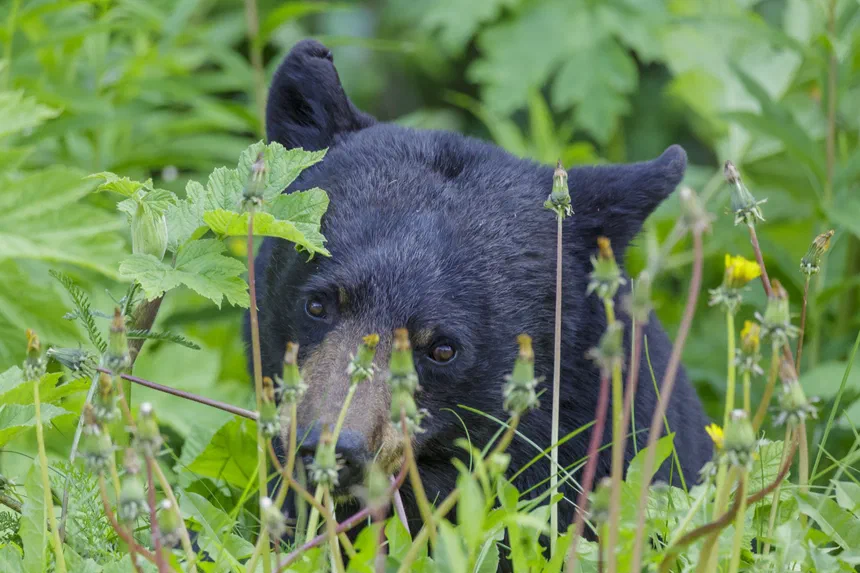
Image: Thomas Fuhrmann — CC BY-SA 4.0 · source
What Is a American Black Bear?
The American black bear (Ursus americanus) is the most common and widely distributed bear species in North America. Despite its name, it is a highly adaptable omnivore that thrives in forested regions from Canada through the United States and into northern Mexico. It is smaller and more retiring than the brown bear, and it is the only bear found across much of its range.
Appearance and Identification
American black bears have a stocky, muscular build with short, powerful limbs and a relatively short tail. Coat color is variable: while most individuals in the east are glossy black, western populations can be brown, cinnamon, or even blond, and rare bluish-gray (“glacier”) and white (“Kermode” or “spirit”) forms occur. The face is typically tan or brownish with a straight profile, and many bears sport a pale chest patch. They lack the prominent shoulder hump of the grizzly, and their claws are short and strongly curved, which makes them excellent climbers. Adults generally measure about 1.2 to 1.9 meters in length, with males noticeably heavier than females.
Habitat and Range
This species occupies a broad swath of North America, from the forests of Canada and Alaska southward through much of the United States and into parts of Mexico. Black bears favor densely wooded areas that offer both food and cover, including deciduous and coniferous forests, mountain slopes, swamps, and brushy areas. Their adaptability allows them to persist near human settlements, and they sometimes venture into suburban zones in search of food. Access to trees is important, as bears climb to escape threats and reach food.
Diet
Black bears are opportunistic omnivores, and the bulk of their diet is plant matter. They feed heavily on berries, nuts (especially acorns and beechnuts), fruits, grasses, roots, and buds, shifting their menu with the seasons. Insects such as ants, termites, and bee larvae provide valuable protein, and bears will also eat carrion, fish, small mammals, and the occasional young deer or moose calf. In late summer and fall they enter a period of intense feeding called hyperphagia, consuming huge quantities of food to build fat reserves for winter. Human-associated foods, from garbage to crops, readily attract them.
Behavior
American black bears are generally solitary, except for mothers with cubs and brief associations during the mating season. They are most active around dawn and dusk but adjust their timing to avoid people. Though not true hibernators, black bears enter a state of winter dormancy in dens, during which their heart rate and metabolism drop sharply while their body temperature falls only modestly. They can go months without eating, drinking, or eliminating waste. Bears communicate through vocalizations, scent marking, and body posture, and they possess an exceptional sense of smell that guides them to food over long distances. When threatened, they usually flee or climb rather than fight.
Life Cycle and Reproduction
Mating occurs in summer, typically June and July, but implantation of the fertilized egg is delayed until autumn, ensuring cubs are born during the winter denning period. Females give birth to one to five (commonly two or three) tiny, helpless cubs in January or February while in the den. The cubs nurse and grow rapidly, emerging with their mother in spring. Young bears remain with their mother for about a year and a half, learning to forage before dispersing. Females typically breed every other year and reach maturity at around three to five years of age. In the wild, black bears often live 20 years or more, though many die younger.
Conservation Status
The American black bear is listed as Least Concern by the IUCN, reflecting a large and generally stable or increasing population across most of its range. Regulated hunting is managed in many regions, and populations have rebounded in areas where they were once depleted. Localized threats include habitat fragmentation, vehicle collisions, and conflicts with people over food. Securing garbage and reducing food attractants around homes are key to limiting dangerous encounters and keeping both bears and humans safe.
Frequently Asked Questions
Are American black bears dangerous to people? They are generally shy and avoid humans. Serious attacks are rare, and most conflicts arise when bears are attracted to human food or when a mother perceives a threat to her cubs.
Do black bears truly hibernate? Not in the strictest sense. They enter a deep winter dormancy in which metabolism slows greatly, but their body temperature stays relatively high and they can rouse if disturbed.
Are all black bears black in color? No. While black is most common, individuals may be brown, cinnamon, blond, bluish-gray, or even white, with lighter colors more frequent in western North America.
References
The conservation status and key facts in this profile are supported by these sources:
- Animal Diversity Web — Ursus americanus (American black bear) (accessed 2026-07-28)
- GBIF — Ursus americanus (American black bear) (accessed 2026-07-28)
Found an error, source problem, or image concern? Report this page.