Mammals Guide
American Bison
What Is a American Bison? The American bison (Bison bison) is the largest land mammal in North America and an enduring symbol of the continent’s grasslands. Often called the American buffalo, it is not a true buffalo but …
At a glance
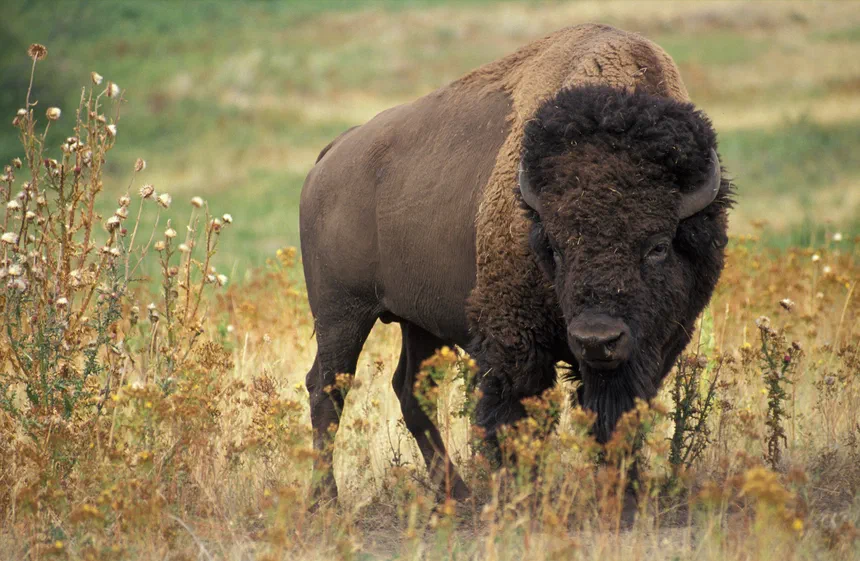
Image: Jack Dykinga — Public domain · source
What Is a American Bison?
The American bison (Bison bison) is the largest land mammal in North America and an enduring symbol of the continent’s grasslands. Often called the American buffalo, it is not a true buffalo but a close relative of cattle, sheep, and goats. Once numbering in the tens of millions, bison were driven nearly to extinction in the 1800s before conservation efforts brought them back from the brink.
Appearance and Identification
The American bison has an unmistakable silhouette dominated by a massive, humped shoulder and a broad, low-slung head. The hump is supported by tall spines on the vertebrae, which anchor powerful muscles that let the animal swing its head to sweep snow away from forage. A dense, dark coat of shaggy hair covers the head, neck, and forequarters, while the hindquarters carry shorter, finer hair.
Both males and females grow short, curved black horns. Bulls are considerably larger and more heavily built than cows, with a thicker mane and a broader forehead. Despite their bulk, bison are surprisingly agile and can run at speeds of up to about 35 mph (55 km/h).
Habitat and Range
Historically, bison roamed across much of North America, from the interior plains and prairies to open woodlands and river valleys. The great herds of the Great Plains were the most famous, but the species also occupied parts of the eastern woodlands and reached into northern Mexico and southern Canada.
Today, wild and semi-wild bison occupy a much smaller portion of that former range. Notable free-ranging herds live in protected areas such as Yellowstone National Park, while many others are managed on public lands, tribal lands, and private ranches. The northern wood bison, a subspecies, favors the boreal forests and meadows of Canada.
Diet
Bison are grazers that feed primarily on grasses and sedges, supplementing their diet with other low-growing plants depending on the season. They spend much of the day foraging, using their broad muzzles to crop vegetation close to the ground. In winter, they use their heads and hooves to clear snow and reach the dried grasses beneath.
Like cattle, bison are ruminants with a multi-chambered stomach that ferments tough plant material, allowing them to extract nutrients from fibrous grasses. Their grazing shapes the structure of the grassland, making them an important influence on prairie ecosystems.
Behavior
Bison are social animals that typically live in herds. For much of the year, cows, calves, and younger animals form groups, while mature bulls tend to remain solitary or gather in smaller bachelor bands, joining the larger herds mainly during the breeding season. Herd size can swell dramatically where food is abundant.
Though they often appear placid, bison are powerful and can be unpredictable, especially bulls during the rut and cows protecting calves. They communicate through grunts, snorts, and bellows, and they wallow in dust or mud to shed loose hair, deter insects, and cool off.
Life Cycle and Reproduction
The breeding season, or rut, generally takes place in mid- to late summer. Bulls compete for access to cows through displays, bellowing contests, and sometimes head-to-head shoving matches that can be intense but rarely fatal. A dominant bull will tend a receptive cow, guarding her from rivals.
After a gestation of roughly nine months, a cow usually gives birth to a single calf in spring. Newborn calves are reddish-orange, which earns them the nickname “red dogs,” and they can stand and follow the herd within hours of birth. Calves are weaned over several months and reach breeding age at around two to three years, though bulls often do not compete successfully until they are older. In the wild, bison commonly live around 15 to 20 years.
Conservation Status
The American bison is currently listed as Near Threatened on the IUCN Red List. After being reduced to only a few hundred wild animals by the late 1800s, the species has recovered to tens of thousands in conservation herds, plus far larger numbers raised commercially. Ongoing challenges include limited genetic diversity, restricted range, and hybridization with domestic cattle. The bison holds deep cultural significance for many Native American nations and was named the national mammal of the United States in 2016.
Frequently Asked Questions
Is a bison the same as a buffalo? Not exactly. The American bison is often called a buffalo, but true buffalo, such as the African cape buffalo and the Asian water buffalo, belong to different genera. The “buffalo” name is a longstanding nickname rather than a scientific label.
How fast can a bison run? Despite weighing up to a ton, bison are remarkably quick and can sprint at roughly 35 mph (55 km/h), and they can pivot and jump with surprising ease.
Why did bison nearly go extinct? Widespread market hunting in the 1800s, combined with habitat loss and deliberate slaughter, reduced a population of tens of millions to only a few hundred wild animals. Conservation herds established soon after saved the species.
References
The conservation status and key facts in this profile are supported by these sources:
- IUCN Red List — Bison bison (American Bison) assessment (accessed 2026-07-28)
- Animal Diversity Web — Bison bison (American bison) (accessed 2026-07-28)
Found an error, source problem, or image concern? Report this page.