Mammals Guide
American Badger
What Is a American Badger? The American badger (Taxidea taxus) is a stocky, powerfully built member of the weasel family, Mustelidae, native to the open country of North America. Built for a life underground, it is one …
At a glance
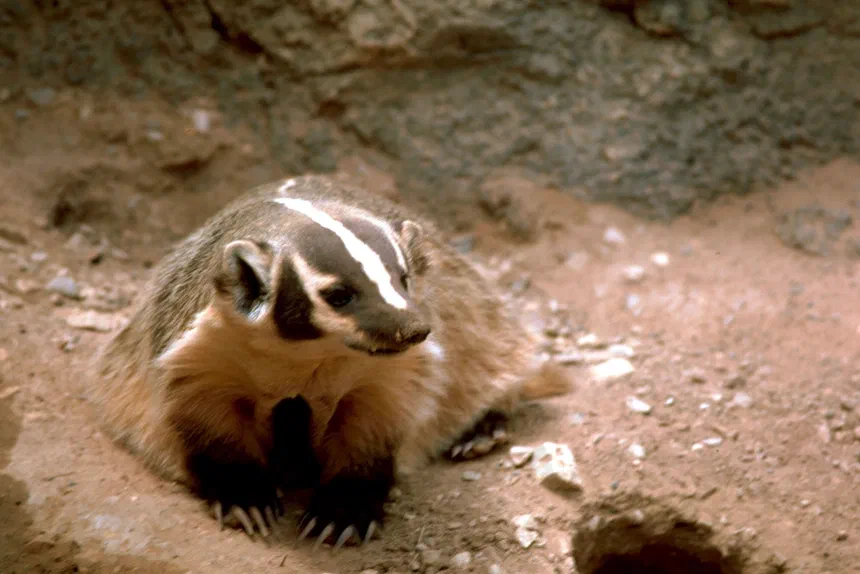
Image: Gary M. Stolz, USFWS — Public domain · source
What Is a American Badger?
The American badger (Taxidea taxus) is a stocky, powerfully built member of the weasel family, Mustelidae, native to the open country of North America. Built for a life underground, it is one of the continent’s most accomplished diggers, using its muscular forelimbs and long claws to pursue prey and excavate extensive burrows.
Appearance and Identification
The American badger has a flattened, wedge-shaped body that sits low to the ground, an adaptation that suits its burrowing lifestyle. Its coat is a grizzled mix of gray, tan, and brown, with a distinctive white stripe running from the tip of the nose back over the top of the head. The face is marked with black patches, sometimes called badges, on the cheeks.
Its most striking features are the front legs and feet. The forelimbs are short but heavily muscled, ending in long, curved claws that can measure up to about 2 inches (5 cm). Small eyes, short ears, and a short bushy tail complete the profile. Males are generally larger and heavier than females.
Habitat and Range
American badgers favor open, treeless landscapes where the soil is suitable for digging and prey is plentiful. Typical habitats include grasslands, prairies, sagebrush country, farmland edges, and dry meadows. They are found from central and western Canada southward through much of the western and central United States and into northern Mexico.
Because their survival depends on abundant burrowing rodents, badgers tend to be most common where these prey animals thrive. They avoid dense forest and very wet ground, but they can tolerate a range of elevations, from low plains to mountain valleys.
Diet
The American badger is a specialized carnivore that hunts primarily by digging. Its diet centers on fossorial rodents such as ground squirrels, prairie dogs, pocket gophers, and mice, which it excavates directly from their burrows. When the opportunity arises, it will also take rabbits, reptiles, ground-nesting birds, insects, and occasionally carrion.
Badgers are known to cache surplus food, burying prey to eat later. In some regions they hunt cooperatively with coyotes, with the badger flushing rodents underground while the coyote catches those that bolt above ground, an unusual partnership that benefits both animals.
Behavior
American badgers are mostly solitary and largely nocturnal, though they may be active by day in undisturbed areas. Much of their life revolves around digging: they excavate burrows for shelter, for raising young, and in the course of hunting, and a single animal may use many burrows across its home range.
When threatened, a badger can be a formidable opponent. It may hiss, growl, and bare its teeth, and it can retreat rapidly by digging itself out of sight. In colder parts of their range, badgers do not truly hibernate but enter periods of reduced activity and torpor during harsh winter weather.
Life Cycle and Reproduction
Mating typically occurs in late summer and early autumn. American badgers exhibit delayed implantation, meaning the fertilized embryo does not begin developing until later in the year, so that young are born in spring. A female usually produces a litter of one to five cubs in an underground den.
Cubs are born blind and helpless, nursing for several weeks before beginning to emerge from the den. They grow quickly and become independent by late summer or fall of their first year, dispersing to establish their own territories. In the wild, badgers commonly live around four to ten years, with predation, vehicles, and human activity among the main causes of death.
Conservation Status
The American badger is listed as Least Concern on the IUCN Red List, reflecting its wide distribution and generally stable overall numbers. However, some regional populations have declined where grasslands have been converted to intensive agriculture or fragmented by development, and the species is protected or considered at risk in parts of its range, including some Canadian provinces. Threats include habitat loss, road mortality, and the control of the burrowing rodents on which they depend.
Frequently Asked Questions
Are American badgers dangerous to people? Badgers are not aggressive toward humans and generally flee or retreat underground when disturbed. If cornered, however, they can defend themselves fiercely, so it is best to give them space.
How well can American badgers dig? They are among the fastest diggers of any mammal, able to tunnel through soil rapidly with their powerful forelegs and long claws, sometimes disappearing below the surface in a matter of minutes.
Do American badgers really hunt with coyotes? Yes. In some areas badgers and coyotes team up to hunt ground squirrels and other rodents, with each species catching prey the other flushes out. Both animals tend to have more success hunting together than alone.
References
The conservation status and key facts in this profile are supported by these sources:
- IUCN Red List — Taxidea taxus (American Badger) assessment (accessed 2026-07-28)
- Animal Diversity Web — Taxidea taxus (American badger) (accessed 2026-07-28)
Found an error, source problem, or image concern? Report this page.