Mammals Guide
Amazon River Dolphin
What Is a Amazon River Dolphin? The Amazon river dolphin (Inia geoffrensis), also known as the boto or pink river dolphin, is a freshwater cetacean native to the rivers of northern South America. It is the largest of the …
At a glance
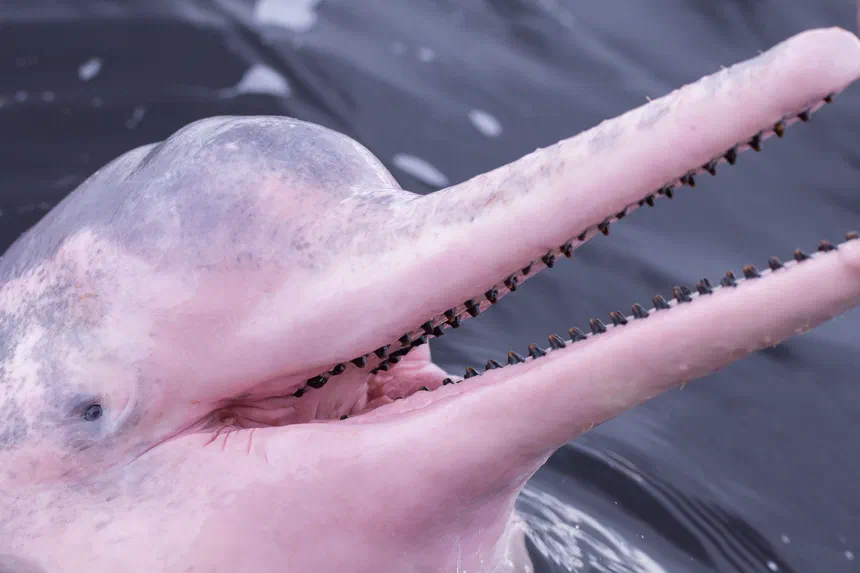
Image: Diogo Luiz — CC BY-SA 4.0 · source
What Is a Amazon River Dolphin?
The Amazon river dolphin (Inia geoffrensis), also known as the boto or pink river dolphin, is a freshwater cetacean native to the rivers of northern South America. It is the largest of the world’s river dolphins and is famous for the rosy pink hue that many adults develop. Unlike ocean dolphins, it spends its entire life in fresh water, navigating a maze of rivers, lakes, and seasonally flooded forests.
Appearance and Identification
This species is unmistakable among dolphins. Adults range from pale gray to a striking pink, with the color often intensifying as the animal ages or becomes physically active. It has a long, slender snout lined with dozens of teeth, a bulging forehead (the melon), and small eyes. Rather than a tall dorsal fin, it carries a low ridge along its back. Its neck vertebrae are unfused, allowing it to turn its head from side to side—an unusual trait that helps it maneuver through submerged vegetation. Males tend to be noticeably larger and pinker than females.
Habitat and Range
The Amazon river dolphin lives throughout the Amazon and Orinoco river basins, spanning parts of Brazil, Peru, Colombia, Ecuador, Bolivia, Venezuela, and Guyana. It favors slow-moving main channels, tributaries, oxbow lakes, and river confluences. During the rainy season, when rivers overflow their banks, these dolphins move into the flooded forest (várzea and igapó), swimming among tree trunks to hunt prey that gathers there. As waters recede in the dry season, they concentrate back in the main river channels.
Diet
The boto is a versatile predator with one of the most varied diets of any cetacean. It feeds primarily on fish, taking more than 40 different species, and its robust, differentiated teeth allow it to grip and crush hard-bodied prey. In addition to fish, it eats freshwater crustaceans such as crabs, and it occasionally captures small river turtles. Its flexible neck and long snout make it well suited to probing crevices and root tangles where prey hides.
Behavior
Amazon river dolphins are generally seen alone or in small, loose groups, though larger gatherings may form where food is abundant. They are curious and sometimes approach boats. Like other toothed whales, they rely heavily on echolocation, producing clicks to navigate and locate prey in the murky, sediment-laden water where eyesight is of limited use. Adult males are known to carry objects such as sticks, clumps of grass, or lumps of clay in social displays that may be linked to courtship and dominance.
Life Cycle and Reproduction
Reproduction is slow, which makes the species vulnerable to population decline. After a gestation of roughly 11 months, females typically give birth to a single calf, often timed to coincide with the flood season when food is plentiful. Calves nurse for a year or more and may stay close to their mothers for a period beyond weaning. Females usually breed only once every few years, and calving intervals can stretch across several years. In the wild, individuals are thought to live from around 15 to 30 years.
Conservation Status
The IUCN classifies the Amazon river dolphin as Endangered. Its populations face a range of threats, including entanglement in fishing gear, deliberate killing for use as fishing bait, mercury pollution from mining, and the fragmentation of river systems by dams. Habitat degradation and declining water quality add further pressure. Because the species reproduces slowly, recovery from population losses is difficult, and continued conservation efforts across its range are considered essential.
Frequently Asked Questions
Why are some Amazon river dolphins pink? The pink coloration comes partly from blood vessels near the skin surface and can be influenced by age, activity, and even water temperature. Older and more active animals, especially males, often appear the pinkest, sometimes flushing brighter after exertion.
Do Amazon river dolphins live in the ocean? No. They are strictly freshwater animals, living in rivers, lakes, and flooded forests rather than the sea. This distinguishes them from most other dolphins, which are marine.
How do they find food in muddy water? They rely on echolocation, emitting rapid clicks and interpreting the returning echoes to detect prey and obstacles. This lets them hunt effectively in dark, sediment-rich water where vision alone would fail.
References
The conservation status and key facts in this profile are supported by these sources:
- IUCN Red List — Inia geoffrensis assessment (accessed 2026-07-28)
- Animal Diversity Web — Inia geoffrensis (accessed 2026-07-28)
Found an error, source problem, or image concern? Report this page.