Mammals Guide
Alpaca
What Is a Alpaca? The alpaca (Vicugna pacos) is a small domesticated member of the camel family, native to the high plateaus of the South American Andes. It is prized above all for its soft, dense fleece, and was bred …
At a glance
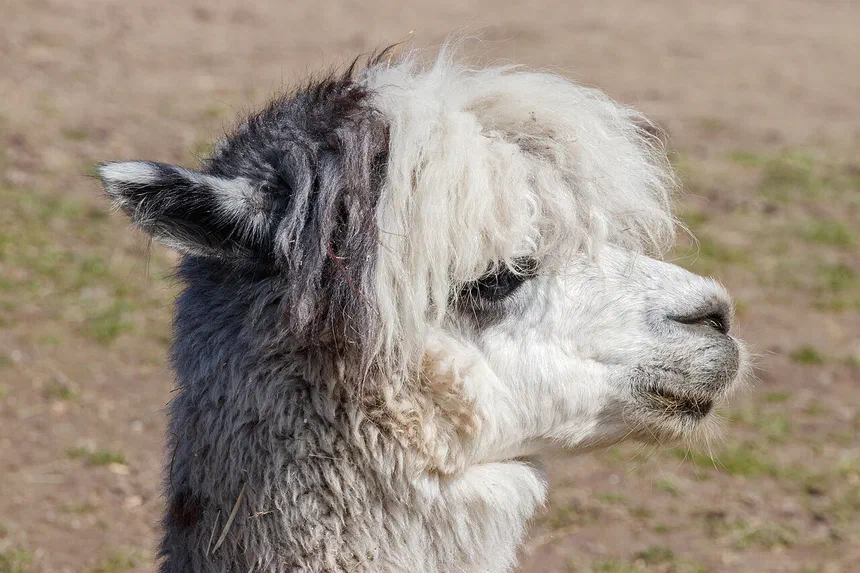
Image: H. Zell — CC BY-SA 3.0 · source
What Is a Alpaca?
The alpaca (Vicugna pacos) is a small domesticated member of the camel family, native to the high plateaus of the South American Andes. It is prized above all for its soft, dense fleece, and was bred over thousands of years from the wild vicuña. Alpacas are close relatives of llamas, guanacos, and vicuñas, together making up the group known as South American camelids.
Appearance and Identification
Alpacas are compact, long-necked animals with slender legs, padded feet, and a rounded body covered in thick, woolly fleece. Adults typically stand a little over three feet tall at the shoulder and weigh roughly 120 to 190 pounds, making them noticeably smaller than the llama. Their heads are short and blunt, topped with upright, spear-shaped ears and a prominent tuft of fiber on the forehead.
Fleece color varies widely, from pure white and cream through shades of fawn, brown, and gray to solid black, and many individuals are patched or mixed. There are two main breeds: the Huacaya, with dense, crimped, sheep-like fleece that stands out from the body, and the Suri, whose fiber grows in long, silky, hanging locks. Alpacas lack the coarse outer guard hairs of some relatives, which helps make their wool especially fine and prized.
Habitat and Range
The alpaca’s original home is the Altiplano, the cold, treeless highlands of the Andes spanning parts of Peru, Bolivia, Chile, and Ecuador, often at elevations above 11,000 feet. In this harsh environment of thin air, strong sun, and freezing nights, their thick fleece provides excellent insulation.
Because alpacas are fully domesticated, they no longer live as wild animals. Today they are raised on farms across the Andes and, increasingly, in many other countries including the United States, Australia, and much of Europe, where they adapt well to a range of temperate pastures.
Diet
Alpacas are grazing herbivores that feed mainly on grasses and other low-growing plants. They have a three-chambered stomach and chew cud, allowing them to extract nutrition efficiently from relatively sparse, fibrous forage, an adaptation well suited to the poor soils of the high Andes.
Compared with many livestock, alpacas eat modestly for their size and are gentle grazers. Rather than pulling plants out by the roots, they nip vegetation with their lower teeth, which reduces damage to pasture. On farms their diet is often supplemented with hay and mineral supplements, and they require steady access to fresh water.
Behavior
Alpacas are social, herd-living animals that feel most secure in the company of others of their kind. Within a group they communicate through soft humming sounds, body postures, and ear and tail positions, and they use a shrill alarm call to warn of danger. Most are naturally curious yet cautious, and generally gentle toward people when handled calmly.
Like other camelids, alpacas will spit, usually at one another to settle disputes over food or rank, and less often at humans. Herds also share communal dung piles, a tidy habit that helps limit the spread of parasites. Their alert, watchful nature means they are sometimes kept alongside sheep or other small livestock as guardians.
Life Cycle and Reproduction
Alpacas usually give birth to a single offspring, called a cria, after a gestation of roughly eleven to twelve months. Births typically occur during daylight hours, and the cria is up and walking within an hour or two. Females can often breed again within a few weeks of giving birth.
Crias nurse for several months before being weaned and reach breeding maturity within their first year or two, though breeders often wait until the animals are more fully grown. With good care, alpacas commonly live around 15 to 20 years.
Conservation Status
As a domesticated animal, the alpaca is not assessed on the IUCN Red List, and global populations are large and secure, numbering in the millions. Its wild ancestor, the vicuña, was once heavily hunted but has recovered under protection. The main concerns for alpacas today involve preserving the genetic diversity of traditional Andean herds and maintaining the livelihoods of the communities that depend on them.
Frequently Asked Questions
Are alpacas the same as llamas? No. Both are domesticated South American camelids, but alpacas are smaller, bred mainly for their fine fleece, while the larger llama was bred primarily as a pack animal.
Do alpacas really spit? Yes, but mostly at each other to resolve arguments over food or status. Spitting at people is far less common and usually a sign the animal feels crowded or threatened.
What are alpacas used for? They are raised chiefly for their soft, warm fleece, which is spun into yarn and textiles. They are also kept as companion animals and, in some places, as gentle guardians for other livestock.
References
The conservation status and key facts in this profile are supported by these sources:
- GBIF — Vicugna pacos (alpaca) (accessed 2026-07-28)
- Animal Diversity Web — Vicugna pacos (Lama pacos), alpaca (accessed 2026-07-28)
Found an error, source problem, or image concern? Report this page.