Mammals Guide
Agouti
What Is a Agouti? The agouti (Dasyprocta) is a genus of medium-sized rodents native to the forests and clearings of Central and South America and parts of the Caribbean. These long-legged, rabbit-sized animals are close …
At a glance
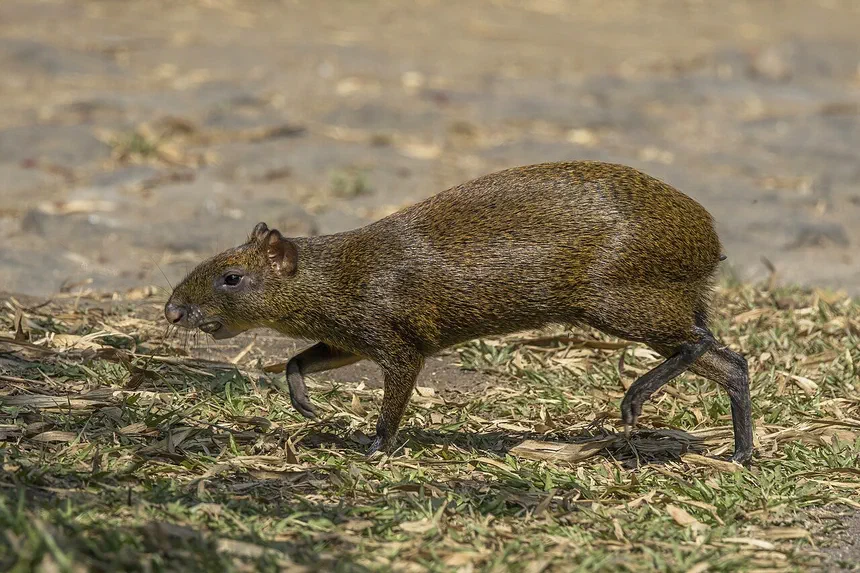
Image: Charles J. Sharp — CC BY-SA 4.0 · source
What Is a Agouti?
The agouti (Dasyprocta) is a genus of medium-sized rodents native to the forests and clearings of Central and South America and parts of the Caribbean. These long-legged, rabbit-sized animals are close relatives of the larger capybaras and pacas, and they play a key role in tropical ecosystems as seed dispersers.
Appearance and Identification
Agoutis have a compact, arched-backed body set on unusually slender, long legs that give them a nimble, deer-like gait. The coat is made of coarse, glossy hairs that range from grizzled brown and reddish-orange to nearly black, often with a paler underside and a brighter, sometimes rufous rump. The individual hairs are frequently banded with light and dark segments, producing the speckled “agouti” coloring that lends its name to a pattern seen in many other mammals.
The head is somewhat elongated with small rounded ears and large dark eyes. Agoutis have a very short, almost invisible tail and hoof-like claws on their toes, with five toes on the forefeet and three on the hind feet. Adults typically measure roughly 16 to 24 inches in head-body length and weigh between about 4.5 and 13 pounds, depending on the species.
Habitat and Range
The genus is distributed widely across the Neotropics, from southern Mexico through Central America and down into much of tropical South America, with some species also found on Caribbean islands. Different species occupy different regions, and several have been introduced beyond their native ranges.
Agoutis favor humid tropical and subtropical forests but are adaptable, also living in savannas, dense thickets, riverbanks, and cultivated areas near people. They rely on cover for safety and often stay close to water. During the day they rest in shallow burrows, hollow logs, or dens among tree roots and rocks.
Diet
Agoutis are herbivores with a strong preference for fruit, seeds, and nuts, supplemented by leaves, roots, flowers, and fallen vegetation. They are among the few animals able to gnaw open very hard seeds, such as those of the Brazil nut, using their powerful chisel-like incisors.
This feeding behavior makes them important seed dispersers. Like squirrels, agoutis bury surplus seeds in scattered caches for later use, and the ones they fail to recover often germinate far from the parent tree. In this way they help maintain the diversity and regeneration of tropical forests.
Behavior
Agoutis are mainly active during the day, especially in the early morning and late afternoon, though they may shift to more nocturnal habits where they are hunted or disturbed. They are alert, fast-moving animals that bolt for cover at the first sign of danger and can leap surprising distances from a standstill.
They communicate through a range of sounds, including sharp alarm barks, and may thump the ground with their hind feet. Many agoutis form long-term pair bonds and defend a shared territory, foraging within it and marking it with scent. When resting, an agouti often sits back on its haunches and holds food in its forepaws.
Life Cycle and Reproduction
Agoutis can breed throughout the year in favorable conditions, often producing two litters annually. After a gestation of roughly three to four months, the female usually gives birth to one or two well-developed young, occasionally more.
The newborns are precocial, arriving fully furred with open eyes and able to move about within hours. The mother keeps them hidden in a small burrow too narrow for adults to enter, visiting to nurse until they are weaned after several weeks. Young agoutis reach sexual maturity within their first year and may remain near their parents for a time before dispersing.
Conservation Status
Most agouti species are currently considered stable, and several are listed as Least Concern by the IUCN, reflecting their broad ranges and tolerance of disturbed habitats. However, status varies by species, and a few with restricted distributions face greater pressure.
The main threats are habitat loss from deforestation and heavy hunting, since agoutis are widely eaten as bushmeat across their range. Because of their vital role in dispersing large seeds, declines in agouti populations can have knock-on effects on forest health.
Frequently Asked Questions
Is an agouti a type of rodent? Yes. Agoutis are rodents in the family Dasyproctidae, related to capybaras, pacas, and guinea pigs.
Are agoutis dangerous to people? No. They are shy, non-aggressive herbivores that flee from humans and pose no real threat.
Why are agoutis important to forests? They bury seeds and can open very hard nuts, so the caches they forget help many tropical trees, including the Brazil nut, to regenerate.
References
The conservation status and key facts in this profile are supported by these sources:
- Animal Diversity Web — Central American agouti (Dasyprocta punctata) (accessed 2026-07-28)
- GBIF — Dasyprocta punctata (Central American agouti) (accessed 2026-07-28)
Found an error, source problem, or image concern? Report this page.