Mammals Guide
African Wild Dog
What Is a African Wild Dog? The African wild dog (Lycaon pictus) is a lean, long-legged canid native to sub-Saharan Africa and one of the continent’s most efficient social predators. Its scientific name means “painted …
At a glance
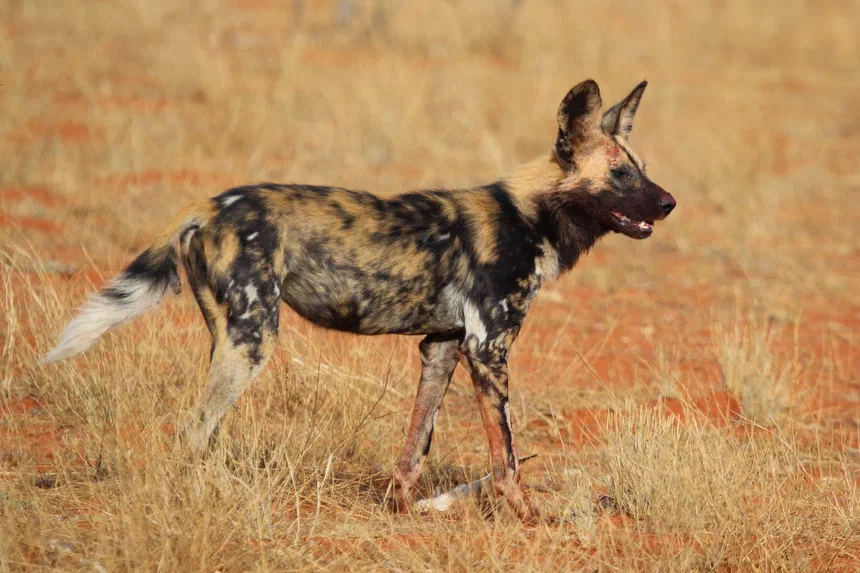
Image: Charles J. Sharp — CC BY-SA 4.0 · source
What Is a African Wild Dog?
The African wild dog (Lycaon pictus) is a lean, long-legged canid native to sub-Saharan Africa and one of the continent’s most efficient social predators. Its scientific name means “painted wolf,” a nod to the swirling coat of tan, black, and white that makes every individual instantly recognizable. Despite the name, it is not a close relative of domestic dogs and is the sole living member of its genus.
Appearance and Identification
The African wild dog has a slender, athletic build suited to long-distance running. Its most striking feature is its coat: a mottled, irregular patchwork of tan, black, white, and yellow that differs on every animal, functioning much like a fingerprint. Large, rounded, bat-like ears sit high on the head and aid in hearing and heat regulation. Unlike most other canids, it has only four toes on each foot rather than five. Adults typically stand around 30 inches at the shoulder and weigh between 40 and 70 pounds, with animals in southern Africa tending to be larger than those farther north.
Habitat and Range
This species favors open and lightly wooded country, including savanna, grassland, open plains, and semi-arid scrub, though it will also range through woodland and mountainous terrain in pursuit of prey. Historically it roamed across nearly all of sub-Saharan Africa, but its range has contracted sharply. Today the largest populations survive in southern and eastern Africa, particularly in and around large protected areas such as those in Botswana, Zimbabwe, Tanzania, and neighboring countries. Packs require very large territories, often spanning hundreds of square miles.
Diet
The African wild dog is a specialized carnivore that hunts cooperatively in packs. Medium-sized antelope form the core of its diet, with impala, gazelles, and similar species taken most often, though packs will also pursue larger prey like wildebeest calves and smaller animals such as hares. Rather than relying on a single killing bite or ambush, the pack runs prey down over open ground in an endurance chase, taking turns to maintain the pace. This coordinated approach gives them one of the highest hunting success rates of any large predator.
Behavior
African wild dogs are intensely social, living in tightly bonded packs that typically number from around six to twenty or more individuals. The pack usually centers on a dominant breeding pair, and members cooperate closely in hunting, defending territory, and rearing young. Communication is elaborate, involving a range of twittering calls, high-pitched contact sounds, body postures, and even a sneeze-like signal that appears to help the group decide when to set off on a hunt. Members share food readily, regurgitating meat for pups, sick or injured adults, and elderly pack mates that cannot hunt.
Life Cycle and Reproduction
In most packs only the dominant female breeds, producing a single large litter each year after a gestation of roughly 10 weeks. Litters are unusually large for a canid, often numbering around 6 to 12 pups and sometimes more. Pups are born in a den, frequently an abandoned burrow, and the entire pack helps guard and feed them. Once the young are old enough to travel, the pack resumes its nomadic life, with adults continuing to provision the juveniles until they can hunt effectively. Young females typically disperse to join or found new packs, helping maintain genetic diversity across the population.
Conservation Status
The African wild dog is classified as Endangered by the IUCN, with only a few thousand mature individuals estimated to remain in the wild. Major threats include habitat loss and fragmentation, conflict with people and livestock, road collisions, and infectious diseases such as rabies and canine distemper spread from domestic dogs. Because packs need vast territories, they are especially vulnerable when protected areas become isolated. Conservation efforts focus on maintaining large connected landscapes, reducing disease transmission, and easing conflict with local communities.
Frequently Asked Questions
Are African wild dogs the same as domestic dogs? No. They belong to a separate genus, Lycaon, and cannot interbreed with domestic dogs. They are a distinct wild species with unique traits, including four toes per foot instead of five.
Why are they called “painted” dogs? The scientific name Lycaon pictus translates roughly to “painted wolf,” describing the irregular blotches of tan, black, and white that cover the coat. No two individuals share the same pattern.
How successful are they at hunting? Because they hunt cooperatively and rely on stamina to run prey down, African wild dogs succeed in a large share of their hunts, giving them one of the highest success rates among Africa’s large predators.
References
The conservation status and key facts in this profile are supported by these sources:
- IUCN Red List — Lycaon pictus assessment (accessed 2026-07-28)
- Animal Diversity Web — Lycaon pictus (accessed 2026-07-28)
Found an error, source problem, or image concern? Report this page.