Mammals Guide
African Wild Ass
What Is a African Wild Ass? The African wild ass (Equus africanus) is a wild member of the horse family and the ancestor of the domestic donkey. Superbly adapted to some of the harshest deserts on Earth, it survives …
At a glance
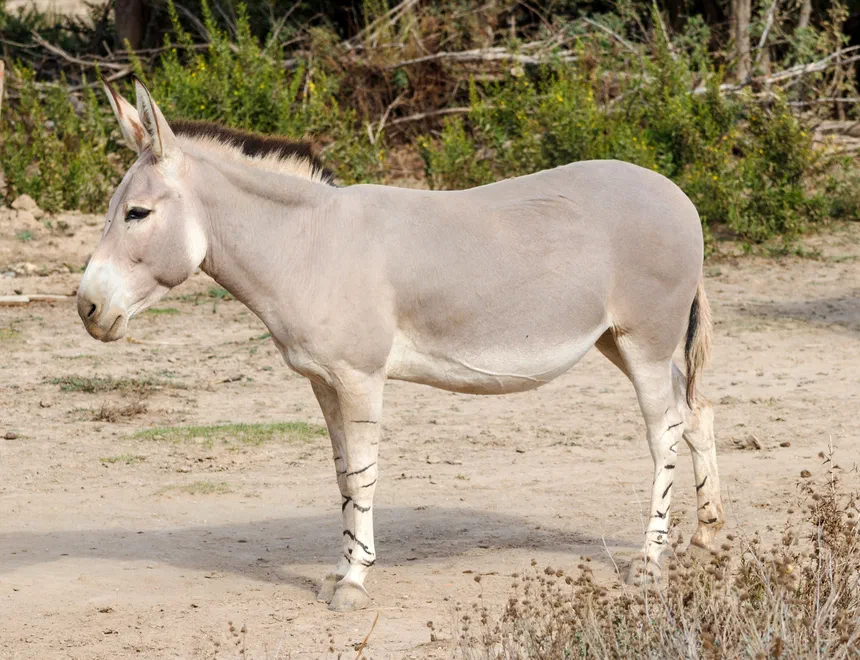
Image: H. Zell — CC BY-SA 3.0 · source
What Is a African Wild Ass?
The African wild ass (Equus africanus) is a wild member of the horse family and the ancestor of the domestic donkey. Superbly adapted to some of the harshest deserts on Earth, it survives today only in scattered populations across the Horn of Africa. It is one of the most endangered wild equids in the world.
Appearance and Identification
The African wild ass is a slender, long-legged equid with a smooth coat that ranges from pale gray to sandy fawn, fading to nearly white on the belly and legs. A dark, narrow stripe often runs along the spine, and one subspecies, the Somali wild ass, carries bold horizontal black bars on its lower legs that recall a zebra’s markings. The head is large with a pale muzzle, and the ears are long and tipped in black. A stiff, upright mane runs along the neck, and the tail ends in a dark tuft. Adults typically stand 1.2 to 1.4 meters at the shoulder and weigh between roughly 230 and 280 kilograms.
Habitat and Range
This species is a true desert specialist, occupying arid and rocky terrain where few large mammals can persist. It favors stony deserts, dry hills, and semi-desert grasslands with sparse vegetation and scattered water sources. Historically the African wild ass ranged widely across northern Africa, but its wild range has contracted dramatically. Today small, fragmented populations remain in Eritrea, Ethiopia, and possibly Somalia, largely in remote and lightly settled country.
Diet
The African wild ass is a herbivore that grazes and browses on the tough plant life of the desert. Its diet centers on grasses but also includes bark, leaves, and the woody stems of drought-hardy shrubs. Like other desert equids, it can extract nourishment from coarse, fibrous forage that many animals cannot digest efficiently. It is remarkably tolerant of water scarcity and can go for extended periods between drinks, traveling long distances to reach waterholes when needed.
Behavior
African wild asses are active mainly in the cooler hours of early morning and late afternoon, resting in shade during the midday heat. Their social structure is loose and flexible, an adaptation to a landscape where food and water are widely dispersed. Adult males often hold and defend large territories around reliable water sources, while females and young move in small, temporary groups. The species is well known for its loud, carrying bray, which helps individuals stay in contact across open desert. Keen senses and considerable speed help it evade predators.
Life Cycle and Reproduction
Breeding can occur across much of the year, though births often coincide with periods of better forage. After a gestation of about 11 to 12 months, a female gives birth to a single foal. Newborns are able to stand and follow their mother within hours, an essential trait in open habitat where staying mobile means safety. Foals nurse for several months and gradually shift to grazing. Females usually reach breeding age at around two to three years, and individuals may live 25 to 30 years.
Conservation Status
The African wild ass is classified as Critically Endangered by the IUCN, with only a few hundred mature animals thought to remain in the wild. Its decline has been driven by hunting for meat and traditional medicine, competition with livestock for grazing and water, and interbreeding with domestic donkeys, which dilutes the wild gene pool. Political instability across much of its range has made protection and monitoring difficult. Captive breeding programs in zoos and reserves now serve as an important safeguard against extinction.
Frequently Asked Questions
Is the African wild ass the ancestor of the donkey? Yes. The domestic donkey descends from the African wild ass, and the two remain closely related enough to interbreed, which is one of the threats to the wild population.
Why does it have striped legs? The Somali wild ass, one subspecies, has dark horizontal bands on its lower legs. These markings resemble a zebra’s and are a natural feature of the wild coat rather than a sign of hybridization.
How many are left in the wild? Estimates suggest only a few hundred mature individuals survive, making the African wild ass one of the rarest large mammals on the continent.
References
The conservation status and key facts in this profile are supported by these sources:
- IUCN Red List — Equus africanus (African Wild Ass) assessment (accessed 2026-07-28)
- GBIF — Equus africanus (African Wild Ass) (accessed 2026-07-28)
Found an error, source problem, or image concern? Report this page.