Mammals Guide
African Leopard
What Is a African Leopard? The African leopard (Panthera pardus pardus) is the most widespread subspecies of leopard, ranging across much of sub-Saharan Africa. It is a powerful, adaptable big cat known for its spotted …
At a glance
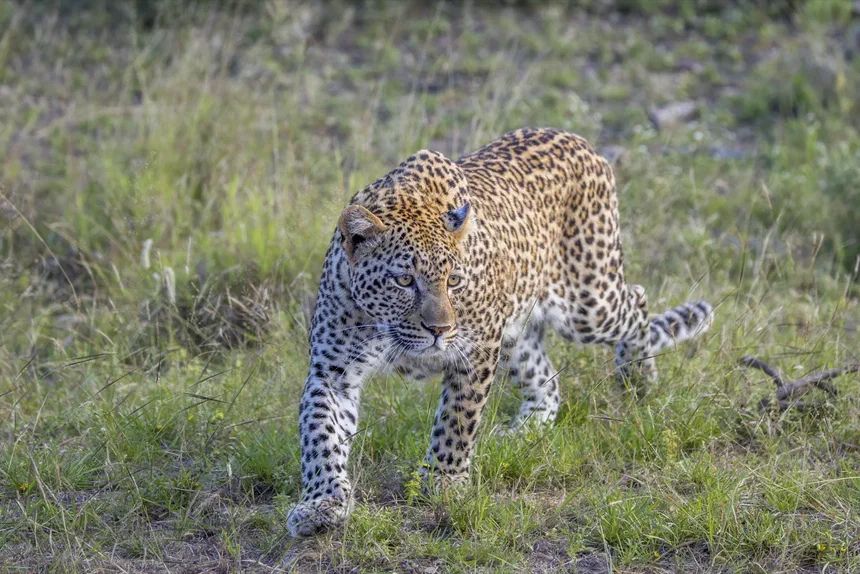
Image: Charles J. Sharp — CC BY-SA 4.0 · source
What Is a African Leopard?
The African leopard (Panthera pardus pardus) is the most widespread subspecies of leopard, ranging across much of sub-Saharan Africa. It is a powerful, adaptable big cat known for its spotted coat, secretive habits, and remarkable ability to thrive in habitats from dense forest to open savanna. Among the big cats it is the most versatile and elusive, often living close to people without being seen.
Appearance and Identification
The African leopard has a muscular, low-slung body built for stealth and strength. Its coat is golden to tawny yellow, patterned with dark rosettes and spots that break up the animal’s outline and provide excellent camouflage in dappled light. The belly and inner limbs are paler, while the rosettes are smaller and denser on the head, legs, and flanks.
Leopards are notably strong for their size, with a stocky neck, broad paws, and a long tail used for balance. Males are considerably larger and heavier than females. Some individuals, particularly in humid forested regions, are melanistic, appearing nearly black; their rosettes remain faintly visible in good light. Keen eyesight and hearing make the leopard a highly effective nocturnal hunter.
Habitat and Range
The African leopard occupies a broader range of habitats than almost any other big cat. It is found across sub-Saharan Africa in savannas, grasslands, rainforests, woodlands, rocky hills, and semi-arid scrub, and can persist in mountainous terrain and areas near human settlement. This flexibility has helped the subspecies survive where less adaptable predators have disappeared.
Leopards are strongly territorial, with individuals maintaining home ranges that they mark with scent and scratches. Range size varies widely depending on the availability of prey and cover, tending to be smaller in rich habitats and much larger in arid regions where food is sparse.
Diet
The African leopard is a carnivore with an exceptionally varied diet. It preys on medium-sized antelope such as impala and duiker, but will readily take monkeys, hares, birds, rodents, reptiles, and even fish or insects when the opportunity arises. This dietary breadth is a key reason for the leopard’s success across so many environments.
A hallmark behavior is the leopard’s habit of hauling kills into trees. By caching prey on high branches, it keeps meals away from lions, hyenas, and other scavengers, and can return to feed over several days. Leopards are ambush hunters, stalking close before a short, explosive rush.
Behavior
Leopards are largely solitary and mostly active at night and during the cooler hours of dawn and dusk. Outside of mating and mothers with cubs, adults live and hunt alone, communicating through scent marks, scrapes, and a distinctive rasping, saw-like call. Their solitary, cryptic nature makes them difficult to observe in the wild.
Superb climbers, leopards move easily through trees and often rest draped over branches during the heat of the day. They are also capable swimmers. When threatened or defending a kill, a leopard can be formidable, but its usual strategy is to avoid confrontation and slip away unseen.
Life Cycle and Reproduction
Leopards can breed throughout the year, with no fixed season across most of their range. After a gestation of roughly three to three and a half months, a female gives birth to a litter of usually two or three cubs, sheltered in a den among rocks, dense vegetation, or hollow trees. Newborn cubs are blind and helpless, and the mother moves them between hiding places to reduce the risk of predation.
Cubs begin to accompany their mother on hunts as they grow and are typically weaned by around three months, though they remain dependent for many more months while learning to hunt. Young leopards become independent at roughly one and a half to two years of age. In the wild, leopards commonly live around 10 to 15 years, with some reaching older ages in captivity.
Conservation Status
The leopard as a species is listed as Vulnerable on the IUCN Red List, and many regional populations are declining. Although the African leopard remains the most numerous and widespread subspecies, it faces mounting pressure from habitat loss, depletion of its prey, conflict with livestock owners, and illegal killing for skins and body parts. In parts of North and West Africa its numbers have fallen sharply.
Conservation efforts focus on protecting large habitat blocks, reducing human-wildlife conflict, and regulating trade and trophy hunting. The leopard’s adaptability offers hope, but sustained protection is needed to keep populations secure.
Frequently Asked Questions
How is an African leopard different from other leopards? It is the same species as leopards in Asia but a distinct subspecies, Panthera pardus pardus, found across sub-Saharan Africa. It is the most widespread and numerous of all leopard subspecies.
Why do leopards drag their prey into trees? Storing a kill in a tree keeps it safe from lions, hyenas, and other scavengers, allowing the leopard to feed undisturbed over several days.
Are all African leopards spotted? Most have the classic golden coat with dark rosettes, but some individuals are melanistic and appear nearly black, especially in humid forest regions. Their rosettes are still faintly visible up close.
References
The conservation status and key facts in this profile are supported by these sources:
- IUCN Red List — Panthera pardus (leopard) assessment (accessed 2026-07-28)
- Animal Diversity Web — Panthera pardus (leopard) (accessed 2026-07-28)
Found an error, source problem, or image concern? Report this page.