Mammals Guide
African Civet
What Is a African Civet? The African civet (Civettictis civetta) is a stocky, nocturnal carnivoran native to much of sub-Saharan Africa. It is the largest member of the civet family in Africa and the only living species …
At a glance
What Is a African Civet?
The African civet (Civettictis civetta) is a stocky, nocturnal carnivoran native to much of sub-Saharan Africa. It is the largest member of the civet family in Africa and the only living species in its genus. Despite its cat-like name, it is not a true cat but belongs to the family Viverridae, a group of small, primitive carnivores that also includes genets and other civets.
Appearance and Identification
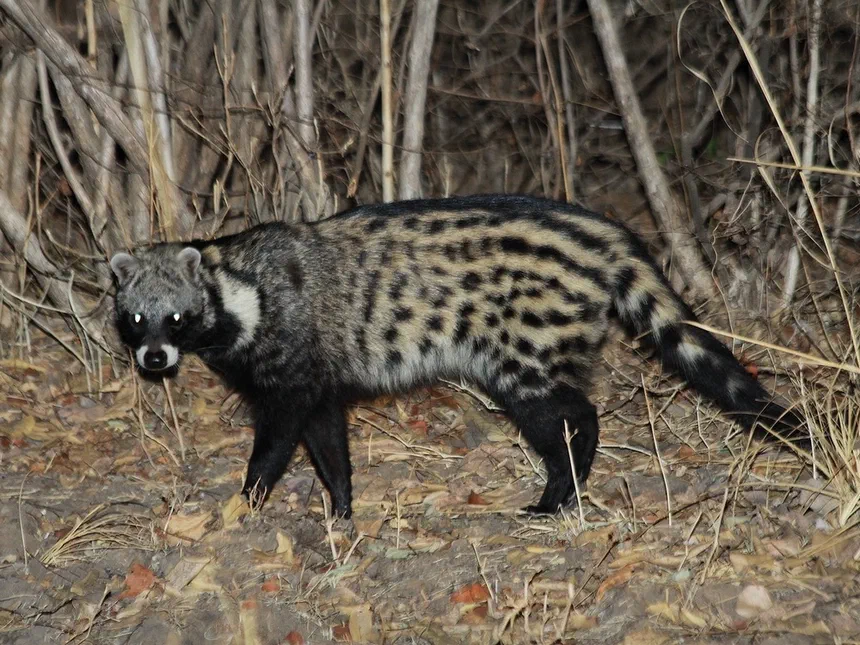
The African civet has a distinctive, rather shaggy appearance that sets it apart from other viverrids. Its coarse coat is grayish to buff, patterned with rows of black spots and bands that break up its outline in dappled light. A striking black-and-white mask surrounds the face, and a crest of longer hair runs along the spine, which the animal can raise to look larger when threatened.
The body is robust with relatively short, dark legs and a bushy, ringed tail. The head is broad with a pointed muzzle, small rounded ears, and a keen sense of smell. Like other civets, it has perineal scent glands that produce a musky secretion known as civet, historically harvested for the perfume trade.
Habitat and Range
African civets occur widely across sub-Saharan Africa, from Senegal in the west across to Somalia in the east and south into parts of southern Africa. They are adaptable animals found in a range of habitats, including savanna, woodland, forest edges, and areas of dense grass or thicket.
Water and cover are important to them, so they are often associated with vegetation near rivers, wetlands, and other moist ground. They generally avoid the most arid deserts but tolerate a variety of landscapes, including some agricultural and secondary habitats, as long as suitable shelter is available.
Diet
The African civet is an opportunistic omnivore with an unusually broad diet. It feeds on insects, small mammals, birds, reptiles, amphibians, and eggs, along with a substantial amount of fruit and other plant material. It will also scavenge carrion when the opportunity arises.
This dietary flexibility allows the civet to exploit whatever food is seasonally abundant. It is notable among carnivores for eating items that many others avoid, including toxic invertebrates and some poisonous prey, and for consuming fruit that helps disperse seeds through its range.
Behavior
African civets are primarily nocturnal and solitary, resting by day in dense vegetation, thickets, or burrows dug by other animals and becoming active after dark to forage. They cover the ground with a steady, head-down walk, relying heavily on scent to locate food.
Scent also plays a central role in communication. Civets deposit their musky glandular secretions and droppings at regular latrine sites known as civetries, which help mark territory and pass information to other individuals. When alarmed, a civet raises its dorsal crest, arches its back, and may produce growls or a low cough-like call.
Life Cycle and Reproduction
After a gestation of roughly two to three months, a female African civet gives birth to a litter of usually one to four young, often sheltered in a burrow or dense cover. Unlike many carnivores, newborn civets are relatively well developed, with a coat of hair, and they can crawl within a short time of birth.
The young grow quickly and begin taking solid food within a few weeks, remaining dependent on their mother for several months before becoming independent. In the wild, African civets typically live around ten to fifteen years, and individuals in captivity may reach a somewhat greater age.
Conservation Status
The African civet is listed as Least Concern on the IUCN Red List, reflecting its wide distribution, adaptable habits, and presumed large population. It is not considered globally threatened, though local pressures exist from hunting, roadkill, and habitat loss. In some regions civets have historically been kept to harvest their musk for perfume, and bushmeat hunting can affect populations locally.
Frequently Asked Questions
Is the African civet a type of cat? No. Although it is sometimes called a “civet cat,” it is not a true cat. It belongs to the family Viverridae, an old lineage of small carnivores separate from the cat family.
What is civet used for? The animal’s musky glandular secretion, called civet, has long been used as a fixative in perfumery. Today most of the fragrance industry relies on synthetic substitutes.
Are African civets dangerous to people? They are shy and avoid humans, posing little threat. Their main defenses are fleeing, raising their crest to appear larger, and releasing a strong musky odor.
References
The conservation status and key facts in this profile are supported by these sources:
- Animal Diversity Web — Civettictis civetta (accessed 2026-07-28)
- U.S. Fish & Wildlife Service — African Civet (Civettictis civetta) (accessed 2026-07-28)
Found an error, source problem, or image concern? Report this page.