Mammals Guide
African Bush Elephant
What Is a African Bush Elephant? The African bush elephant (Loxodonta africana) is the largest living land animal on Earth. It is one of two recognized African elephant species, the other being the smaller African forest …
At a glance
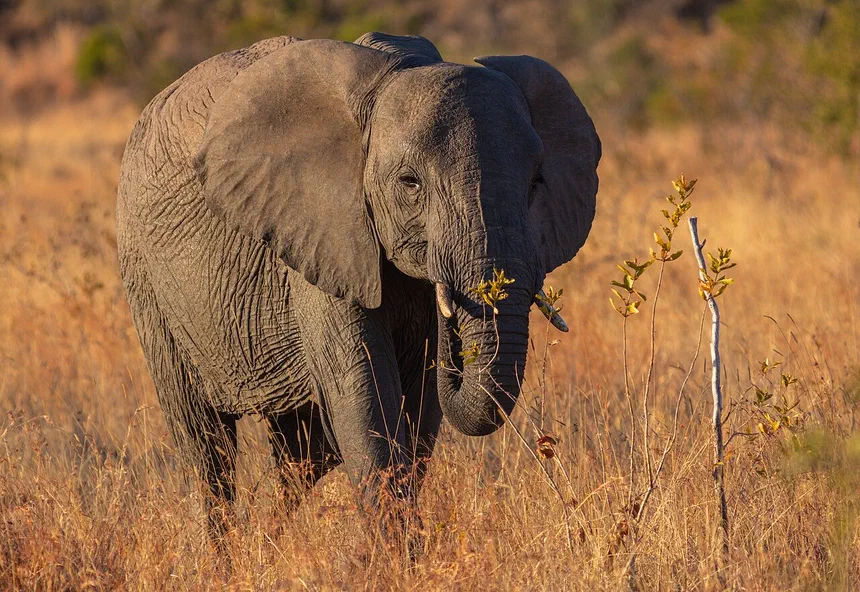
Image: Diego Delso — CC BY-SA 4.0 · source
What Is a African Bush Elephant?
The African bush elephant (Loxodonta africana) is the largest living land animal on Earth. It is one of two recognized African elephant species, the other being the smaller African forest elephant. These highly social, intelligent mammals roam a wide swath of sub-Saharan Africa and play an outsized role in shaping the ecosystems they inhabit.
Appearance and Identification
African bush elephants are unmistakable for their massive bodies, columnar legs, and long, muscular trunks. Adults typically stand between 8 and 13 feet tall at the shoulder and weigh several tons, with bulls (males) growing considerably larger than cows (females). Their skin is thick, gray, and deeply wrinkled, and it often appears brown or reddish because the animals dust and wallow in local soils.
Two features set this species apart from its Asian relatives: large, fan-shaped ears that help radiate excess body heat, and a trunk that ends in two finger-like lips for grasping. Both sexes usually carry tusks, which are elongated incisor teeth used for digging, stripping bark, and defense. The trunk itself is an extraordinary organ combining nose and upper lip, capable of both delicate manipulation and powerful lifting.
Habitat and Range
This species occupies a remarkable variety of habitats across sub-Saharan Africa, including open savannas, grasslands, woodlands, seasonal wetlands, and some forest margins. Populations are scattered across eastern, southern, and parts of central and western Africa, with major strongholds in countries such as Botswana, Zimbabwe, Kenya, and Tanzania.
Access to water strongly influences where elephants live, since they must drink regularly and use water and mud for cooling and skin care. Herds may travel long distances between feeding grounds and water sources, and their movements often follow seasonal patterns of rainfall and plant growth.
Diet
African bush elephants are herbivores with enormous appetites. A single adult can consume on the order of 220 to 440 pounds of vegetation per day, along with large quantities of water. Their diet includes grasses, leaves, twigs, bark, roots, and fruit, and it shifts with the seasons and local availability.
Because they process food inefficiently, elephants spend much of the day and night feeding. In doing so they knock down trees, strip bark, and open up dense vegetation, actions that reshape the landscape and create opportunities for other species. They also disperse seeds over wide areas through their dung, earning them a reputation as ecosystem engineers.
Behavior
Elephants are deeply social animals. The core unit is a family herd of related females and their young, led by an experienced older female known as the matriarch. Her memory of water sources, migration routes, and past dangers can be vital to the herd’s survival. Adult males generally leave their birth herd as they mature and live alone or in loose bachelor groups, associating with cows mainly during breeding.
Communication is rich and varied. Elephants use trumpeting calls, rumbles, body postures, and touch, and they produce low-frequency infrasound that can travel over long distances. They display behaviors that suggest strong social bonds, including cooperation, apparent mourning of dead herd members, and greeting rituals when reunited.
Life Cycle and Reproduction
African bush elephants reproduce slowly. Gestation lasts about 22 months, the longest of any land mammal, and normally results in a single calf. Newborns are large and depend heavily on their mothers and other herd females, who help protect and guide them.
Calves nurse for several years and continue learning survival skills well into youth. Females typically reach breeding age in their early teens, while bulls may not compete successfully for mates until later. This slow reproductive rate means populations recover only gradually from losses, making the species especially vulnerable to sustained threats.
Conservation Status
The African bush elephant is classified as Endangered on the IUCN Red List. The greatest threats are poaching for ivory and the steady loss and fragmentation of habitat as human land use expands. Conflict between elephants and farming communities also contributes to declines in some regions.
Conservation efforts focus on anti-poaching enforcement, protected areas, wildlife corridors that reconnect fragmented ranges, and programs that reduce conflict between people and elephants. International restrictions on the ivory trade remain a key part of protecting remaining populations.
Frequently Asked Questions
How is the African bush elephant different from the forest elephant? The bush elephant is larger, has more outward-curving tusks, and lives in open habitats, while the forest elephant is smaller, darker, and adapted to dense central African rainforests.
Are both male and female African bush elephants tusked? Yes, both sexes usually grow tusks, although those of bulls tend to be longer and heavier. Tusks are used for feeding tasks, digging, and defense.
Why are elephants considered important to their ecosystems? By feeding, uprooting trees, digging for water, and spreading seeds in their dung, elephants shape habitats and support many other species, which is why they are often called ecosystem engineers.