Mammals Guide
African Buffalo
What Is a African Buffalo? The African buffalo (Syncerus caffer) is a large, powerfully built bovine native to much of sub-Saharan Africa. It is one of the continent’s most abundant large grazers and is famous as a …
At a glance
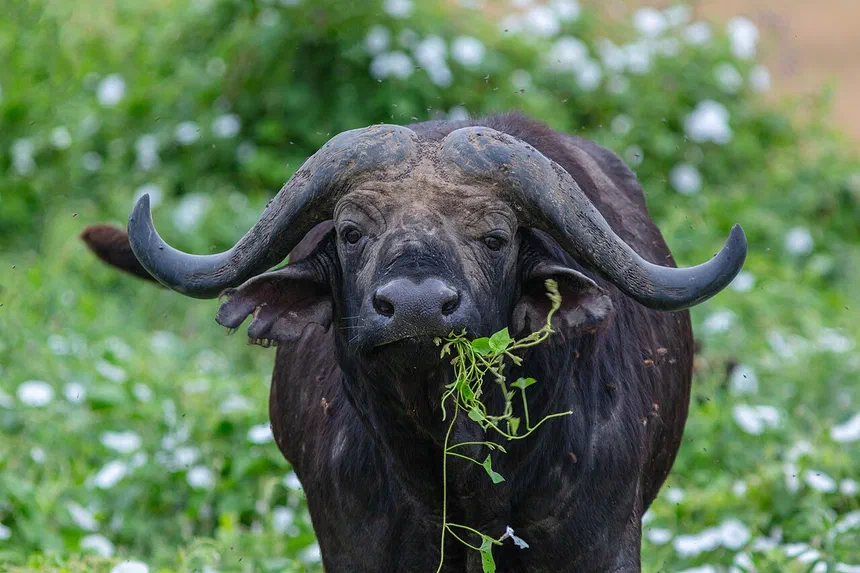
Image: Diego Delso — CC BY-SA 4.0 · source
What Is a African Buffalo?
The African buffalo (Syncerus caffer) is a large, powerfully built bovine native to much of sub-Saharan Africa. It is one of the continent’s most abundant large grazers and is famous as a member of the “Big Five,” a term originally coined by hunters for the animals considered most dangerous to pursue on foot. Despite superficial similarities, it is not closely related to the domestic water buffalo of Asia and has never been successfully domesticated.
Appearance and Identification
The African buffalo is a stocky, heavily muscled animal with a broad chest, short thick legs, and a large head carried low. Adult hide color ranges from dark brown to nearly black, while younger animals tend to be more reddish-brown. The ears are large and fringed, drooping below a set of curving horns.
The horns are the species’ most distinctive feature. In mature bulls the horn bases broaden and fuse across the top of the skull to form a heavy shield known as a “boss,” from which the horns sweep out, down, and then upward. Cows have slimmer horns and lack the fully developed boss. Several regional forms exist, including the large Cape buffalo of southern and eastern Africa and the smaller, redder forest buffalo of the Central African rainforests.
Habitat and Range
African buffalo occur across a wide swath of sub-Saharan Africa, from the grasslands and savannas of the east and south to the tropical forests of the Congo Basin. They are highly dependent on water and rarely stray far from it, needing to drink regularly and often wallowing in mud to cool off and discourage biting insects.
Preferred habitats include open savanna, grassy floodplains, reed beds, and lightly wooded country with ample grazing. Forest-dwelling populations occupy dense rainforest clearings and swampy openings. Suitable grass cover and reliable water are the main factors shaping where herds settle.
Diet
The African buffalo is a bulk grazer that feeds primarily on grasses and sedges, supplementing its diet with other coarse herbage when grass is scarce. Its wide muzzle and strong tongue allow it to crop tall, fibrous vegetation that many other grazers avoid, making it an important shaper of grassland structure.
Because it processes large quantities of low-quality forage, the buffalo spends much of the day and night feeding and ruminating. Its heavy reliance on water means feeding movements are usually organized around access to rivers, lakes, and waterholes.
Behavior
African buffalo are highly social and typically live in herds that can range from a few dozen to several hundred, occasionally forming aggregations of thousands where grazing is rich. Herds are led by cooperative group dynamics, and members will collectively defend calves and weaker individuals. Older bulls sometimes leave the main herd to live alone or in small bachelor groups.
The species has a formidable reputation for being unpredictable and aggressive when threatened. Buffalo will mob predators such as lions, and a cornered or wounded animal is considered extremely dangerous. This collective defense, combined with their bulk and speed, means healthy adult herds have few natural enemies.
Life Cycle and Reproduction
Breeding is often tied to the rainy season, when food is most plentiful. After a gestation of roughly eleven months, a cow usually gives birth to a single calf. Calves can stand and follow the herd within hours and remain closely bonded to their mothers, nursing for several months before becoming fully independent.
Females typically reach breeding age at around four to five years, while bulls usually must grow larger and older before they can compete successfully for mating opportunities. In the wild, African buffalo commonly live around 15 to 25 years, with survival strongly influenced by predation, disease, and drought.
Conservation Status
The African buffalo is currently listed as Near Threatened on the IUCN Red List. While still numerous overall and abundant in many protected areas, populations outside reserves have declined due to habitat loss, competition with livestock, hunting, and disease. Cattle-borne illnesses such as rinderpest historically caused catastrophic die-offs, and ongoing disease transmission remains a management concern where buffalo and livestock overlap.
Frequently Asked Questions
Are African buffalo dangerous to people? They can be. African buffalo are powerful, fast, and highly defensive, and wounded or startled individuals have injured and killed people, which is why they are treated with great caution in the wild.
Are African buffalo the same as domestic cattle or water buffalo? No. The African buffalo is a distinct species that has never been domesticated and is only distantly related to Asian water buffalo and to domestic cattle.
Do African buffalo live in large groups? Yes. They are social animals that gather in herds ranging from a few dozen to several hundred, and their collective defense helps protect calves and weaker members from predators.
References
The conservation status and key facts in this profile are supported by these sources:
- IUCN Red List — Syncerus caffer assessment (accessed 2026-07-28)
- Animal Diversity Web — Syncerus caffer (accessed 2026-07-28)
Found an error, source problem, or image concern? Report this page.