Mammals Guide
Addax
What Is a Addax? The addax (Addax nasomaculatus) is a desert-dwelling antelope native to the Sahara of North Africa. Sometimes called the white antelope or screwhorn antelope, it is superbly adapted to some of the …
At a glance
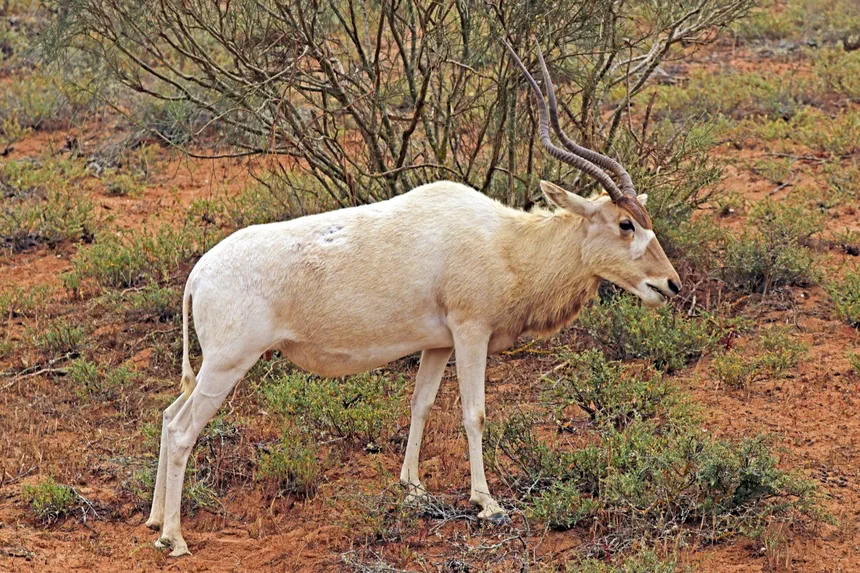
Image: Charles J. Sharp — CC BY-SA 4.0 · source
What Is a Addax?
The addax (Addax nasomaculatus) is a desert-dwelling antelope native to the Sahara of North Africa. Sometimes called the white antelope or screwhorn antelope, it is superbly adapted to some of the harshest, driest environments on Earth. It is the only living member of its genus and is among the most threatened large mammals in the world.
Appearance and Identification
The addax is a stocky, medium-sized antelope with a coat that shifts with the seasons. In the heat of summer the fur is pale, almost white, which helps reflect sunlight, while in the cooler months it turns grayish-brown. A distinctive patch of dark hair sits on the forehead, and a white marking across the face gives the species its scientific name, meaning “spotted nose.”
Its most striking feature is the pair of long, spiraling horns carried by both males and females. These twist in two or three graceful turns and can reach well over 2.5 ft (about 80 cm) in length. The addax also has broad, splayed hooves that spread its weight and keep it from sinking into soft sand.
Habitat and Range
The addax is a true desert specialist, historically ranging across a vast swath of the Sahara and neighboring arid zones. It favors sandy dune fields, stony plains, and semi-desert flats where sparse vegetation grows after rare rains.
Today its wild range has collapsed dramatically. Once found from Mauritania to Egypt, the species now survives in only a few remote pockets, chiefly on the border region of Niger and Chad. The addax follows the unpredictable rhythm of desert rainfall, wandering long distances in search of fresh plant growth.
Diet
As a herbivore, the addax grazes and browses on the tough, drought-resistant plants that manage to survive in the desert. Its diet includes desert grasses, small shrubs, herbs, and the leaves of hardy perennials, and it is especially drawn to fresh growth that sprouts after infrequent storms.
One of the addax’s most remarkable traits is its ability to live without drinking free water for long periods, sometimes its entire life. It extracts nearly all the moisture it needs from its food, and it conserves water by producing highly concentrated urine and dry dung, and by feeding at night and during cooler hours when plants hold more moisture.
Behavior
Addax are social animals that traditionally gathered in herds, though the size of these groups has shrunk as populations have declined. They are most active in the cooler parts of the day and rest during the searing midday heat, often scraping out shallow depressions in the sand beneath sparse cover.
The species is well known for its stamina and its ability to detect distant rainfall, moving across great stretches of desert to reach freshly greened areas. Slow-moving compared with many antelope, the addax relies on its remote habitat rather than speed to avoid danger, a trait that has unfortunately made it easy prey for hunters.
Life Cycle and Reproduction
Breeding can occur throughout the year, often peaking in seasons tied to rainfall and food availability. After a gestation of roughly eight to nine months, a female typically gives birth to a single calf.
Newborn calves can stand and follow the herd within hours, an important advantage in open desert where hiding places are scarce. Young are weaned over several months and reach sexual maturity within about two to three years. Under good conditions addax can live around 15 to 20 years, with individuals in managed care sometimes living longer.
Conservation Status
The addax is listed as Critically Endangered on the IUCN Red List, and only a very small number are thought to remain in the wild. Decades of unregulated hunting, disturbance from human activity, and habitat degradation drove the collapse of its populations.
The species survives today largely thanks to captive-breeding programs and protected herds in zoos and reserves around the world. Reintroduction efforts and strict protection in parts of its range offer some hope, but the wild addax remains perilously close to extinction.
Frequently Asked Questions
Where do addax live? Addax are native to the Sahara Desert of North Africa. Once widespread, wild animals now cluster in a few isolated areas, mostly along the Niger-Chad border.
How does the addax survive without water? It obtains almost all its moisture from the plants it eats and conserves water through concentrated waste, nighttime feeding, and other desert adaptations, allowing it to go long stretches without drinking.
Why is the addax endangered? Uncontrolled hunting, human disturbance, and habitat loss reduced the wild population to a critically low level, making it one of the rarest large antelope on Earth.
References
The conservation status and key facts in this profile are supported by these sources:
- IUCN Red List — Addax nasomaculatus assessment (accessed 2026-07-28)
- Animal Diversity Web — Addax nasomaculatus (accessed 2026-07-28)
Found an error, source problem, or image concern? Report this page.