Mammals Guide
Aardwolf
What Is a Aardwolf? The aardwolf (Proteles cristatus) is a small, insect-eating member of the hyena family native to Africa. Despite its shy, dog-like appearance, it is a specialist termite hunter rather than a scavenger …
At a glance
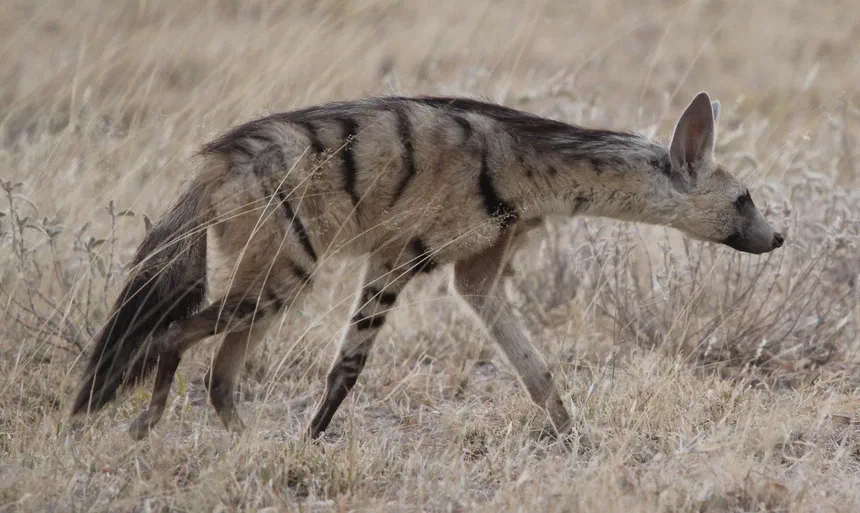
What Is a Aardwolf?
The aardwolf (Proteles cristatus) is a small, insect-eating member of the hyena family native to Africa. Despite its shy, dog-like appearance, it is a specialist termite hunter rather than a scavenger or predator of large prey. Its name comes from Afrikaans and means “earth wolf,” a nod to its habit of sheltering in burrows.
Appearance and Identification
The aardwolf resembles a slender, scaled-down striped hyena. It has a yellowish to tawny coat marked by several vertical black stripes on the body and horizontal bands on the legs. A prominent mane of long hair runs along the back and neck, which the animal can raise to appear larger when threatened.
Adults typically measure about 22 to 31 inches in head and body length, stand roughly 16 to 20 inches at the shoulder, and weigh somewhere between 15 and 31 pounds. Like other hyenas, the aardwolf has a sloping back with front legs longer than the hind legs, giving it a distinctive hunched profile. Its most specialized feature is its dentition: the cheek teeth are small and peg-like, reduced from the powerful crushing molars of its relatives because it feeds almost entirely on soft-bodied insects. A long, sticky tongue helps it lap up prey.
Habitat and Range
Aardwolves occupy open, dry country where termites are plentiful, including grasslands, savanna, and scrubland. They generally avoid dense forest and true desert. The species has two separate populations: one in eastern Africa, spanning countries such as Kenya, Tanzania, Ethiopia, and Somalia, and another across southern Africa, including South Africa, Namibia, Botswana, and neighboring nations.
For shelter, aardwolves rely on burrows, often taking over dens dug by aardvarks, springhares, or other animals rather than excavating their own. A single individual may use several burrows within its territory.
Diet
The aardwolf is a highly specialized insectivore. Its diet consists overwhelmingly of harvester termites, particularly those of the genus Trinervitermes, which it licks up from the ground surface rather than digging into mounds. A single aardwolf can consume enormous numbers of termites in one night, with estimates ranging into the hundreds of thousands.
Unlike aardvarks, it does not tear open termite nests but instead gathers insects as they forage on the surface. Because harvester termites produce defensive chemicals that repel many predators, the aardwolf has largely cornered this abundant food source. When its preferred termites are seasonally scarce, it may also eat other insects.
Behavior
Aardwolves are primarily nocturnal, emerging at dusk to forage and using acute hearing and smell to locate termite columns in the dark. They are generally solitary while feeding, though a mated pair and their young share and defend a common territory, which they mark with secretions from anal glands.
The species is shy and non-aggressive, relying on avoidance rather than confrontation. When cornered, an aardwolf raises its mane, arches its back, and may release a foul-smelling secretion, but it lacks the strength to be a serious fighter. Territories are patrolled and scent-marked regularly, especially during the breeding season.
Life Cycle and Reproduction
Aardwolves typically form monogamous pairs, at least seasonally. After a gestation period of roughly 90 days, the female gives birth to a litter of usually two to four cubs in a burrow. Both parents contribute to raising the young: the male often guards the den while the female forages, helping protect the cubs from predators such as jackals.
The cubs remain dependent for several months, gradually accompanying adults on foraging trips before becoming independent and eventually dispersing to establish their own territories. Aardwolves generally live around 8 to 13 years in the wild.
Conservation Status
The aardwolf is listed as Least Concern by the IUCN. It is fairly widespread across its range and is not currently considered threatened, in part because it depends on abundant termites rather than resources that bring it into direct conflict with people. Localized threats include habitat loss, road mortality, and persecution by those who mistakenly believe it preys on livestock. Pesticide use targeting termites and locusts can also reduce its food supply in some areas.
Frequently Asked Questions
Is the aardwolf a type of hyena? Yes. The aardwolf belongs to the hyena family (Hyaenidae), but it is the smallest member and the only one that specializes in eating insects rather than meat.
Does the aardwolf dig up termite mounds like an aardvark? No. Instead of breaking into nests, it licks foraging termites off the ground surface with its long, sticky tongue, so its teeth are reduced and peg-like.
Are aardwolves dangerous to humans or livestock? No. They are shy, insect-eating animals that pose no threat to livestock and avoid people whenever possible.
References
The conservation status and key facts in this profile are supported by these sources:
- IUCN Red List — Proteles cristatus assessment (accessed 2026-07-28)
- Animal Diversity Web — Proteles cristata (accessed 2026-07-28)
Found an error, source problem, or image concern? Report this page.