Insects Guide
Monarch Butterfly
What Is a Monarch Butterfly? The monarch butterfly (Danaus plexippus) is one of the most recognizable insects in the Americas, known for its bright orange-and-black wings and its remarkable long-distance migrations. It …
At a glance
What Is a Monarch Butterfly?
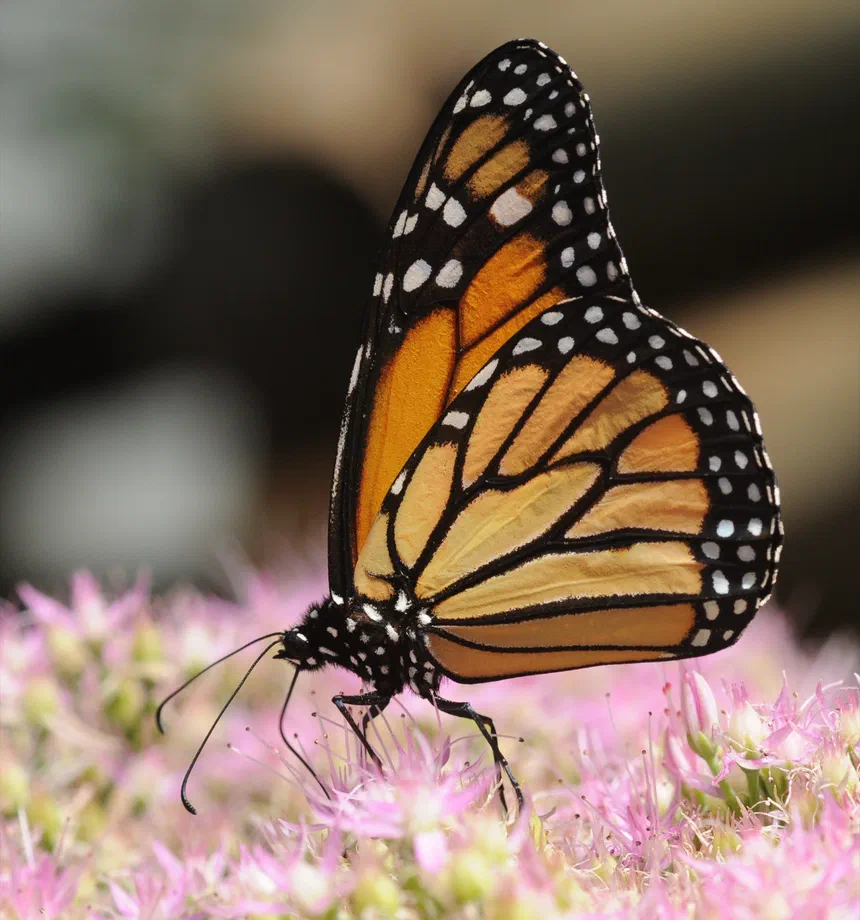
The monarch butterfly (Danaus plexippus) is one of the most recognizable insects in the Americas, known for its bright orange-and-black wings and its remarkable long-distance migrations. It belongs to the brush-footed butterfly family (Nymphalidae) and is celebrated as much for its beauty as for the astonishing multi-generational journeys some populations make each year.
Appearance and Identification
Adult monarchs have orange wings crossed by bold black veins and framed with a black border studded with rows of small white spots. The wingspan typically measures about 3.5 to 4 inches (9 to 10 cm). Males can be distinguished from females by a small black scent-gland spot on a vein of each hindwing and by slightly thinner black veining. The underside of the wings is paler, showing more yellowish-orange tones. Monarchs are often confused with the viceroy butterfly, but the viceroy is smaller and has an extra black line crossing its hindwings. The bright coloring serves as a warning: monarchs store toxins from milkweed, making them distasteful to predators.
Habitat and Range
Monarchs are found throughout North America and range south into Central and South America, with additional populations in parts of the Pacific, Australia, and the Iberian Peninsula. During the breeding season they favor open habitats where milkweed and nectar plants grow, including meadows, prairies, fields, roadsides, wetland edges, and cultivated gardens. Overwintering monarchs gather in specific forested sites: eastern populations cluster in high-elevation oyamel fir forests in central Mexico, while western populations winter along the coast of California in groves of eucalyptus, Monterey pine, and cypress.
Diet
The monarch is strictly herbivorous. Caterpillars feed almost exclusively on milkweed plants (genus Asclepias), consuming the leaves and absorbing cardiac glycoside compounds that make both the larvae and adults toxic to many predators. Adult butterflies do not eat leaves; instead they use a long, coiled proboscis to drink nectar from a wide variety of flowering plants. Nectar provides the sugars that fuel flight and, for the migratory generation, the fat reserves needed to survive the winter.
Behavior
Monarchs are best known for their annual migration, one of the longest and most complex of any insect. Each autumn, monarchs east of the Rocky Mountains travel thousands of miles to overwintering sites in Mexico, navigating by the sun and an internal circadian clock. No single butterfly completes the entire round trip; instead, it takes several generations over the course of a year. By day monarchs are active fliers that bask to warm their flight muscles, and at cool overwintering sites they cluster together in dense masses on tree branches to conserve heat.
Life Cycle and Reproduction
Like all butterflies, monarchs undergo complete metamorphosis with four stages: egg, larva (caterpillar), pupa (chrysalis), and adult. Females lay small, ridged eggs singly on the underside of milkweed leaves. The caterpillar that hatches is banded in yellow, black, and white and grows quickly through several molts before forming a green, gold-flecked chrysalis. Inside, its body reorganizes over roughly one to two weeks before an adult emerges. Most summer adults live only a few weeks, but the special generation that emerges in late summer enters a non-reproductive state and can live eight to nine months, surviving the winter before breeding the following spring.
Conservation Status
The migratory monarch subspecies (Danaus plexippus plexippus) was assessed by the IUCN as Vulnerable, reflecting steep declines in overwintering populations. Major threats include the loss of milkweed and nectar habitat, deforestation at overwintering sites, pesticide and herbicide use, and climate change. Conservation efforts focus on planting native milkweed and nectar plants, protecting overwintering forests, and monitoring population trends through community science programs.
Frequently Asked Questions
Why do monarch caterpillars only eat milkweed? Milkweed contains toxins that the caterpillars store in their bodies, making them poisonous and unpalatable to predators. This chemical defense carries through to the adult butterfly.
How far do monarchs migrate? Eastern monarchs may travel up to about 3,000 miles from Canada and the northern United States to central Mexico, one of the longest insect migrations known.
Are monarch butterflies endangered? The migratory monarch is listed as Vulnerable by the IUCN due to declining numbers, though it is not formally listed as endangered under all national frameworks. Habitat loss and climate change are key concerns.