Insects Guide
June Beetle
What Is a June Beetle? June beetle is a common name for the many scarab beetles in the genus Phyllophaga, a large group that includes several hundred described species. They are best known for the clumsy, buzzing flights …
At a glance
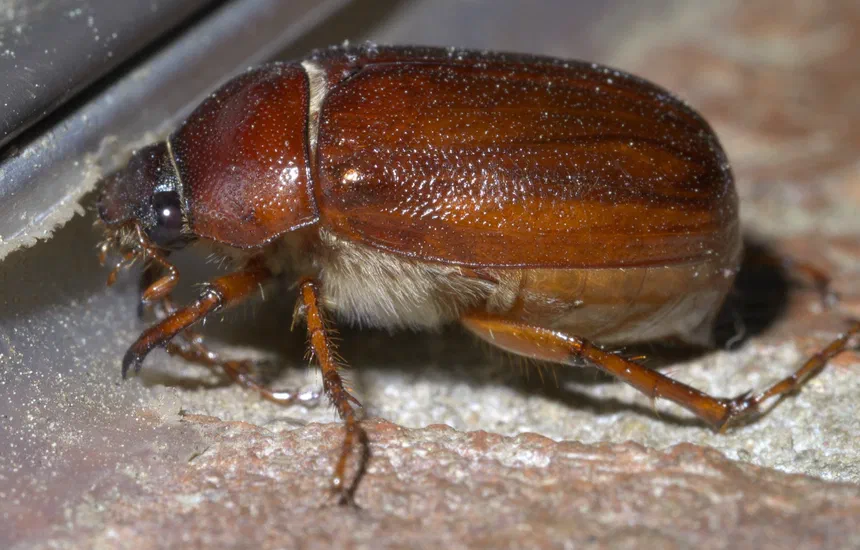
Image: xpda — CC BY-SA 4.0 · source
What Is a June Beetle?
June beetle is a common name for the many scarab beetles in the genus Phyllophaga, a large group that includes several hundred described species. They are best known for the clumsy, buzzing flights the adults make on warm early-summer evenings, when they gather around porch lights and windows. Because they are most conspicuous in late spring and early summer, they are also called June bugs or May beetles.
Appearance and Identification
Adult June beetles are robust, oval insects with a hard, glossy exoskeleton that ranges from reddish-brown to a deep chestnut or nearly black. Most species measure roughly 12 to 25 millimeters in length, giving them a stout, thumbnail-sized body. The wing covers, or elytra, are smooth and slightly ridged, and the underside is often covered in fine pale hairs. Their antennae end in a distinctive fan-like club of plates that the beetle can spread apart to sense odors. The stout legs bear small spines and end in strong claws suited to gripping and burrowing. The larvae, commonly called white grubs, are plump, C-shaped, cream-colored creatures with a brown head and three pairs of legs near the front.
Habitat and Range
Members of the genus Phyllophaga are widespread across North and Central America, with the greatest diversity in the eastern and central United States. They favor open and semi-open habitats such as grasslands, meadows, pastures, gardens, lawns, and the edges of woodlands. The larvae live underground in soil rich in plant roots and organic matter, so areas with healthy turf, crop fields, or leaf litter tend to support the largest populations. Adults are strong enough fliers to disperse into surrounding yards and buildings in search of foliage and mates.
Diet
June beetles are herbivores throughout their lives, but the adults and larvae feed on very different tissues. Adult beetles chew on the leaves of trees, shrubs, and various broadleaf plants, sometimes leaving ragged, skeletonized foliage when they are abundant. The subterranean larvae feed on the fine roots of grasses and other plants. Because heavy grub populations can sever the roots of lawns and pastures, some Phyllophaga species are considered agricultural and turf pests, and their feeding can leave patches of grass that lift easily from the soil.
Behavior
Adult June beetles are chiefly nocturnal and are strongly drawn to artificial lights, which is why they so often appear around porch lamps and lit windows on summer nights. Their flight is heavy and awkward, and they frequently collide with walls and screens. During the day they usually shelter in soil, leaf litter, or low vegetation. The larvae spend nearly all of their time hidden in the ground, moving up toward the surface to feed on roots in warm weather and burrowing deeper to escape cold or drought.
Life Cycle and Reproduction
June beetles undergo complete metamorphosis, passing through egg, larva, pupa, and adult stages. After mating in late spring or summer, females burrow into the soil and lay their eggs a few inches below the surface. The eggs hatch into white grubs that feed on roots and grow through several molts. Depending on the species and climate, the larval stage can last anywhere from about one to three years, making it by far the longest part of the life cycle. When fully grown, the larva forms an earthen cell and pupates, then emerges as an adult that tunnels to the surface the following season.
Conservation Status
The genus Phyllophaga as a whole has not been assessed by the IUCN, and its most common species are abundant and widespread. Where they damage crops, lawns, or pastures they are often managed as pests rather than protected. As with many insects, some localized or specialized species may be sensitive to habitat loss and pesticide use, but broad populations are not currently considered at risk.
Frequently Asked Questions
Are June beetles harmful to people? No. Adult June beetles do not bite or sting and are harmless to humans and pets. They can be a nuisance around lights and their grubs can damage lawns and crops.
Why do June beetles fly into lights and windows? Adults are nocturnal and instinctively navigate toward light sources, so bright porch lamps and windows attract them on warm evenings.
What are the white grubs in my lawn? The C-shaped white grubs found in soil are the larvae of June beetles and related scarabs. They feed on grass roots and, in large numbers, can loosen and brown patches of turf.