Insects Guide
Jumping Bristletail
What Is a Jumping Bristletail? Jumping bristletails are small, wingless insects that make up the order Archaeognatha. They are among the most ancient lineages of living insects, and their name comes from their ability to …
At a glance
What Is a Jumping Bristletail?
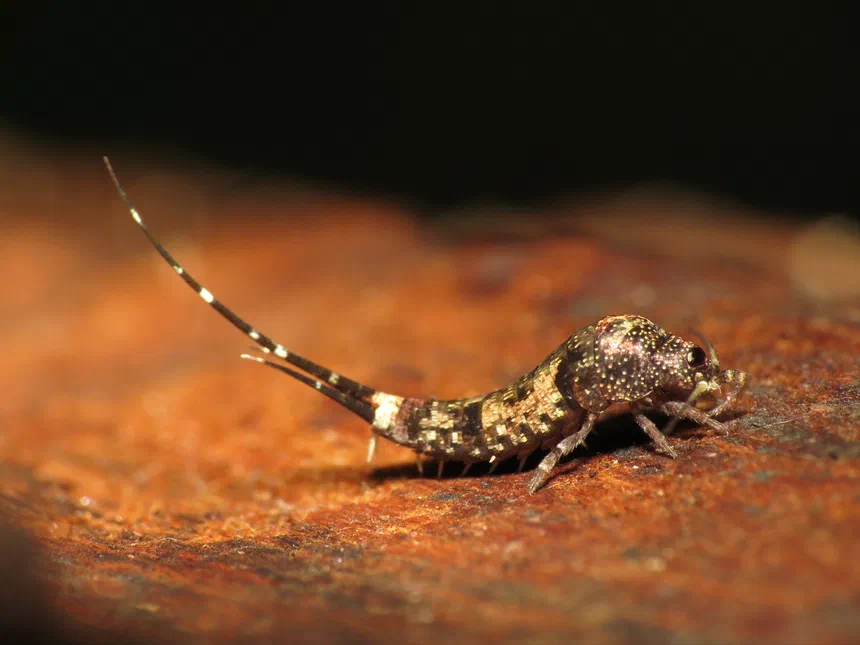
Jumping bristletails are small, wingless insects that make up the order Archaeognatha. They are among the most ancient lineages of living insects, and their name comes from their ability to spring several centimeters into the air by suddenly flexing the abdomen. Despite a superficial resemblance to silverfish, they belong to a separate and more primitive group.
Appearance and Identification
A jumping bristletail has an elongated, humpbacked body that tapers toward the rear and is covered in tiny, often iridescent scales. The body typically measures about 10 to 15 millimeters, though the three thread-like tails at the abdomen’s tip can add substantially to that length. The central tail (a median filament) is longer than the two flanking cerci. Two long, many-segmented antennae sweep forward from the head, and the large compound eyes meet at the top of the head, a distinctive feature that helps separate archaeognathans from silverfish, whose eyes are small and widely spaced. Coloration is usually a camouflaging blend of brown, gray, and bronze that blends with rock, bark, and leaf litter.
Habitat and Range
Jumping bristletails are found nearly worldwide, occurring on every continent except Antarctica. They favor humid, sheltered microhabitats such as leaf litter, the underside of stones, crevices in rock, loose bark, and coastal cliffs where they graze on algae and lichen. Some species tolerate surprisingly exposed environments, including alpine scree and rocky shorelines within reach of sea spray. Because they lack a waxy waterproof cuticle as effective as that of many other insects, they generally stay near moist refuges and are most active at night.
Diet
These insects are herbivores and detritivores. Their diet centers on algae, lichens, mosses, and decaying vegetation, and they will also consume bits of fungal material and plant debris. Using chewing mouthparts, they scrape thin films of growth from rock and bark surfaces. This feeding habit makes them part of the decomposer community, helping to recycle nutrients in the environments they inhabit.
Behavior
The most striking behavior is the escape jump. By rapidly arching the abdomen against the ground, a bristletail can launch itself several centimeters upward and away from a threat, an unpredictable movement that helps it evade predators. Otherwise they are secretive and nocturnal, hiding by day and emerging in darkness or damp weather to feed. They are agile runners on uneven surfaces and rely heavily on their long antennae and cerci to sense their surroundings. Unlike most insects, adults continue to molt throughout their lives.
Life Cycle and Reproduction
Archaeognathans develop through a process called ametaboly, meaning the young hatch looking like miniature adults and simply grow larger with each molt rather than undergoing metamorphosis. Reproduction is indirect: rather than mating directly, the male spins a fine thread and deposits a droplet of sperm (a spermatophore), which the female then takes up to fertilize her eggs. Females lay small clutches of eggs in soil crevices or sheltered spots. Individuals reach maturity in several months to a year and may live roughly two to four years, molting many times over their lifespan, which is unusually long for such small insects.
Conservation Status
The vast majority of jumping bristletail species have not been formally assessed by the IUCN, so most carry no conservation designation. As a group they are widespread and locally common, and they face no broad conservation concern. However, species restricted to specialized habitats such as isolated coastal or mountain sites could be locally vulnerable to habitat disturbance, and many species likely remain undescribed by science.
Frequently Asked Questions
Are jumping bristletails the same as silverfish? No. Both are wingless and scaly, but silverfish belong to a different order (Zygentoma). Bristletails have a humped body, large eyes that touch at the top of the head, and the ability to jump, none of which silverfish share.
Do jumping bristletails bite or damage homes? No. They do not bite people and are not pests. They live outdoors among rocks and leaf litter and feed on algae, lichen, and decaying plant matter rather than household materials.
How do they jump without legs built for leaping? They snap the abdomen downward against the surface, which flings the whole body into the air. It is a defensive escape reflex rather than a way of traveling around.