Insects Guide
Julia Butterfly
What Is a Julia Butterfly? The Julia butterfly (Dryas iulia) is a slender, bright orange butterfly of the family Nymphalidae, known for its long, narrow wings and fast, restless flight. It is the only species in the …
At a glance
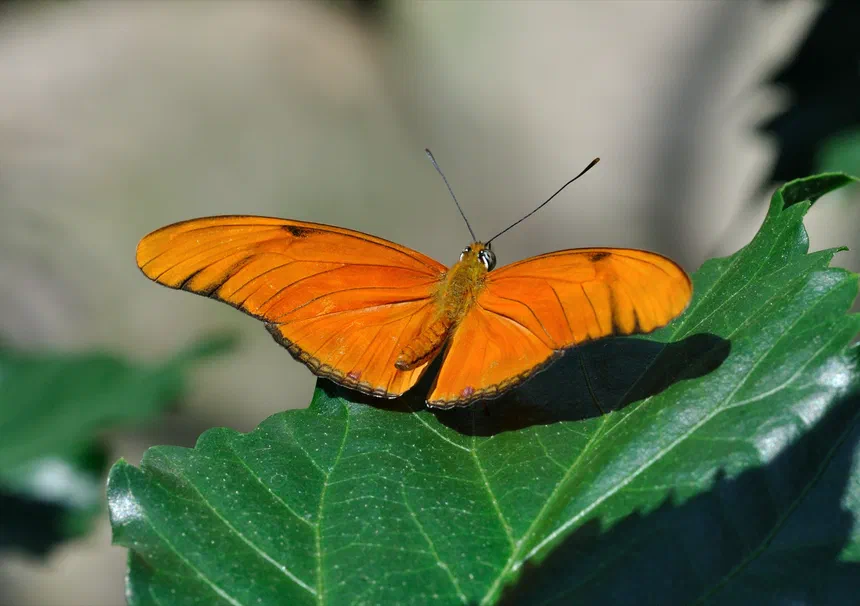
Image: Quartl — CC BY-SA 3.0 · source
What Is a Julia Butterfly?
The Julia butterfly (Dryas iulia) is a slender, bright orange butterfly of the family Nymphalidae, known for its long, narrow wings and fast, restless flight. It is the only species in the genus Dryas and ranges widely across the warmer parts of the Americas, where it is a familiar sight in gardens and butterfly houses.
Appearance and Identification
The Julia butterfly is easily recognized by its elongated wings and warm orange coloring. Males are a bright, uniform orange with only a few small black markings near the wingtips and along the forewing edges. Females are typically duller, ranging from orange to brownish, and carry heavier dark markings and pale bands, which makes the two sexes fairly easy to tell apart. The underside of the wings is a softer brown-orange with subtle silvery or darker spotting that helps the resting butterfly blend into foliage. With a wingspan of roughly 8 to 9 centimeters (about 3.1 to 3.7 inches) and unusually long, slim forewings, the Julia has a distinctive silhouette in flight. It is sometimes confused with the related gulf fritillary, but the Julia’s longer, narrower wings and plainer upper surface set it apart.
Habitat and Range
The Julia butterfly occurs from the southern United States, particularly Florida and southern Texas, southward through Mexico and Central America and into much of South America as far as Brazil and Bolivia. It has also become established in parts of the Caribbean. The species favors warm, humid environments and is most often seen along the sunny edges of tropical and subtropical forests, in clearings, second growth, and open woodland. It readily visits gardens, parks, and cultivated areas where nectar plants and its larval host vines are available.
Diet
Like most butterflies, the Julia has a diet that changes completely between life stages. Caterpillars feed exclusively on the leaves of passionflower vines (genus Passiflora), plants that contain natural toxins the larvae can tolerate. Adults feed on liquids through a coiled proboscis, chiefly flower nectar, but they also take up moisture and minerals from damp ground, rotting fruit, and bird droppings. The Julia is notable for a striking feeding behavior: adults have been observed drinking the tears of caimans and turtles to obtain salts, a form of mineral-seeking behavior called lachryphagy.
Behavior
Julia butterflies are active, sun-loving insects that fly by day, often with a rapid, darting motion low over vegetation and along forest edges. They are strong, agile fliers and are frequently seen basking with their wings spread in patches of sunlight. Adults gather at flowers and at damp soil, and males in particular patrol open areas in search of females. The bright orange coloring is thought to warn predators, since the toxins acquired from passionflower host plants during the larval stage can make the butterflies distasteful.
Life Cycle and Reproduction
The Julia butterfly undergoes complete metamorphosis through four stages: egg, larva, pupa, and adult. Females lay eggs, usually singly, on or near passionflower vines so that the hatching caterpillars have immediate access to their host plant. The larvae are spiny and dark, a common defense among passionflower-feeding butterflies, and they pass through several growth stages before pupating. The chrysalis is mottled brown and shaped to resemble a dead leaf or scrap of bark, providing camouflage while the insect transforms. In warm parts of its range the Julia breeds year-round and produces multiple generations, with adults living for a matter of weeks.
Conservation Status
The Julia butterfly has not been formally assessed by the IUCN, but it is common, widespread, and abundant throughout much of its large range, so it is not considered to be at risk. It adapts well to disturbed and cultivated habitats and is widely reared for display in butterfly conservatories, where its bright color and lively flight make it a popular exhibit. As with many tropical insects, the main long-term concern is habitat loss, though at present the species remains secure.
Frequently Asked Questions
Why is the Julia butterfly so brightly orange? The vivid orange is thought to act as a warning to predators. As caterpillars, Julia butterflies feed on passionflower vines and take in natural toxins that can make the adults unpalatable.
What do Julia caterpillars eat? They feed only on the leaves of passionflower vines (Passiflora). Adults, by contrast, drink nectar and other liquids and do not eat leaves.
Where can I see a Julia butterfly? In the United States they are most common in Florida and southern Texas, and they range south through Central and South America. They are also commonly kept in butterfly houses and conservatories worldwide.