Insects Guide
Jewel Wasp
What Is a Jewel Wasp? The jewel wasp (Ampulex compressa), also called the emerald cockroach wasp, is a small solitary wasp famous for its striking metallic coloring and its remarkable, almost surgical way of parasitizing …
At a glance
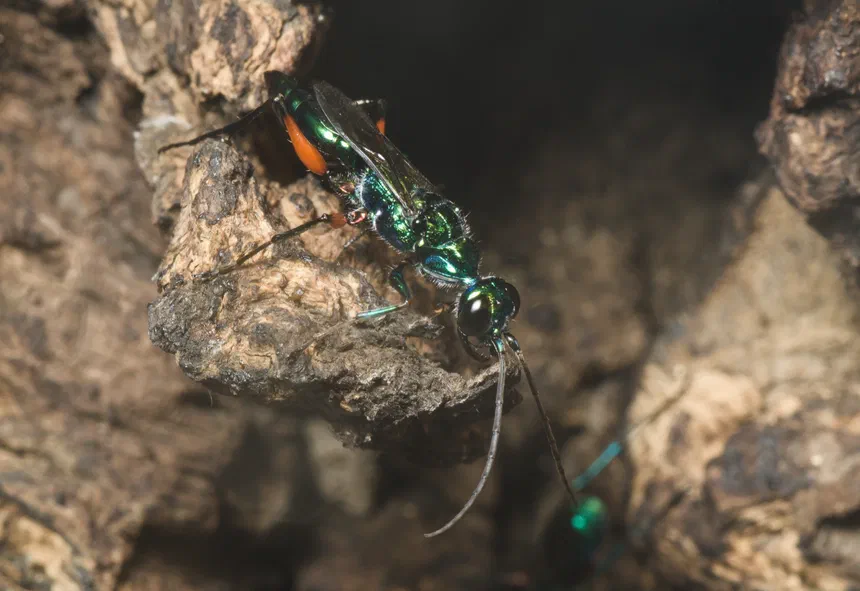
Image: Pjt56 — CC BY-SA 4.0 · source
What Is a Jewel Wasp?
The jewel wasp (Ampulex compressa), also called the emerald cockroach wasp, is a small solitary wasp famous for its striking metallic coloring and its remarkable, almost surgical way of parasitizing cockroaches. It belongs to the family Ampulicidae and is best known to scientists as a natural model for studying how venom can influence behavior.
Appearance and Identification
This is a slender, glossy wasp roughly 2 centimeters (about 0.8 inches) in length, with females tending to be a little larger than males. The body gleams with a deep metallic blue-green, sometimes appearing almost jewel-like in bright light, which gives the species its common name. A distinctive feature is the pair of reddish-orange segments on the upper hind legs, contrasting sharply with the emerald body. The wings are smoky and translucent, and the wasp has long, slender antennae and legs suited to grasping and steering much larger prey.
Habitat and Range
The jewel wasp favors warm climates and is found across tropical and subtropical regions, including parts of South and Southeast Asia, Africa, and various Pacific islands. It has also been introduced to some areas, such as Hawaii, in attempts to control cockroach populations. Because its life cycle depends on cockroaches, it thrives wherever suitable host insects are common, often near human dwellings, gardens, leaf litter, and other sheltered lowland environments.
Diet
Adult jewel wasps feed mainly on nectar and other plant sugars, making the adult stage largely harmless to other animals. The larvae, by contrast, are parasitoids: each grub develops by feeding on a single living cockroach that the mother has prepared for it. The female does not eat the cockroach herself but uses it entirely as a nursery and food supply for her offspring.
Behavior
The jewel wasp is best known for the extraordinary way it subdues its prey. A female first delivers a quick sting that briefly paralyzes a cockroach’s front legs, then follows with a precisely aimed sting into the roach’s head, injecting venom into specific regions of its nervous system. Rather than killing or fully paralyzing the cockroach, this venom suppresses its drive to flee, leaving it docile and compliant. The wasp can then lead the still-mobile roach by one antenna, walking it back to a burrow much like a leashed animal. This targeted manipulation of behavior is rare in the animal world and has made the species a subject of considerable scientific interest.
Life Cycle and Reproduction
After guiding the subdued cockroach into a suitable chamber, the female lays a single egg on the roach’s body, often attaching it to a leg. She then seals the burrow with debris to protect the developing young. When the larva hatches, it feeds first on the outside of the living but passive host, then bores inside to consume the internal tissues in an order that keeps the roach alive as long as possible. Eventually the larva forms a cocoon within the emptied body of the cockroach, pupates, and later emerges as an adult wasp. The entire cycle from egg to adult typically takes several weeks, depending on temperature.
Conservation Status
The jewel wasp has not been formally assessed by the IUCN and carries no special conservation designation. It is widespread across its warm-climate range and is not considered threatened. In some places it is even regarded as beneficial for its role in reducing cockroach numbers, though a single wasp accounts for only a small share of local roach populations.
Frequently Asked Questions
Is the jewel wasp dangerous to humans? No. Its sting is adapted for controlling cockroaches, and the species poses no meaningful threat to people or pets.
Why does it turn cockroaches into “zombies”? Its venom targets specific parts of the cockroach’s nervous system, removing the urge to escape so the wasp can guide the roach to a burrow as living food for its larva.
Where are jewel wasps found? They live in warm tropical and subtropical regions of Asia, Africa, and the Pacific, and have been introduced elsewhere, including Hawaii.