Insects Guide
Jewel Beetle
What Is a Jewel Beetle? Jewel beetles are members of the family Buprestidae, a large group of wood-boring beetles famous for their brilliant, metallic body colors. With roughly 15,000 described species worldwide, they …
At a glance
What Is a Jewel Beetle?
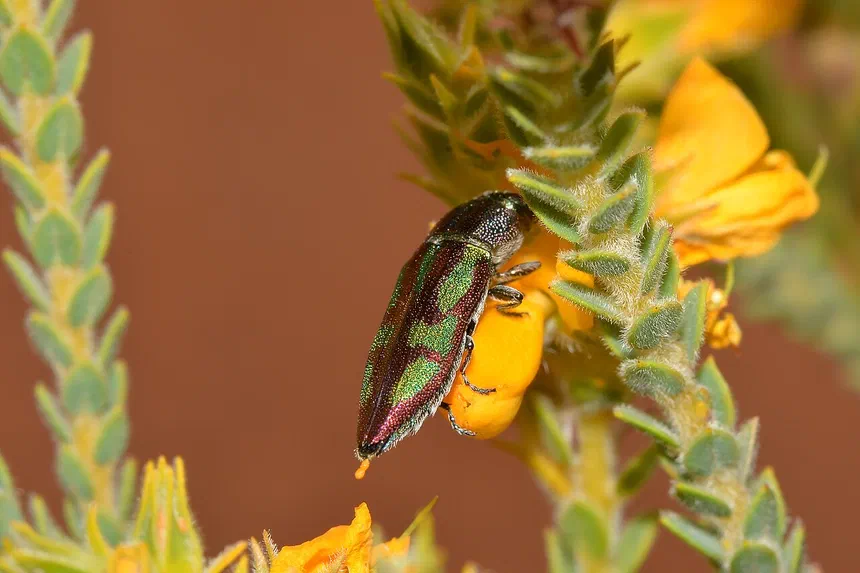
Jewel beetles are members of the family Buprestidae, a large group of wood-boring beetles famous for their brilliant, metallic body colors. With roughly 15,000 described species worldwide, they are among the most visually striking of all insects. The name reflects their gem-like sheen, which has long made their hardened wing covers popular in jewelry and decorative art.
Appearance and Identification
Most jewel beetles have an elongated, bullet-shaped or teardrop body with a slightly flattened underside and a tapering rear. Their standout feature is structural coloration: microscopic layers in the exoskeleton reflect light to produce shimmering greens, blues, coppers, and golds that seem to shift with viewing angle rather than fading like ordinary pigment. Sizes vary enormously, from tiny species only a few millimeters long to tropical giants approaching 100 mm. Key identifying traits include short, serrated (saw-toothed) antennae, large eyes, and a hard, compact body built for life in wood. Many species also carry contrasting spots, bands, or metallic pits that aid identification.
Habitat and Range
Jewel beetles occur on every continent except Antarctica and are absent only from the coldest polar and high-alpine zones. Diversity peaks in warm tropical and subtropical regions, though many species thrive in temperate forests and woodlands. Because their larvae depend on wood and plant tissue, adults are most often found in and around forests, savannas, orchards, and gardens, frequently resting on tree trunks, dead branches, or sun-warmed foliage. Some specialize on a single host plant, while others use a broad range of trees and shrubs.
Diet
The family is herbivorous at every stage, but adults and larvae feed very differently. Larvae, sometimes called flatheaded borers because of their broadened front segment, tunnel through the wood, bark, or roots of host plants, feeding on the living and dead tissue as they grow. Adults are generally more visible feeders, nibbling on leaves and often visiting flowers to eat pollen and nectar. A number of species are drawn to stressed, dying, or recently burned trees, which provide ideal conditions for their offspring.
Behavior
Jewel beetles are mostly active by day and are strong, if somewhat clumsy, fliers that favor warm, sunny weather. Their metallic colors likely serve several purposes, including camouflage among glossy leaves, confusing predators, and signaling to potential mates. When threatened, many drop from vegetation and stay motionless, relying on their hard shell and shifting sheen to avoid notice. Some species are attracted to heat and smoke, and a few famously detect forest fires from a distance, flying toward freshly killed timber to lay their eggs.
Life Cycle and Reproduction
Like all beetles, jewel beetles undergo complete metamorphosis with egg, larval, pupal, and adult stages. Females lay eggs in bark crevices or on the surface of suitable host plants. After hatching, the pale, grub-like larvae bore inward and may feed for months to several years, depending on species and wood quality, before pupating just beneath the surface. Emerging adults chew their way out, leaving distinctive D-shaped or oval exit holes. Adults are comparatively short-lived, surviving weeks to a few months, during which they mate and start the next generation.
Conservation Status
The family as a whole has not been assessed by the IUCN, and most jewel beetles are common where suitable host plants exist. Because they rely on specific trees and healthy woodland, however, individual species can be threatened by deforestation and habitat loss. A few, such as certain wood-boring emerald species introduced beyond their native range, have become serious pests of trees far from home, showing that the same wood-feeding lifestyle can make some jewel beetles ecologically damaging rather than at risk.
Frequently Asked Questions
Why are jewel beetles so shiny? Their color comes from structural coloration, not pigment. Nanoscale layers in the exoskeleton reflect and scatter light to create iridescent metallic hues that shift with the viewing angle.
Are jewel beetles harmful? Most are harmless natives that recycle dead wood. A handful, including some invasive wood-borers, damage or kill trees and are treated as pests.
How long do jewel beetles live? Larvae may develop for months to several years inside wood, while adults typically live only a few weeks to a few months.