Insects Guide
Japanese Beetle
What Is a Japanese Beetle? The Japanese beetle (Popillia japonica) is a small, brightly colored scarab beetle best known outside its homeland as a destructive garden and crop pest. Native to Japan, it has become widely …
At a glance
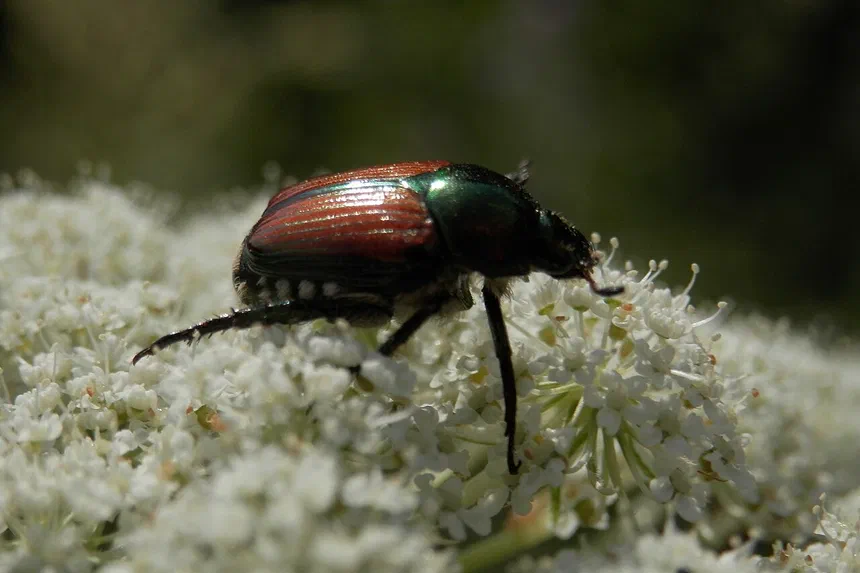
Image: Ryan Hodnett — CC BY-SA 4.0 · source
What Is a Japanese Beetle?
The Japanese beetle (Popillia japonica) is a small, brightly colored scarab beetle best known outside its homeland as a destructive garden and crop pest. Native to Japan, it has become widely established across much of the eastern and central United States and has appeared in parts of Canada and Europe. Its combination of showy metallic coloring and broad appetite makes it one of the most recognizable insect invaders in North America.
Appearance and Identification
Adults are compact, roughly oval beetles about 8 to 11 millimeters long. The head and thorax gleam with a metallic green sheen, while the hardened wing covers (elytra) are a warm coppery bronze. The most reliable identification feature is a row of five small white tufts of hair along each side of the abdomen, plus a pair at the rear tip. These tufts, formed of dense white bristles, distinguish the Japanese beetle from several similar-looking native scarabs. Males and females look much alike, though females tend to be slightly larger.
Habitat and Range
Japanese beetles thrive in temperate areas with moist soils and abundant plant life. Adults are commonly found in gardens, orchards, croplands, lawns, parks, and along woodland edges wherever suitable host plants grow. The larvae, or grubs, live underground in turf and pasture, favoring well-watered grassy soils where they feed on roots. In its native Japan the species is kept in check by natural predators and parasites and is only a minor pest, but in regions where it has been introduced it can reach very high densities.
Diet
This beetle is a broad generalist herbivore. Adults feed on the foliage, flowers, and fruit of several hundred plant species, including roses, grapes, lindens, fruit trees, beans, and many ornamentals. They chew the soft tissue between leaf veins, leaving a distinctive lacy, skeletonized appearance. The white grubs feed below ground on the roots of grasses and other plants, which can brown and thin out lawns and pastures. Because the two life stages attack different parts of plants, the species can cause damage both above and below the soil.
Behavior
Adults are active on warm, sunny days and are strong, if clumsy, fliers. They often gather in large numbers on favored plants, drawn partly by odors released from leaves that other beetles have already damaged. Feeding aggregations can quickly strip foliage. When disturbed, an adult may drop from a plant and fold its legs in a brief defensive posture before flying off. The insects are attracted to a mix of floral and sex-related scent cues, a behavior exploited by commercial pheromone traps.
Life Cycle and Reproduction
Japanese beetles typically complete one generation per year. After mating, females burrow a few centimeters into moist soil and lay eggs in small batches, often returning to the surface to feed before laying again. The eggs hatch into C-shaped white grubs that feed on roots through late summer and autumn. As the soil cools, grubs move deeper to overwinter, then return toward the surface in spring to resume feeding and pupate. New adults emerge in early to mid summer, and the cycle begins again. In cooler climates the larval stage may occasionally stretch across two years.
Conservation Status
The Japanese beetle has not been assessed by the IUCN and is not considered at risk. Across its introduced range it is instead treated as an invasive agricultural and horticultural pest, and it is the target of quarantine, monitoring, and control programs intended to slow its spread rather than to protect it.
Frequently Asked Questions
Are Japanese beetles harmful to people? No. They do not bite or sting and pose no direct threat to humans or pets. Their impact is economic and ecological, through damage to plants and lawns.
Why are they such a problem outside Japan? In introduced regions they lack the specialized predators, parasites, and diseases that limit their numbers at home, so populations can grow far larger and cause more plant damage.
How can gardeners manage them? Common approaches include hand-picking beetles into soapy water, protecting valued plants with netting, encouraging natural enemies, and treating turf for grubs. Scent traps can monitor activity but may draw in more beetles than they catch.