Insects Guide
Ivy Bee
What Is a Ivy Bee? The ivy bee (Colletes hederae) is a solitary, ground-nesting bee named for its close reliance on the flowers of common ivy. It belongs to the plasterer bee family (Colletidae), a group whose females …
At a glance
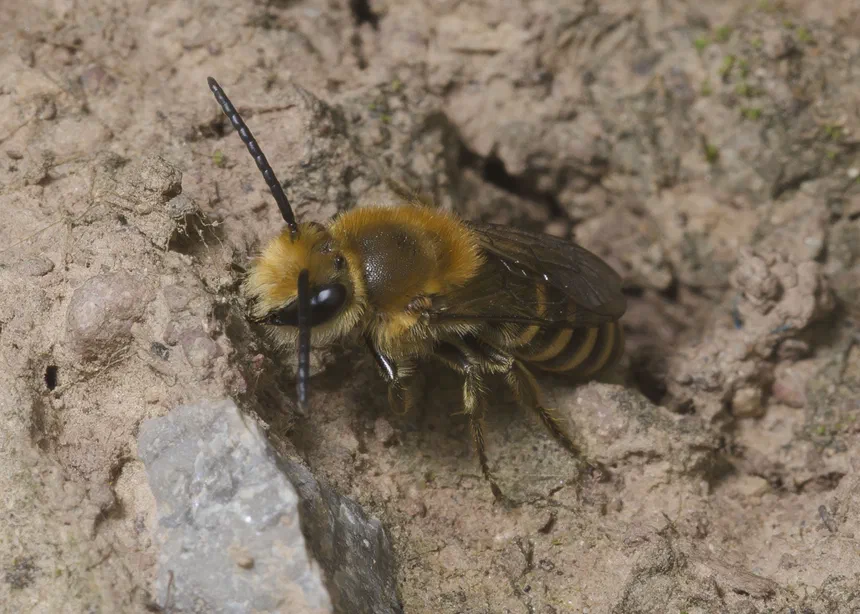
Image: Pjt56 — CC BY-SA 4.0 · source
What Is a Ivy Bee?
The ivy bee (Colletes hederae) is a solitary, ground-nesting bee named for its close reliance on the flowers of common ivy. It belongs to the plasterer bee family (Colletidae), a group whose females waterproof their nest cells with a cellophane-like secretion. First described as a distinct species in 1993, it is one of the latest bees to fly in the year across much of Europe.
Appearance and Identification
The ivy bee is a medium-sized bee, roughly the size of a honey bee. Females are the more striking sex, with a dense coat of ginger to orange hairs covering the thorax and a boldly banded abdomen marked by broad, buff-yellow to amber stripes over a dark background. Males are slimmer and slightly smaller, with similar but less vivid coloring. The clear abdominal banding, combined with the fox-colored thorax and its very late flight season, helps separate the ivy bee from related plasterer bees, though close inspection is often needed for a certain identification.
Habitat and Range
This bee favors warm, sunny, and often sandy or soft-soil sites where females can dig their nest burrows. Typical habitats include south-facing coastal cliffs and dunes, earthen banks, hedgerows, road verges, brownfield land, and suburban gardens, especially where ivy grows nearby. Native to western and central Europe and the Mediterranean, the ivy bee has expanded its range markedly in recent decades. It spread across France and reached southern England around 2001, and has since moved steadily northward through Britain and into parts of northern Europe, a shift often linked to a warming climate and the wide availability of ivy.
Diet
Adults feed on nectar for energy and collect pollen to provision their nests. As its name suggests, the ivy bee is a near-specialist on common ivy (Hedera species), whose flowers open in autumn and offer an abundant late-season food source when most other blooms have faded. This tight timing between the bee’s flight period and ivy’s bloom is a defining feature of the species. When ivy is scarce, ivy bees will also visit other late-flowering plants, but ivy pollen dominates the diet they gather for their young.
Behavior
Ivy bees are solitary, meaning each female builds and provisions her own nest without workers, yet they are often described as gregarious because many females nest close together in loose aggregations. Where conditions are right, thousands of burrows can riddle a single bank or lawn, though each is an independent nest. Males emerge before females and patrol nesting areas in large numbers, sometimes forming a writhing “mating ball” of several males around a single emerging female. Despite these dramatic gatherings, the bees are docile and rarely sting; females possess a sting but are not aggressive toward people.
Life Cycle and Reproduction
The ivy bee has a single generation each year, tightly synchronized with autumn. Adults typically fly from late summer into mid-autumn. After mating, each female excavates a vertical burrow in the soil with several side branches, each ending in a brood cell. She lines the cells with her waterproof secretion, stocks each with a mass of ivy pollen and nectar, lays an egg, and seals it. The larvae feed on these stores, then overwinter underground as resting prepupae. They pupate the following year and emerge as adults the next autumn, completing the cycle. Adults live only a few weeks.
Conservation Status
The ivy bee has not been formally assessed by the IUCN, so it carries no global Red List category. In practice, however, it is currently thriving and expanding rather than declining, benefiting from abundant ivy and warming conditions. It is not considered threatened anywhere in its range. Conserving mature, flowering ivy and leaving areas of bare, undisturbed soil for nesting are the most effective ways to support local populations.
Frequently Asked Questions
Are ivy bees dangerous? No. Ivy bees are gentle and unlikely to sting. Females can sting if handled roughly, but they are not aggressive, and the large male swarms seen at nest sites are stingless.
Why do so many ivy bees appear in one spot? Although each female nests alone, many choose the same warm, sandy bank, forming dense aggregations. Males then gather there to find mates, creating the impression of a busy colony.
When are ivy bees active? They fly late in the year, generally from late summer through mid-autumn, matching the flowering of ivy that gives them their name.