Insects Guide
Isabella Tiger Moth
What Is a Isabella Tiger Moth? The Isabella tiger moth (Pyrrharctia isabella) is a common North American moth in the tiger moth subfamily (Arctiinae). It is best known not for the adult moth but for its larva, the …
At a glance
What Is a Isabella Tiger Moth?
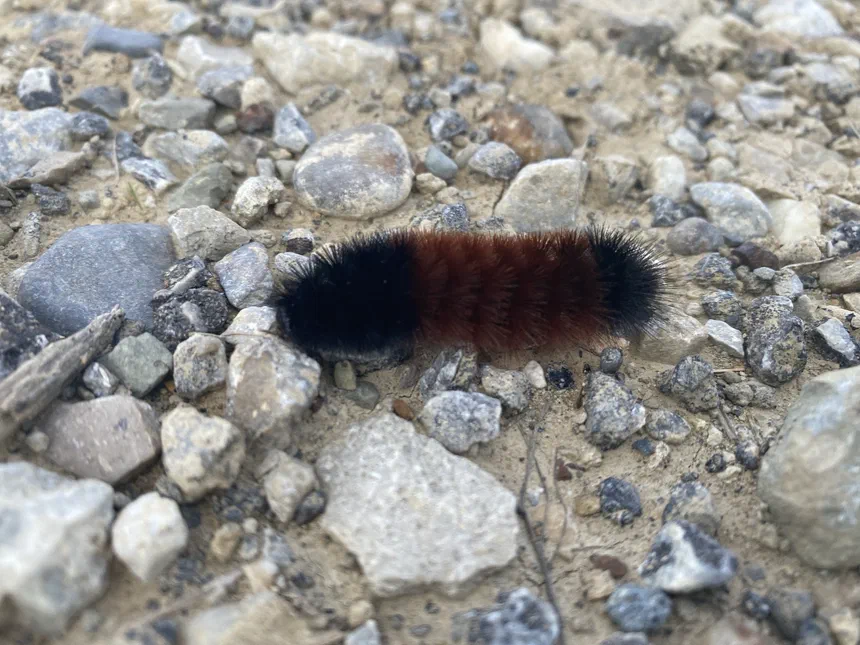
The Isabella tiger moth (Pyrrharctia isabella) is a common North American moth in the tiger moth subfamily (Arctiinae). It is best known not for the adult moth but for its larva, the familiar “woolly bear” or “woolly worm” caterpillar whose banded, bristly appearance is a fixture of autumn folklore.
Appearance and Identification
The adult moth is modest in color, with dull yellow to orange-tan forewings often marked by faint rows of small dark dots, and paler hindwings that may carry a slight pink or orange wash. The body is stout and fuzzy, and the base of the wings and abdomen frequently show orange scaling with black spots. Wingspans generally fall in the range of about 4.5 to 6.5 centimeters. The caterpillar is far more distinctive: a dense coat of stiff bristles (setae) arranged in a black band at each end and a broad rusty-brown or coppery band across the middle. The width of that middle band varies widely from individual to individual, which is the source of the popular but unreliable belief that the caterpillar predicts the coming winter.
Habitat and Range
Pyrrharctia isabella is widespread across much of North America, ranging from southern Canada through the United States and into northern Mexico. It is a generalist that occupies open and edge habitats, including meadows, prairies, gardens, fields, roadsides, forest clearings, and suburban yards. Its tolerance for disturbed and human-altered landscapes helps explain why the woolly bear is such a commonly encountered caterpillar.
Diet
The caterpillar is a broad-spectrum herbivore that feeds on many herbaceous plants and low vegetation. Recorded food plants include dandelion, plantain, clover, grasses, nettles, and a variety of other forbs and low shrubs. This generalist diet allows the species to thrive across diverse habitats. Adult moths have reduced feeding compared to the larval stage and are short-lived, focusing their brief lives on reproduction rather than foraging.
Behavior
The woolly bear is famous for its wandering behavior in autumn, when caterpillars are often seen crossing roads and paths as they search for sheltered spots to overwinter. When disturbed, the caterpillar typically curls into a tight, bristly ball, a defensive posture that protects its softer underside. The larvae are notably cold-hardy: they survive freezing temperatures by producing cryoprotectant compounds that limit ice damage to their tissues. In the far north, larvae may take more than one season to complete development, feeding and freezing across multiple years before finally pupating.
Life Cycle and Reproduction
The species passes through complete metamorphosis: egg, larva (the woolly bear), pupa, and adult. Eggs are laid in clusters on or near host plants. The caterpillar feeds through the warm months and, rather than pupating before winter, overwinters as a larva in leaf litter or other cover. In spring it becomes active again briefly, then spins a fuzzy cocoon incorporating its own bristles and pupates. Adults emerge later in spring or summer, mate, and lay the next generation. Depending on climate, there may be one or two generations per year in warmer regions, while the coldest parts of the range may see a single extended cycle.
Conservation Status
The Isabella tiger moth has not been formally assessed by the IUCN, but it is abundant, broadly distributed, and closely associated with common and disturbed habitats. There is no indication of population decline, and the species is considered secure across its range. As with many insects, its long-term fortunes depend on the general health of pollinator-friendly and pesticide-free landscapes.
Frequently Asked Questions
Can a woolly bear caterpillar really predict the winter? No. The width of the rusty middle band reflects the caterpillar’s age, diet, and moisture conditions during growth, not the severity of the coming winter. The folklore is charming but has no reliable scientific basis.
Is the woolly bear caterpillar dangerous to touch? Its bristles are stiff but not venomous, so it is generally harmless to handle. Some people with sensitive skin may feel mild irritation, so gentle handling is best.
Where do woolly bears go in winter? They shelter under leaf litter, logs, and other cover, surviving the cold as larvae by producing natural antifreeze compounds before resuming activity and pupating in spring.