Insects Guide
Io Moth
What Is a Io Moth? The io moth (Automeris io) is a colorful North American member of the giant silk moth family, Saturniidae. It is best known for the pair of large, staring “eyespots” on its hindwings and for its …
At a glance
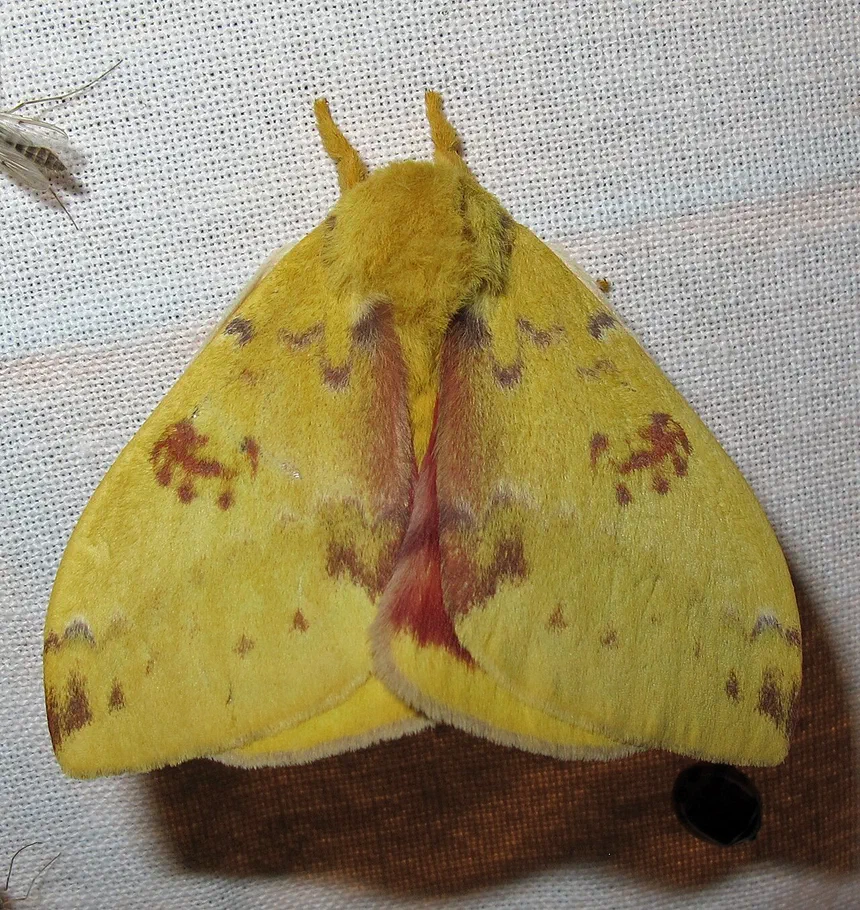
Image: Jacy Lucier — CC BY-SA 4.0 · source
What Is a Io Moth?
The io moth (Automeris io) is a colorful North American member of the giant silk moth family, Saturniidae. It is best known for the pair of large, staring “eyespots” on its hindwings and for its strikingly spiny, venomous caterpillar. Named for a figure in Greek mythology, it is one of the most recognizable saturniid moths in eastern woodlands.
Appearance and Identification
Adult io moths show clear sexual dimorphism. Males typically have bright yellow forewings, while females tend toward a reddish-brown or purplish-brown color. Both sexes share the species’ signature feature: a bold black-and-blue eyespot ringed with lighter scaling on each hindwing, usually hidden until the moth flashes its wings. Wingspan generally ranges from about 2 to 3.5 inches (5 to 9 cm), with females often a little larger and heavier-bodied. Males have broad, feathery (plumose) antennae used to detect female pheromones, while females have thinner antennae. The caterpillar is equally distinctive: green with red-and-white stripes along the sides and covered in clusters of branching, stinging spines.
Habitat and Range
The io moth occupies a wide swath of eastern and central North America, from parts of southern Canada south through the United States and into Mexico. It favors deciduous and mixed woodlands but also turns up along forest edges, in old fields, suburban gardens, and other places where its host plants grow. Because its caterpillars feed on a great many plants, the moth is fairly adaptable and can be locally common where suitable vegetation is abundant.
Diet
Feeding happens almost entirely in the caterpillar stage. Io larvae are generalist herbivores that consume the foliage of a broad list of trees, shrubs, and herbaceous plants, including willow, oak, elm, birch, redbud, hackberry, and many others. Like other giant silk moths, the adult io moth has only vestigial, nonfunctional mouthparts and does not eat at all. Adults survive entirely on energy reserves built up during the caterpillar stage, which is one reason their winged lives are so short.
Behavior
Io moths are mainly nocturnal and are frequently drawn to artificial lights at night. When resting, an adult holds its patterned forewings over the hindwings, concealing the eyespots and blending against bark or leaves. If disturbed, it suddenly pulls the forewings forward to reveal the two large eyespots, a startle display thought to mimic the eyes of a larger animal and deter birds and other predators. The caterpillar relies on a different defense: its many branching spines are connected to venom glands and can deliver a painful, stinging reaction to skin, so the larvae are best admired without handling.
Life Cycle and Reproduction
Like all moths, the io undergoes complete metamorphosis through egg, larva, pupa, and adult stages. Females release pheromones to attract males, which locate them using their feathery antennae, typically at night. After mating, females lay clusters of eggs on host-plant leaves. The caterpillars pass through several molts, growing considerably and often feeding in groups when young before becoming more solitary. When fully grown, a larva spins a papery cocoon, frequently among leaf litter on the ground, and pupates inside. Depending on latitude and climate, the io moth may produce a single generation per year in the north or two or more broods in warmer southern regions, with the pupa overwintering in colder areas.
Conservation Status
The io moth has not been formally assessed by the IUCN and is not considered globally threatened. It remains widespread across its range, though local numbers can fluctuate with habitat quality, pesticide use, artificial lighting, and populations of parasitic wasps and flies. Maintaining native host plants and reducing unnecessary outdoor lighting are simple ways to support this and other native moths.
Frequently Asked Questions
Can an io moth caterpillar sting me? Yes. The caterpillar’s branching spines are venomous and can cause a painful, burning rash if touched, so it is best not to handle them with bare skin.
Do adult io moths eat? No. Adults have reduced, nonfunctional mouthparts and live only about one to two weeks on the energy stored during the caterpillar stage.
What are the big spots on the wings for? The large eyespots on the hindwings are a defensive “startle” display. When threatened, the moth flashes them to imitate the eyes of a larger creature and scare off predators.