Insects Guide
Imperial Moth
What Is a Imperial Moth? The imperial moth (Eacles imperialis) is a large, vividly colored member of the giant silkworm and royal moth family (Saturniidae). Recognized for its yellow wings splashed with pink, orange, and …
At a glance
What Is a Imperial Moth?
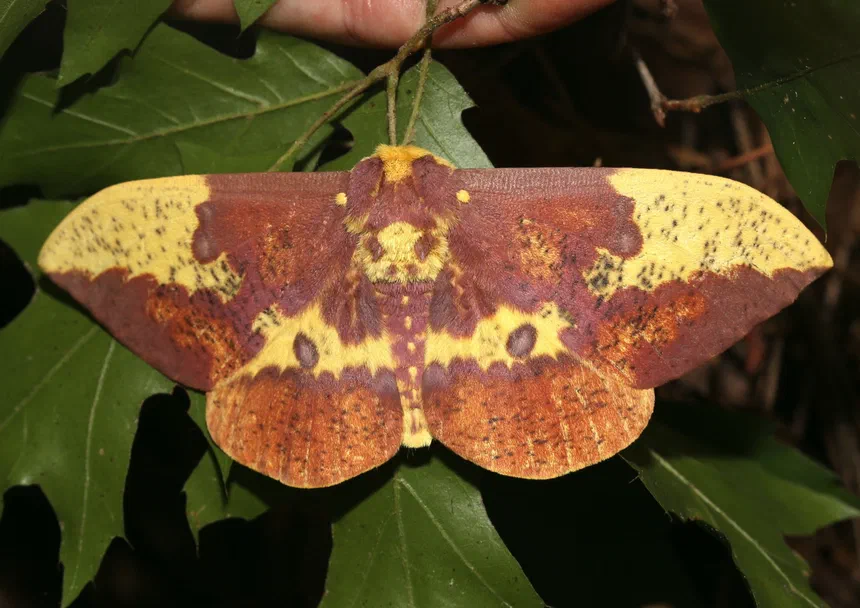
The imperial moth (Eacles imperialis) is a large, vividly colored member of the giant silkworm and royal moth family (Saturniidae). Recognized for its yellow wings splashed with pink, orange, and brown, it is one of the most striking nocturnal insects of North American woodlands.
Appearance and Identification
Adults are unmistakable for their size and coloring. The base wing color is a bright lemon or golden yellow, overlaid with patches and speckles of pinkish purple, rust, and brown, and each wing typically bears a small eyespot-like marking. Wingspans commonly range from about 8 to 17 centimeters (roughly 3 to 7 inches), making this one of the largest moths in its range. Males tend to be smaller and more heavily marked with dark shading, while females are often larger and predominantly yellow. The coloration varies considerably among individuals and across the species’ broad geographic range, and the mottled pattern helps resting moths blend against dead leaves and bark.
Habitat and Range
Imperial moths favor forested habitats, including deciduous and mixed woodlands, pine forests, and wooded suburban areas where suitable host trees grow. The species has an extensive distribution, occurring from southern Canada and the eastern United States southward through Mexico, Central America, and into parts of South America. Populations in the north tend to produce a single generation each year, while warmer southern regions may support more than one brood annually.
Diet
Feeding is confined almost entirely to the caterpillar stage. The larvae are generalist leaf-eaters that consume the foliage of a wide variety of trees, including pine, oak, maple, sweetgum, sassafras, and sycamore. As they grow, the caterpillars can reach lengths of around 8 to 10 centimeters and come in green or brown forms covered with sparse hairs and small tubercles. Adult imperial moths, by contrast, do not feed at all. They lack functional mouthparts and survive entirely on energy reserves stored during the larval stage.
Behavior
Imperial moths are nocturnal and are frequently drawn to artificial lights at night, which is where many people encounter them. During the day, adults rest motionless on tree trunks, foliage, or leaf litter, relying on their camouflaged coloring to avoid predators. Because adults are short-lived and non-feeding, their activity centers almost exclusively on reproduction. The caterpillars are solitary and spend their time feeding and growing high in the canopy before descending to pupate.
Life Cycle and Reproduction
The species undergoes complete metamorphosis through egg, larva, pupa, and adult stages. Females release pheromones to attract males, and after mating they lay eggs singly or in small clusters on the leaves of host trees. The eggs hatch within one to two weeks, and the caterpillars feed through several molts over the summer. Unlike many silk moths, imperial moth larvae do not spin a cocoon; instead, the mature caterpillar burrows into the soil and pupates underground. In northern populations the pupa overwinters, with adults emerging the following summer. Adults live only about a week, just long enough to mate and lay eggs.
Conservation Status
The imperial moth has not been formally assessed by the IUCN and is not considered globally threatened. It remains widespread and locally common across much of its range. However, some regional populations, particularly in the northeastern United States, have declined and become scarce, likely due to habitat loss, light pollution disrupting nocturnal behavior, and the effects of introduced parasitoids used in earlier pest-control efforts. Maintaining native host trees and reducing unnecessary outdoor lighting can help support local populations.
Frequently Asked Questions
Do imperial moths bite or sting? No. Adults are harmless and cannot even feed, and the caterpillars do not sting, though their bristles may look intimidating.
Why do adult imperial moths not eat? They emerge without functional mouthparts and live only long enough to reproduce, relying on fat reserves built up during the caterpillar stage.
Where are you most likely to see one? They are most often spotted at night near outdoor lights during summer in wooded areas of eastern and southern North America.