Insects Guide
Ichneumon Wasp
What Is a Ichneumon Wasp? An ichneumon wasp is any member of family Ichneumonidae, an enormous group of parasitic wasps within the order Hymenoptera. With tens of thousands of described species and likely many more still …
At a glance
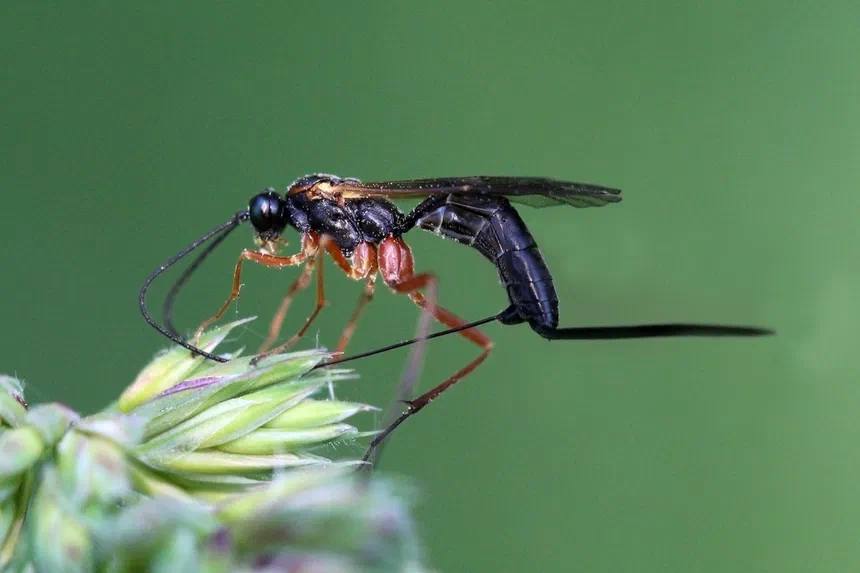
Image: Charles J. Sharp — CC BY-SA 4.0 · source
What Is a Ichneumon Wasp?
An ichneumon wasp is any member of family Ichneumonidae, an enormous group of parasitic wasps within the order Hymenoptera. With tens of thousands of described species and likely many more still unnamed, it ranks among the most diverse animal families on Earth. Nearly all species develop as parasitoids, meaning their larvae feed on and eventually kill other arthropods.
Appearance and Identification
Ichneumon wasps are generally slender, long-bodied insects with a narrow “waist” between the thorax and abdomen typical of many wasps. Body length ranges widely, from roughly 3 millimeters in the smallest species to about 40 millimeters in the largest, not counting the tail-like ovipositor. Coloration varies enormously: many are black, brown, or reddish, and a great number carry bright yellow, orange, or white markings. The antennae are long and threadlike, often with many segments. A distinctive feature of many females is a long, needle-like ovipositor trailing from the tip of the abdomen, which can rival or exceed the body length in some species. Despite its fearsome look, this structure is chiefly an egg-laying tool rather than a defensive stinger, though some species can deliver a mild sting.
Habitat and Range
The family is found on every continent except Antarctica and thrives in an exceptional range of environments. Ichneumon wasps occur in temperate and tropical forests, grasslands, wetlands, gardens, orchards, and agricultural land. Because their survival is tied to the availability of host insects, they tend to be most abundant wherever host populations are plentiful. Species richness is high in temperate regions, an unusual pattern compared with many other insect groups that peak in the tropics.
Diet
Diet differs sharply between life stages. Adult ichneumon wasps feed on sugary liquids such as flower nectar and honeydew produced by aphids, and this feeding makes some species incidental pollinators. The larvae, by contrast, are parasitoids: they consume the tissues of a host arthropod. Hosts are most often the larvae or pupae of butterflies, moths, beetles, sawflies, and flies, though some species attack spiders or other hosts. A parasitoid larva typically feeds in a way that keeps the host alive until late in development, then kills it as the wasp completes its growth.
Behavior
Most ichneumon wasps are solitary and active by day, though some are drawn to lights at night. Females rely on keen senses to locate hidden hosts, detecting chemical cues and even vibrations from larvae boring inside wood or plant stems. Species that target concealed hosts may drill through bark or plant tissue with their long ovipositor to reach the victim. Adults are generally harmless to people; the family is not aggressive and lacks the colonial nest-defending behavior of social wasps.
Life Cycle and Reproduction
Reproduction centers on the female’s search for a suitable host. Once a host is found, she lays one or more eggs on, in, or near it using her ovipositor. The hatching larva feeds on the host, passes through several growth stages, and then pupates, often within a silken cocoon. A new adult emerges to mate and begin the cycle again. Depending on species and climate, ichneumon wasps may produce one or several generations per year, and many overwinter as larvae, pupae, or mated adults. Like other Hymenoptera, they use a haplodiploid system in which unfertilized eggs become males and fertilized eggs become females.
Conservation Status
The family as a whole has not been assessed by the IUCN, and its immense diversity makes broad conclusions difficult. Individual species face pressures from habitat loss, pesticide use, and shifts in host availability, and some researchers have raised concerns about declines in parasitic wasp diversity. Ecologically, ichneumon wasps are valuable natural enemies of many plant-feeding insects and contribute to biological pest control.
Frequently Asked Questions
Do ichneumon wasps sting people? They are not aggressive toward humans. The female’s long ovipositor is used mainly to lay eggs, and while a few species can prick the skin, they pose little threat to people.
Are ichneumon wasps helpful or harmful? They are generally beneficial. By parasitizing caterpillars, beetle grubs, and other insects, they help keep populations of crop and garden pests in check.
Why do some have such long tails? That “tail” is the ovipositor. In species whose hosts hide inside wood or stems, a long ovipositor lets the female reach and lay eggs on prey buried deep out of sight.