Insects Guide
Hummingbird Hawk-Moth
What Is a Hummingbird Hawk-Moth? The hummingbird hawk-moth (Macroglossum stellatarum) is a day-flying moth in the family Sphingidae, named for its uncanny resemblance to a tiny hummingbird as it hovers at flowers. …
At a glance
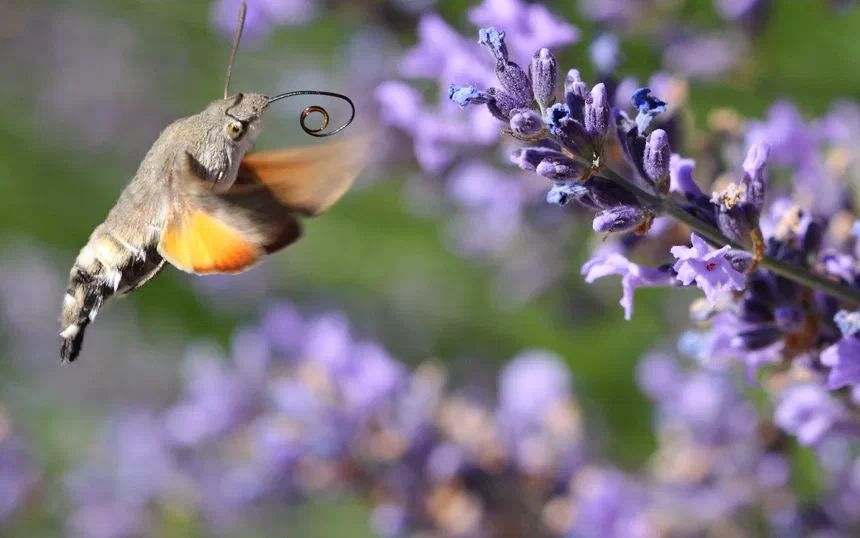
Image: Thorsten Denhard — CC BY-SA 3.0 · source
What Is a Hummingbird Hawk-Moth?
The hummingbird hawk-moth (Macroglossum stellatarum) is a day-flying moth in the family Sphingidae, named for its uncanny resemblance to a tiny hummingbird as it hovers at flowers. Despite being an insect, its whirring wings, darting flight, and long tongue lead many observers to mistake it for a small bird.
Appearance and Identification
This is a stout, compact moth with a wingspan of roughly 40 to 50 millimeters. The forewings are grayish-brown with fine dark lines, while the hindwings are a warm orange that flashes into view during flight. The plump body is grayish and fuzzy, ending in a fan of black-and-white scales that spreads like a tail and helps stabilize the moth as it hovers. A long, coiled proboscis, often as long as the body, uncoils to probe deep into flowers. Large eyes give the moth excellent daytime vision, which it relies on far more than most nocturnal moths.
Habitat and Range
The hummingbird hawk-moth is found across a broad band of the Old World, from Portugal and North Africa eastward through Europe and temperate Asia to Japan. It favors open, flower-rich places: gardens, hedgerows, meadows, coastal scrub, woodland edges, and rocky slopes. The species is a strong migrant. Resident populations in southern Europe and Africa breed year-round, and each summer many individuals move north into Britain, Scandinavia, and other cooler regions, sometimes turning up far from typical breeding areas.
Diet
Adults feed exclusively on flower nectar, which they reach with their long proboscis while hovering rather than landing. They are especially drawn to tubular, sweet-scented blooms such as red valerian, honeysuckle, jasmine, buddleia, phlox, petunia, and lavender. The moths appear to remember productive flower patches and return to them, and they can visit dozens of blossoms in a single feeding bout. Caterpillars are strictly herbivorous, feeding on the leaves of bedstraws (Galium) and closely related plants like wild madder.
Behavior
Unlike most moths, this species is active in daylight and is often seen on warm, sunny afternoons, though it will also fly at dusk and occasionally on overcast days. Its flight is fast, agile, and highly controlled, with rapid wingbeats that produce an audible hum. The moth can hover precisely in front of a flower, dart sideways or backward, and adjust to breezes with remarkable steadiness. It is a keen-sighted insect, using color and shape to locate flowers, and it shows strong site fidelity, returning day after day to the same feeding grounds.
Life Cycle and Reproduction
Females lay tiny, round, greenish eggs singly on or near the leaves of host plants, favoring bedstraws. The caterpillars are green at first, later often turning brownish, with pale side stripes and a small bluish tail horn typical of hawk-moth larvae. After several weeks of feeding, the caterpillar pupates in a loose cocoon at or just below ground level among leaf litter. In warm climates the moth can produce two or more generations a year, and adults may overwinter in sheltered spots such as crevices or outbuildings, emerging on mild days.
Conservation Status
The hummingbird hawk-moth has not been formally assessed on the IUCN Red List, but it is a common and widespread species across much of its range and is not considered threatened. Its numbers fluctuate from year to year with weather and migration patterns, and warming climates appear to be helping it expand and establish farther north. Gardens planted with nectar-rich flowers provide valuable fuel for migrating individuals.
Frequently Asked Questions
Is a hummingbird hawk-moth a bird? No. It is an insect, a moth in the hawk-moth family. Its hovering flight and long tongue simply make it look and behave like a hummingbird.
Does it sting or bite? No. The hummingbird hawk-moth is harmless. It has no sting, and its only mouthpart is a soft, coiled proboscis used to sip nectar.
Where might I see one? Watch sunny, flower-filled gardens and meadows in summer, especially around lavender, valerian, and buddleia, across Europe, North Africa, and temperate Asia.