Insects Guide
Horsefly
What Is a Horsefly? Horseflies are stout, fast-flying biting flies in the family Tabanidae, with the true horseflies placed largely in the genus Tabanus. They are best known for the painful bite delivered by females, …
At a glance
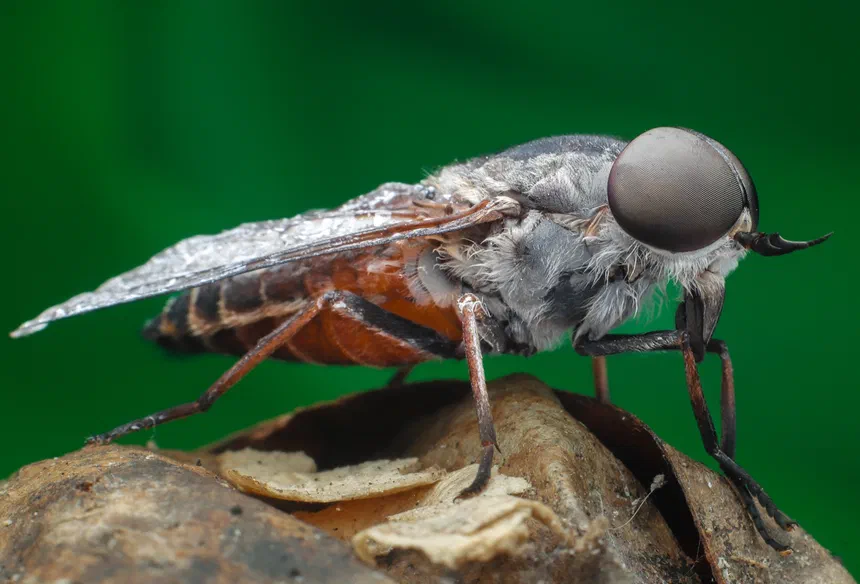
Image: Kramthenik27 — CC BY-SA 4.0 · source
What Is a Horsefly?
Horseflies are stout, fast-flying biting flies in the family Tabanidae, with the true horseflies placed largely in the genus Tabanus. They are best known for the painful bite delivered by females, which need a blood meal to develop their eggs. With hundreds of species distributed across most of the world, horseflies are a familiar and unwelcome presence around livestock, wildlife, and people during warm weather.
Appearance and Identification
Horseflies are medium to large flies, with most species measuring roughly 0.4 to 1 inch (10 to 25 mm) in body length. They have robust, somewhat flattened bodies colored in shades of gray, brown, or black, sometimes with pale stripes or patterned abdomens. Their most striking feature is a pair of very large compound eyes that in life often shimmer with brilliant green, gold, or purple iridescence; in females the eyes are separated, while in males they meet at the top of the head. The wings are usually clear or lightly smoked, and the mouthparts of the female form short, blade-like structures used to slice skin.
Habitat and Range
Members of the genus are found on every continent except Antarctica and are absent only from the harshest polar zones and a few isolated islands. They favor warm, humid environments and are most abundant near the water and damp soils their larvae require. Typical habitats include meadows, pastures, marshes, streamsides, woodland clearings, and the edges of ponds and lakes. Adults are strong fliers and can range widely in search of hosts, which brings them into contact with grazing animals and outdoor recreationists.
Diet
Diet differs sharply between the sexes. Male horseflies feed exclusively on nectar and other plant sugars and do not bite. Females also visit flowers, but most species require a blood meal to mature their eggs. Using their cutting mouthparts, a female slashes the skin of a mammal, such as a horse, cow, deer, or human, and laps up the pooling blood. Larvae are predatory or scavenging, feeding on small invertebrates, organic matter, and other soft-bodied prey in wet soil or shallow water.
Behavior
Horseflies are daytime insects that are most active in warm, sunny, and still conditions, often peaking in the heat of summer. They are powerful, agile fliers and are notoriously persistent once they lock onto a host, circling repeatedly and returning after being brushed away. Their bites are painful because the mouthparts tear rather than pierce cleanly, and biting females are attracted to movement, warmth, dark colors, and exhaled carbon dioxide. Away from hosts, adults rest on vegetation and warm surfaces.
Life Cycle and Reproduction
Horseflies undergo complete metamorphosis, passing through egg, larva, pupa, and adult stages. After feeding, a female lays a mass of several hundred eggs, typically on plants or other surfaces overhanging moist ground or water. The hatching larvae drop into wet soil or mud, where they develop through several stages over months, feeding on small organisms. When mature, the larva moves to drier soil to pupate. The adult emerges to breed, and the full cycle commonly takes about a year, though in cool climates larvae may take longer to develop.
Conservation Status
The vast majority of horsefly species have not been formally assessed by the IUCN, and as a group they are widespread and abundant rather than threatened. Because their larvae depend on wetlands and moist soils, local populations can be affected by drainage, pollution, and habitat loss, but no broad conservation concern applies to the genus. In agricultural settings they are more often regarded as pests of livestock, since heavy biting can stress animals and reduce productivity.
Frequently Asked Questions
Why do horsefly bites hurt so much? Female horseflies cut the skin with blade-like mouthparts rather than making a clean puncture, and their saliva contains anticoagulants, so the wound bleeds freely and can sting, swell, and itch.
Do all horseflies bite? No. Only females bite, and they do so mainly to obtain the blood needed to produce eggs. Males feed solely on nectar and plant juices.
Where do horseflies breed? Females lay eggs near water or damp ground, and the larvae develop in wet soil, mud, marshes, or the shallow margins of ponds and streams.