Insects Guide
Hercules Beetle
What Is a Hercules Beetle? The Hercules beetle (Dynastes hercules) is one of the largest flying insects on Earth and a member of the rhinoceros beetle group within the scarab family. Named for its extraordinary strength, …
At a glance
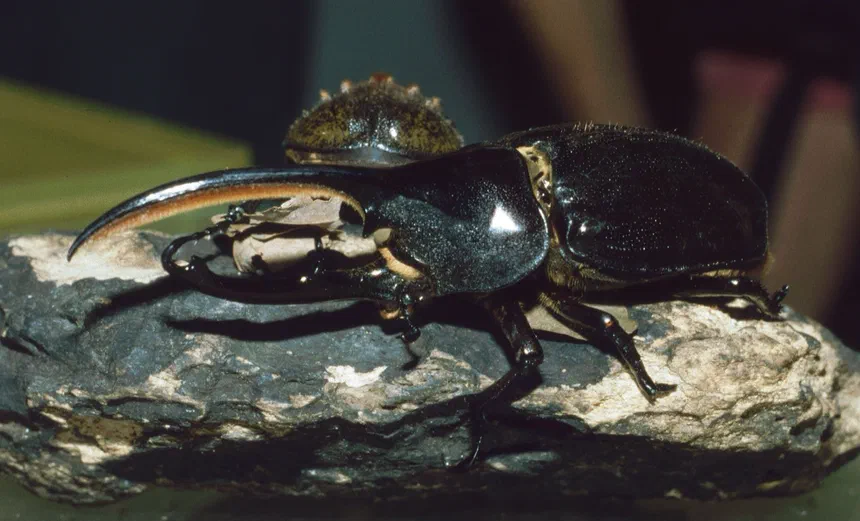
Image: Franz Xaver — CC BY-SA 3.0 · source
What Is a Hercules Beetle?
The Hercules beetle (Dynastes hercules) is one of the largest flying insects on Earth and a member of the rhinoceros beetle group within the scarab family. Named for its extraordinary strength, this Neotropical giant is best known for the pair of enormous horns carried by the males. It is a familiar and celebrated species among naturalists, collectors, and hobbyist breeders around the world.
Appearance and Identification
The Hercules beetle is unmistakable for its size and the striking pair of horns on the males. One long horn projects forward from the thorax while a smaller, upward-curving horn extends from the head, and the two work together like a pincer. Including these horns, large males can measure up to about 17 centimeters, making the species one of the longest beetles in existence, though the body alone is considerably shorter. Females are hornless and generally smaller, with a more rounded, uniformly dark and often bristly body.
The hardened forewings, or elytra, are typically olive-green to yellowish-tan, marked with scattered black spots, while the head, legs, and horns are glossy black. A distinctive feature is that the elytra can shift in color depending on humidity, appearing yellowish when conditions are dry and darkening toward black when the surrounding air is damp. The legs are long and tipped with strong claws suited to gripping bark.
Habitat and Range
Hercules beetles inhabit the tropical and subtropical rainforests of Central America and northern South America, ranging through countries such as Panama, Colombia, Ecuador, Venezuela, Bolivia, and Brazil, with some populations reaching lowland and lower montane forests. Several recognized subspecies occur across this broad range, differing subtly in size, horn shape, and coloration. The beetles depend on forests with abundant rotting wood and fallen fruit, which provide food for both larvae and adults.
Diet
The species is a herbivore, and its diet shifts across its life stages. Adults feed largely on ripe and rotting fruit and on the sugary sap that seeps from trees, drawing the nutrients they need to sustain flight and reproduction. The larvae are decomposers of a sort, tunneling through and consuming decaying logs and rich rotting wood, which supports the substantial growth needed to reach their impressive adult size.
Behavior
Despite their fearsome appearance, Hercules beetles are harmless to people, and their horns are used for contests rather than defense. Rival males wrestle over access to females and feeding sites, using their horns to grip, lift, and pry opponents off branches. The species is famous for its relative strength, capable of moving loads many times its own body weight. Adults are mostly active at night and are capable, if somewhat noisy, fliers. During the day they tend to shelter among leaf litter or under bark.
Life Cycle and Reproduction
Like other beetles, the Hercules beetle undergoes complete metamorphosis through egg, larva, pupa, and adult stages. After mating, the female lays eggs in or near decaying wood. The larvae, pale grub-like creatures that can grow remarkably large and heavy, spend the majority of the animal’s life feeding and developing, a stage that may last a year or more. When fully grown, the larva forms a pupal chamber in which it transforms into an adult. The adult stage is comparatively brief, often lasting only a few months, during which the beetles focus on feeding and reproduction.
Conservation Status
The Hercules beetle has not been formally assessed by the IUCN, so it carries no official conservation ranking. It remains widespread across its range and is commonly bred in captivity for the insect-keeping hobby. Even so, ongoing loss of tropical forest and the collection of large males for trade are pressures worth watching, since the species relies on healthy forests with plentiful dead wood.
Frequently Asked Questions
How strong is a Hercules beetle? Hercules beetles are among the strongest animals relative to their size, and adults can push and carry loads many times their own body weight. Their real-world lifting ability is often exaggerated, but it is still remarkable.
Do only males have horns? Yes. The long thoracic and head horns belong to the males, which use them in wrestling matches with rivals. Females are hornless and have a smoother, rounded body.
Why do the wing covers change color? The elytra respond to humidity, appearing yellow-green in dry conditions and darkening when the air is moist. The effect comes from the microscopic structure of the shell rather than a pigment change.