Insects Guide
Harlequin Beetle
What Is a Harlequin Beetle? The harlequin beetle (Acrocinus longimanus) is a large, strikingly patterned longhorn beetle of the family Cerambycidae, native to the tropical forests of the Americas. It is best known for …
At a glance
What Is a Harlequin Beetle?
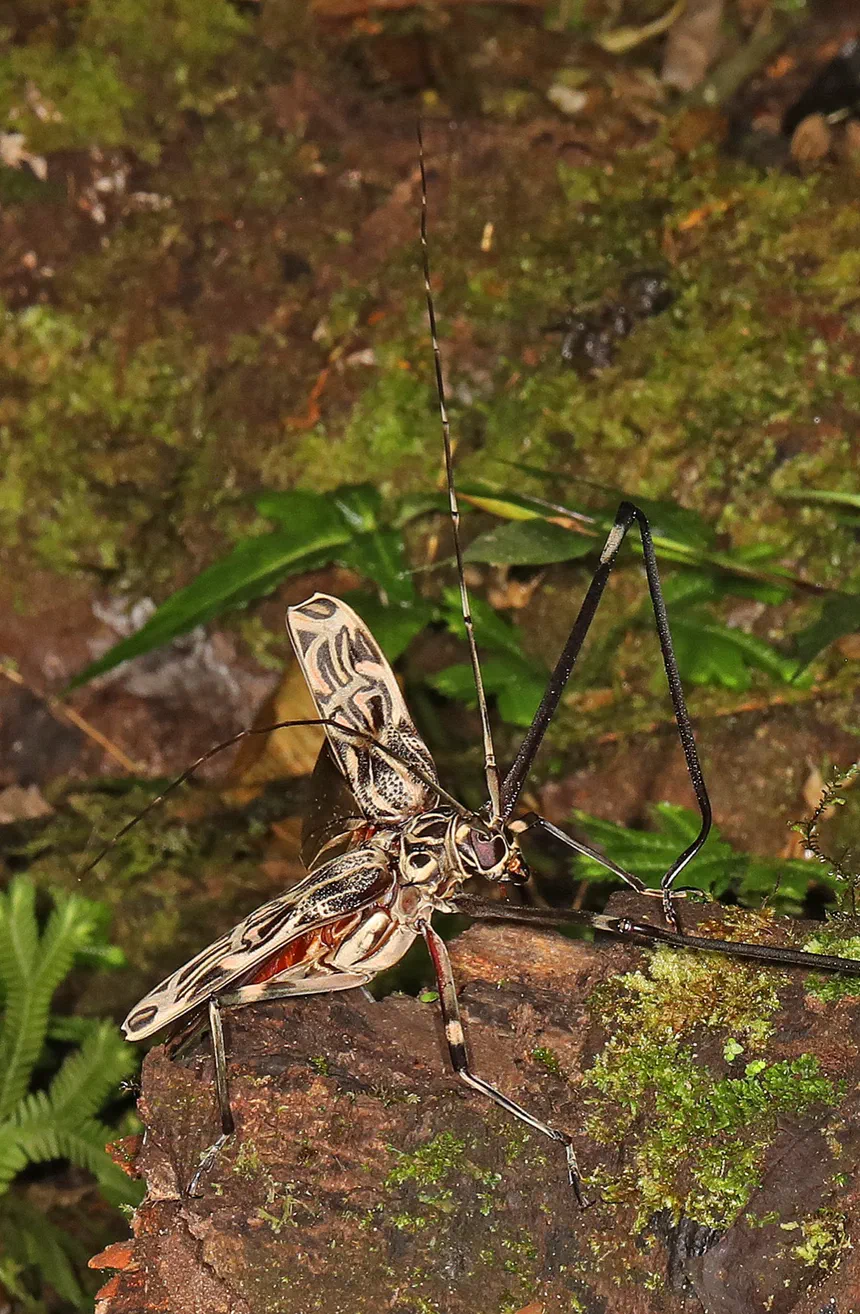
The harlequin beetle (Acrocinus longimanus) is a large, strikingly patterned longhorn beetle of the family Cerambycidae, native to the tropical forests of the Americas. It is best known for its intricately marbled wing covers and, in males, for extraordinarily long front legs that can stretch beyond the length of the entire body.
Appearance and Identification
The harlequin beetle is instantly recognizable for its bold, camouflage-like coloration. Its hardened forewings, called elytra, carry a swirling mosaic of black, brick-red, orange, and greenish-yellow markings that resemble lichen-covered bark. Adults typically measure about 3 to 7.5 centimeters in body length, making this one of the larger beetles in its range. Like other longhorn beetles, it bears very long, backward-sweeping antennae.
The most remarkable feature is the front pair of legs. In males these forelegs are enormously elongated and often exceed the length of the body itself, while in females they are much shorter. These oversized limbs are used in courtship, in contests between rival males, and to help the beetle grip and move across broad tree trunks.
Habitat and Range
This species inhabits warm, humid lowland forests. Its distribution stretches from southern Mexico southward through Central America and into much of tropical South America, reaching countries such as Colombia, Ecuador, Peru, Brazil, and the Guianas. Harlequin beetles are closely tied to standing dead and dying trees, especially fig trees and other broad-trunked species, where both adults and larvae depend on decaying wood.
Diet
Harlequin beetles are herbivorous. Adults feed largely on the sap that seeps from wounds in tree bark, particularly from fig and related trees. The larvae are wood-borers: after hatching, they tunnel into rotting or freshly dead wood, feeding on the fibers as they grow. By breaking down dead timber, the larvae play a modest role in nutrient recycling within the forest.
Behavior
Adults are most active in the warmer parts of the day and are strong, if somewhat clumsy, fliers. Their mottled coloring provides excellent camouflage against lichen- and moss-covered bark, helping them avoid predators such as birds while they rest in plain sight. Males use their long forelegs both to impress females and to wrestle competitors away from prime sites on a tree trunk.
The harlequin beetle also has a well-documented partnership with tiny pseudoscorpions. These arachnids ride beneath the beetle’s wing covers, a behavior called phoresy, using the flying adult as free transport between suitable dead trees where the pseudoscorpions can hunt and breed.
Life Cycle and Reproduction
Reproduction centers on suitable dead or dying host trees. After mating, the female uses her mouthparts to chew small pits in the bark and lays her eggs in these crevices. The emerging larvae bore inward and spend the majority of the beetle’s life feeding within the wood, a stage that can last many months. When fully grown, a larva forms a chamber in the wood and pupates there before emerging as an adult. Adults are relatively short-lived compared with the long larval period, and total lifespan is commonly around one to two years.
Conservation Status
The harlequin beetle has not been formally assessed by the IUCN, and it remains reasonably widespread across its extensive tropical range. It is sometimes collected for the insect trade because of its dramatic appearance, but the main long-term concern for the species is the loss and fragmentation of rainforest habitat and the removal of the dead and dying trees on which its larvae depend.
Frequently Asked Questions
Why do male harlequin beetles have such long front legs? The elongated forelegs are used in courtship displays and in trials of strength with rival males, and they also help the beetle grip and traverse wide tree trunks.
Are harlequin beetles dangerous to people? No. They do not sting and are not venomous. A large individual can deliver a firm pinch with its jaws if handled roughly, but the species poses no real threat to humans.
What do harlequin beetles eat? Adults feed mainly on tree sap, while the larvae bore into and consume decaying wood inside dead or dying trees.