Insects Guide
Green Lacewing
What Is a Green Lacewing? The green lacewing (Chrysoperla carnea) is a delicate, soft-bodied insect in the order Neuroptera, easily recognized by its slender green body and large, transparent, net-veined wings. It is one …
At a glance
What Is a Green Lacewing?
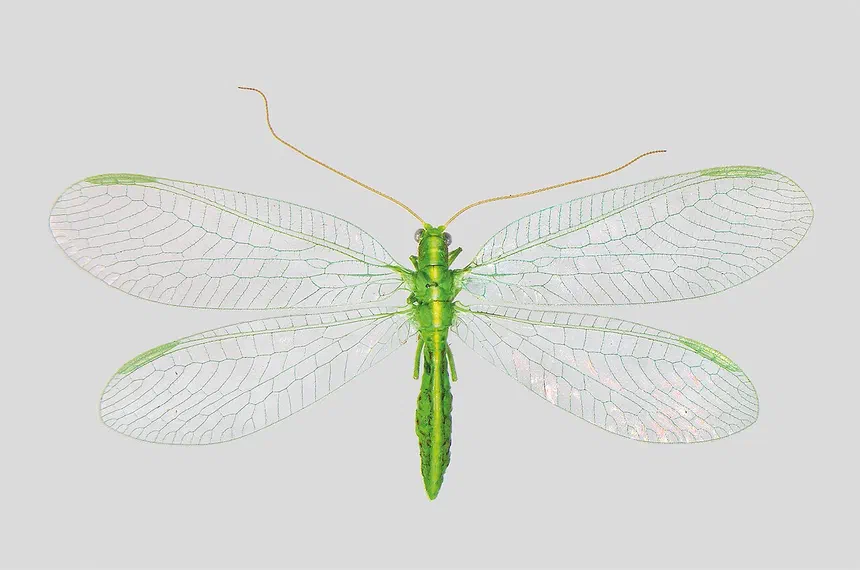
The green lacewing (Chrysoperla carnea) is a delicate, soft-bodied insect in the order Neuroptera, easily recognized by its slender green body and large, transparent, net-veined wings. It is one of the most familiar and beneficial insects in gardens and farmland, where its larvae devour large numbers of plant-feeding pests. The name “lacewing” comes from the intricate, lace-like pattern of veins that runs through each of its four wings.
Appearance and Identification
Adult green lacewings have a slim, pale-to-bright-green body typically measuring about 10 to 15 millimeters long. Their two pairs of membranous wings are longer than the body and are held tent-like over the abdomen when at rest. The wings are clear with a fine mesh of green veins and often catch light with a faint golden or coppery iridescence, which gives some populations the nickname “golden-eyed lacewing” for their shining, metallic-looking eyes. The antennae are long and threadlike. In cooler months, adults of Chrysoperla carnea may turn a reddish-brown or tan color as they prepare to overwinter, then return to green in spring.
Habitat and Range
Green lacewings are found across a wide range of temperate and subtropical environments. They thrive in gardens, hedgerows, meadows, orchards, agricultural fields, and the edges of woodlands, essentially anywhere with abundant vegetation and a supply of soft-bodied prey. The Chrysoperla carnea group is distributed broadly across Europe, temperate Asia, and North America, and members of the wider green lacewing family occur on nearly every continent except Antarctica. Adults are often drawn to lights at night and may enter buildings, especially in autumn when seeking sheltered overwintering sites.
Diet
There is a clear split in diet between the larvae and the adults. The larvae are voracious predators, feeding on aphids, mealybugs, small caterpillars, mites, thrips, whiteflies, insect eggs, and other soft-bodied invertebrates. This appetite has earned the larvae the common nickname “aphid lions.” Adults of Chrysoperla carnea are largely non-predatory and feed instead on nectar, pollen, and honeydew, the sugary secretion left behind by aphids. This mixed feeding strategy makes the species valuable in pest control, since the reproductive adults seek out aphid-rich plants where their offspring will find plenty of food.
Behavior
Green lacewings are mainly active at dusk and after dark. Their fluttering, somewhat weak flight carries them between plants as they search for food and mates. To attract partners, males and females produce low-frequency vibrations by shaking their abdomens against the surface they are standing on, creating species-specific “songs” that travel through leaves and stems rather than through the air. This substrate-borne courtship signaling is an important way that closely related lacewing species keep from interbreeding. When disturbed, some lacewings release a mild, unpleasant odor as a defense. During cold weather, adults enter a dormant state and shelter in leaf litter, bark crevices, or sometimes indoors.
Life Cycle and Reproduction
Green lacewings undergo complete metamorphosis, passing through egg, larva, pupa, and adult stages. Females lay their eggs in a distinctive way: each egg sits atop a slender, hair-like silken stalk attached to a leaf or stem, which helps protect the eggs from predators and from newly hatched, cannibalistic siblings. After hatching, the larvae feed intensively for one to several weeks, molting a few times as they grow. Some larvae camouflage themselves by piling debris and the drained bodies of their prey onto their backs. When mature, a larva spins a small, round silken cocoon in which it pupates. Depending on temperature and region, green lacewings may complete several generations in a single year, with the final generation of the season overwintering as adults.
Conservation Status
The green lacewing has not been formally assessed by the IUCN, and it is not considered threatened. It remains common and widespread throughout its range. Because its larvae are such effective natural predators, the species is commercially reared and released as a biological control agent in greenhouses, gardens, and crop fields, offering an environmentally friendly alternative to chemical pesticides.
Frequently Asked Questions
Are green lacewings harmful to humans? No. Green lacewings do not sting, and while a larva may occasionally deliver a tiny, harmless nip if handled, adults are gentle and pose no threat to people, pets, or plants.
Why are green lacewings good for gardens? Their larvae eat enormous numbers of aphids, mites, and other soft-bodied pests, making the species a natural and chemical-free form of pest control that many gardeners actively encourage.
Why do their eggs sit on tiny stalks? The silk stalks lift the eggs above the leaf surface, helping shield them from ants, other predators, and even from the first-hatched larvae, which will readily eat unhatched eggs nearby.