Insects Guide
Goliath Beetle
What Is a Goliath Beetle? The Goliath beetle (Goliathus goliatus) is one of the largest and heaviest insects on Earth, a member of the scarab family (Scarabaeidae). Native to the tropical forests of Africa, it is prized …
At a glance
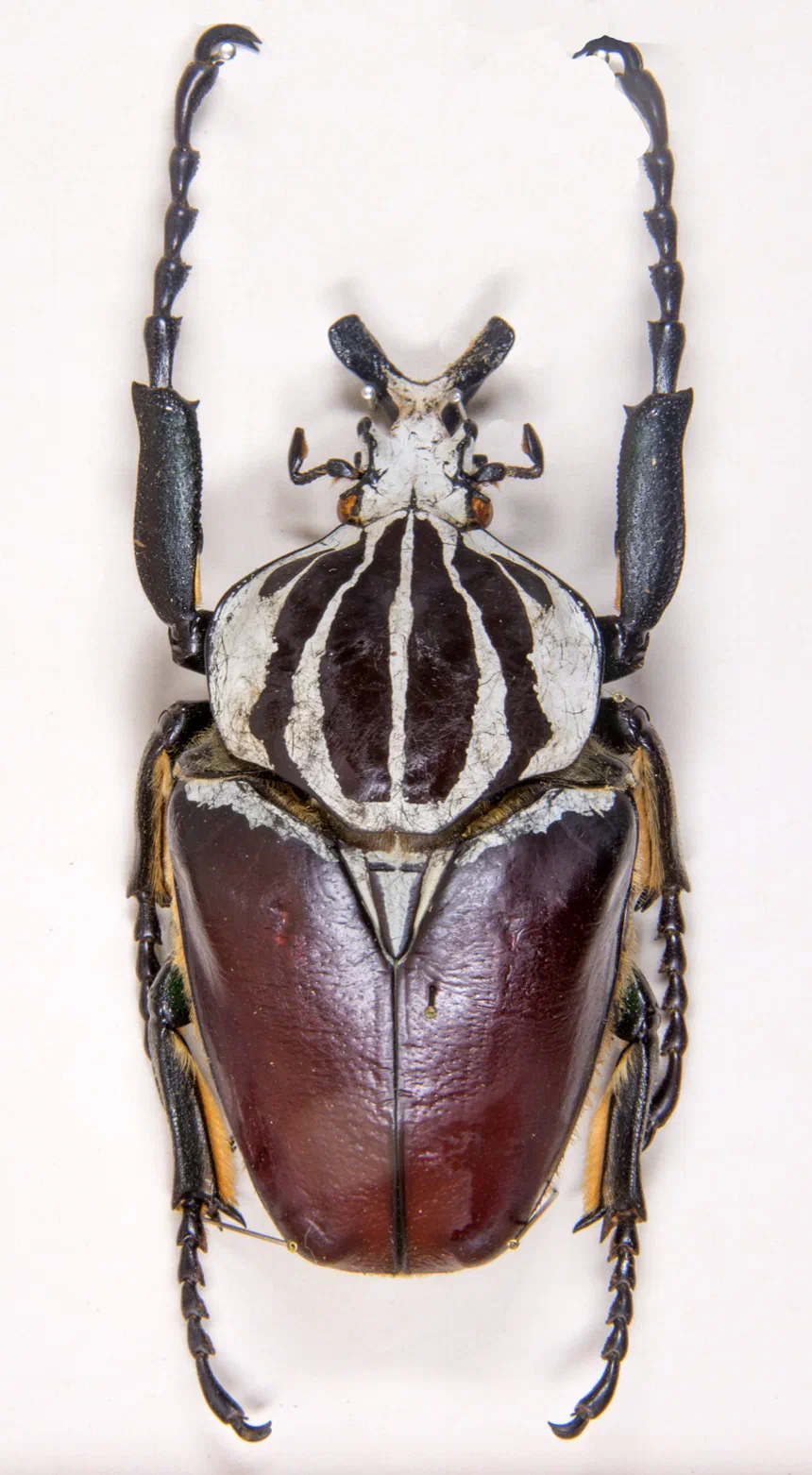
Image: Hannes Grobe — CC BY-SA 4.0 · source
What Is a Goliath Beetle?
The Goliath beetle (Goliathus goliatus) is one of the largest and heaviest insects on Earth, a member of the scarab family (Scarabaeidae). Native to the tropical forests of Africa, it is prized by collectors and hobbyists for its impressive bulk and bold coloration.
Appearance and Identification
Goliath beetles are unmistakable for their sheer size. Adults typically measure roughly 60 to 110 millimeters in length, with the largest specimens ranking among the bulkiest beetles known. Goliathus goliatus usually shows a rich reddish-brown to chestnut coloring on the wing covers, while the pronotum (the shield behind the head) often carries striking black-and-white striping. The body is broad, glossy, and heavily armored. Males are generally larger than females and bear a distinctive Y-shaped horn on the head, used for wrestling rivals; females lack the horn and instead have a wedge-shaped head that helps them burrow into soil to lay eggs. The legs end in strong, hooked claws that grip bark securely.
Habitat and Range
This species inhabits the warm, humid forests and woodlands of equatorial and West-Central Africa, including regions of the Congo Basin and surrounding countries. It favors tropical and subtropical environments where trees produce the sap and ripe fruit that adults feed on. Goliath beetles are most active during the warmer, wetter parts of the year, when food and breeding conditions are best.
Diet
Adult Goliath beetles are herbivores with a strong preference for sugary, high-energy foods. In the wild they feed largely on tree sap, especially the flowing juices of certain trees, as well as overripe fruit and occasionally pollen. In captivity they are often maintained on fruit and specially formulated protein or sugar jellies. The larvae, by contrast, are voracious feeders that consume large amounts of decaying plant material and require substantial protein to fuel their rapid growth.
Behavior
Despite their intimidating size, Goliath beetles are not aggressive toward people. Adults are capable fliers, and their wings produce a loud, helicopter-like buzz in flight. Males compete for access to females and feeding sites, using their horned heads to shove and pry at rivals rather than inflict serious harm. Much of an adult’s time is spent seeking food and mates during the active season. The larvae live hidden below ground, tunneling through soil and rotting vegetation.
Life Cycle and Reproduction
Like all beetles, Goliathus undergoes complete metamorphosis, passing through egg, larva, pupa, and adult stages. After mating, the female burrows into the soil to deposit her eggs. The larvae that hatch are enormous, growing over several months and reaching weights that can exceed those of the adult beetle, making them among the heaviest insect larvae in the world. When fully grown, a larva constructs a hard cocoon-like cell in the soil and pupates within it. The adult emerges to feed, mate, and reproduce. The larval stage generally lasts the longest, while adults typically live for only several months.
Conservation Status
The Goliath beetle has not been formally assessed by the IUCN, so it carries no official conservation ranking. It is not currently considered globally threatened, though like many forest insects it depends on healthy tropical woodland. Habitat loss from deforestation and collection pressure are potential local concerns, but the species remains widespread across its African range.
Frequently Asked Questions
How big do Goliath beetles get? Adults commonly reach 60 to 110 millimeters in length, and heavy specimens are among the bulkiest insects in the world.
Are Goliath beetles dangerous to humans? No. They do not sting and are not aggressive. Their claws can grip firmly, but they pose no real threat to people.
What do Goliath beetles eat? Adults feed mainly on tree sap, ripe fruit, and pollen, while their large larvae consume decaying plant matter and need plenty of protein to grow.