Insects Guide
Giant Water Bug
What Is a Giant Water Bug? The giant water bug (Lethocerus americanus) is one of the largest true bugs in North America, a formidable aquatic predator found in freshwater ponds and wetlands. Belonging to the family …
At a glance
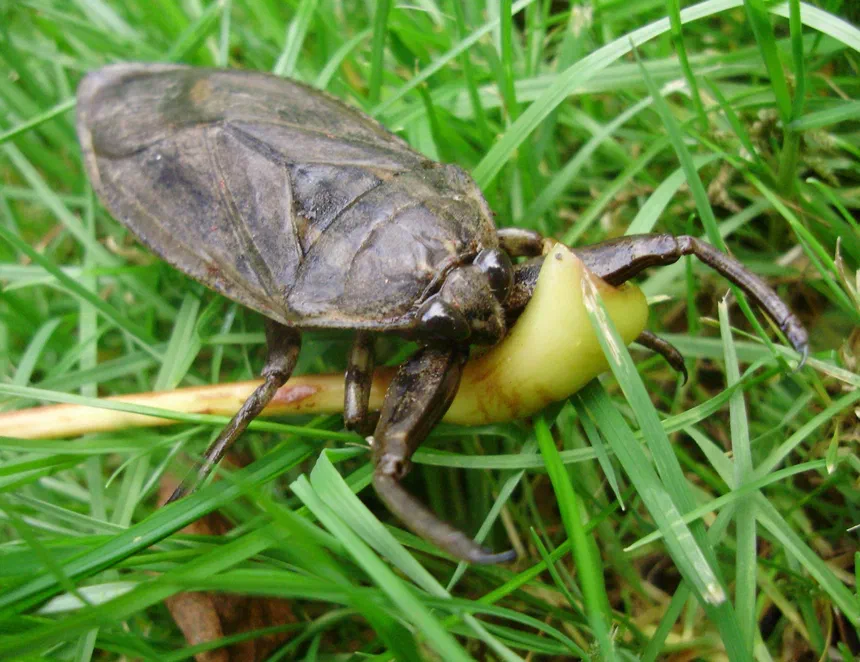
Image: The High Fin Sperm Whale — CC BY-SA 3.0 · source
What Is a Giant Water Bug?
The giant water bug (Lethocerus americanus) is one of the largest true bugs in North America, a formidable aquatic predator found in freshwater ponds and wetlands. Belonging to the family Belostomatidae, it is sometimes called a “toe-biter” or “electric-light bug” for its habit of flying to lights at night. Despite its intimidating size and painful bite, it plays a valuable role in freshwater food webs.
Appearance and Identification
This insect has a broad, flattened, oval body colored in mottled shades of brown to grayish, a pattern that blends well against mud, leaf litter, and submerged vegetation. Adults typically measure about 1.5 to 2.5 inches (40 to 65 mm) in length. The front legs are enlarged and hooked, forming powerful raptorial pincers used to seize prey, while the middle and hind legs are flattened and fringed with hairs that aid swimming. At the rear of the abdomen is a short, retractable breathing appendage that functions like a snorkel, allowing the bug to draw air from the surface. Prominent dark compound eyes sit on either side of the head, and a short piercing beak folds beneath the body when not in use.
Habitat and Range
Giant water bugs live in still or slow-moving freshwater, including ponds, marshes, roadside ditches, and the quiet margins of streams and lakes. They favor waters with abundant aquatic plants, which provide both cover and hunting grounds. Lethocerus americanus ranges across much of Canada and the northern United States, and adults readily disperse by flight, which lets them colonize new ponds and occasionally turn up far from water near outdoor lights.
Diet
As an ambush predator, the giant water bug feeds on a wide range of aquatic animals. Its diet includes insects, tadpoles, small fish, snails, and other invertebrates, and large individuals can tackle prey considerably bigger than themselves. The bug grips victims with its clawed forelegs, then injects saliva containing digestive enzymes through its beak. These enzymes liquefy the prey’s internal tissues, which the bug then sucks out, leaving little more than an empty husk.
Behavior
Giant water bugs spend most of their time lurking motionless among plants or debris, waiting for prey to pass within striking range. They breathe by extending the tail-tip air tube to the surface or by trapping a film of air beneath their wings. When threatened, they may play dead or deliver a genuinely painful bite, the source of the “toe-biter” nickname; the bite is defensive rather than venomous to humans and causes no lasting harm. On warm nights, adults leave the water and fly, often drawn to artificial lights, which is how many people first encounter them.
Life Cycle and Reproduction
Reproduction in Lethocerus americanus involves notable parental care. After mating, the female lays her eggs on emergent vegetation, cattail stems, or other supports above the waterline. The male often guards the eggs, periodically climbing up to wet or brood them and shielding them from drying out and from predators until they hatch. The young emerge as nymphs that resemble small, wingless adults and grow through a series of molts, gradually developing wings and reaching full size. Most individuals complete their development within a single year.
Conservation Status
The giant water bug has not been formally assessed by the IUCN and is not considered threatened. It remains widespread and locally common across its range. Like many freshwater insects, however, it depends on clean, well-vegetated wetlands, so habitat loss, pollution, and drainage of ponds and marshes can reduce local populations. Healthy giant water bug numbers are often a sign of a productive, well-balanced aquatic ecosystem.
Frequently Asked Questions
Is a giant water bug’s bite dangerous? Its bite is painful but not medically serious for most people. The insect uses it defensively, and there is no venom that poses a lasting threat to humans.
Why is it called an “electric-light bug”? Adults fly at night and are strongly attracted to artificial lights, so they frequently show up around porch lights, streetlamps, and other illuminated areas far from water.
What do giant water bugs eat? They are carnivores that ambush insects, tadpoles, small fish, snails, and other small aquatic animals, subduing them with hooked forelegs and digesting them with injected saliva.