Insects Guide
Giant Swallowtail
What Is a Giant Swallowtail? The giant swallowtail (Papilio cresphontes) is a large, striking butterfly and one of the biggest butterflies found in North America. It belongs to the swallowtail family (Papilionidae) and …
At a glance
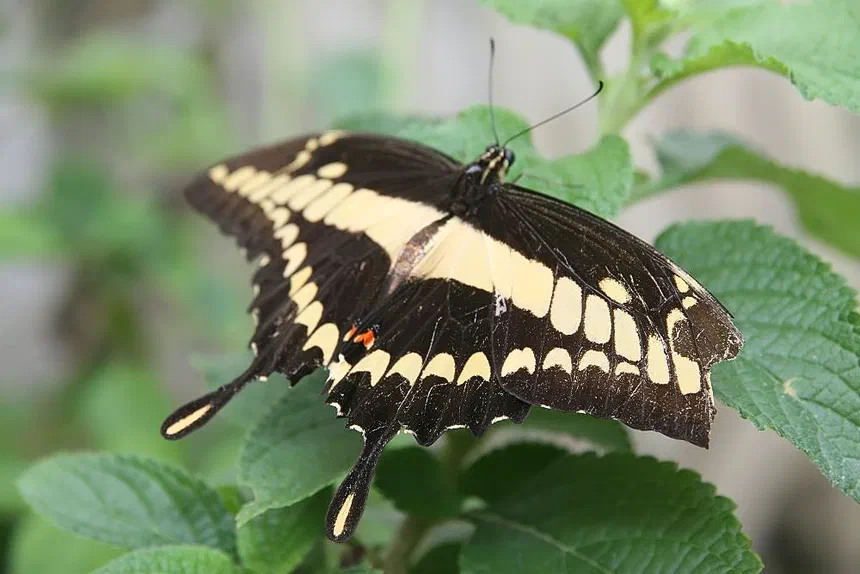
Image: David J. Stang — CC BY-SA 4.0 · source
What Is a Giant Swallowtail?
The giant swallowtail (Papilio cresphontes) is a large, striking butterfly and one of the biggest butterflies found in North America. It belongs to the swallowtail family (Papilionidae) and is well known both for its bold coloring and for its citrus-eating caterpillars.
Appearance and Identification
Adults are unmistakable thanks to their size and pattern. The upper wing surface is dark brown to nearly black, crossed by a broad diagonal band of yellow spots that meets a second horizontal row along the wing edges, forming a rough “X” when the wings are spread. The undersides are largely pale yellow with limited dark markings, and each hindwing carries a slender tail typical of swallowtails. Wingspans commonly range from about 10 to 16 centimeters (4 to 6.3 inches), with females averaging slightly larger than males. The caterpillars are equally distinctive: mottled brown and white, they closely resemble bird droppings, an effective camouflage against predators. Like other swallowtail larvae, they can evert a bright orange, forked scent organ called an osmeterium when disturbed.
Habitat and Range
The giant swallowtail is widespread across the eastern and southern United States, and it also occurs in parts of the Southwest, Mexico, Central America, and into northern South America. It has expanded its range northward in recent decades, reaching areas of the northern United States and southern Canada. Preferred habitats include woodland edges, open fields, rocky and sandy areas, gardens, and especially citrus groves, where its host plants are abundant. It thrives in warm climates but tolerates a range of settings wherever suitable host plants grow.
Diet
Diet differs sharply between life stages. Caterpillars feed on the foliage of plants in the citrus family (Rutaceae). Common hosts include cultivated citrus trees, as well as native plants such as hop tree (wafer ash), prickly ash, and common rue. Because they feed on citrus leaves, the larvae are sometimes considered a minor orchard pest, where they are known as “orange dogs.” Adults do not eat leaves; instead they sip nectar from a variety of flowers and will also visit moist soil and other sources to take up water and minerals.
Behavior
Adult giant swallowtails are strong, gliding fliers and are often seen cruising along woodland edges or hovering at flowers. Males patrol and perch in sunny spots to locate females, and both sexes are active during warm daylight hours. When feeding, the butterfly frequently continues to flutter its wings rather than resting them fully still. The larvae rely on camouflage and the osmeterium for defense, while the adults gain some protection from their large size and rapid, unpredictable flight.
Life Cycle and Reproduction
The species undergoes complete metamorphosis: egg, larva (caterpillar), pupa (chrysalis), and adult. Females lay single, spherical eggs on the leaves of host plants. After hatching, the caterpillars pass through several growth stages, feeding on citrus-family foliage before forming a chrysalis that is camouflaged to resemble a broken twig. Depending on climate, the giant swallowtail produces two to three or more generations per year in warmer regions and fewer in cooler areas. In temperate zones the species overwinters as a chrysalis, with adults emerging in spring.
Conservation Status
The giant swallowtail has not been formally assessed by the IUCN, but it is common, widespread, and in some regions expanding its range, so it is considered secure. It faces no major conservation threats overall, though local populations can be affected by habitat loss and pesticide use in agricultural areas where its host plants grow.
Frequently Asked Questions
Is the giant swallowtail the largest butterfly in North America? It is among the largest, with a wingspan that can exceed 15 centimeters. A few other species rival it, but it is often cited as one of the biggest butterflies on the continent.
Are giant swallowtail caterpillars harmful? They are harmless to people. Because they feed on citrus leaves, they can be a minor nuisance to growers, but their bird-dropping disguise and orange osmeterium are purely defensive.
Where might I see one? Look along woodland edges, in gardens, and near citrus trees across the southern and eastern United States, especially on warm, sunny days when adults are visiting flowers.