Insects Guide
Field Cricket
What Is a Field Cricket? The field cricket (Gryllus pennsylvanicus) is a familiar dark-colored insect known for the loud chirping songs males produce on warm late-summer evenings. It belongs to the family Gryllidae and …
At a glance
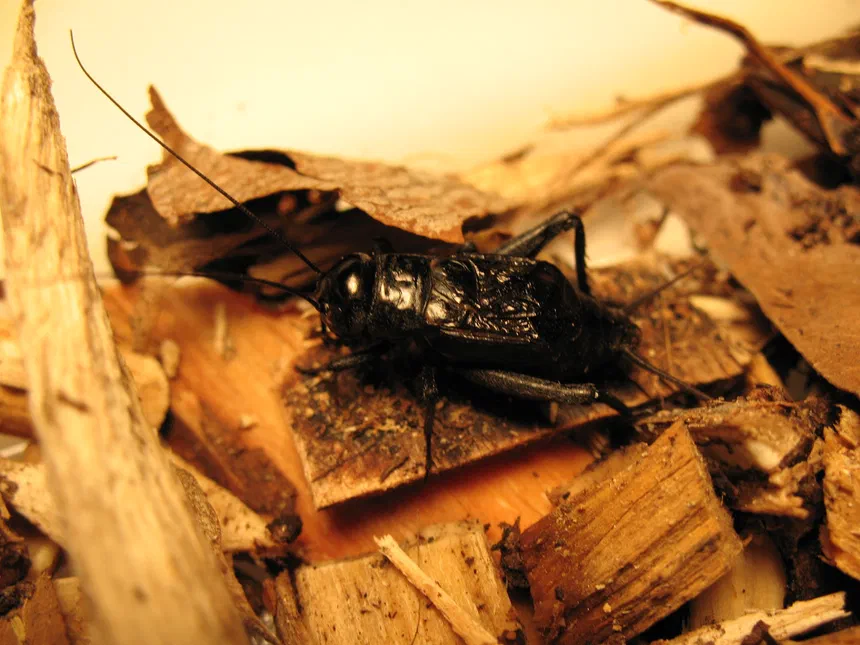
Image: Kevinjudge — CC BY-SA 4.0 · source
What Is a Field Cricket?
The field cricket (Gryllus pennsylvanicus) is a familiar dark-colored insect known for the loud chirping songs males produce on warm late-summer evenings. It belongs to the family Gryllidae and is one of the most common and widely recognized crickets across eastern and central North America.
Appearance and Identification
Field crickets have robust, somewhat flattened bodies that are typically glossy black, though some individuals appear dark brown. Adults usually measure about 15 to 25 millimeters in body length. They have long, thread-like antennae that often exceed the length of the body, and two prominent tail-like structures called cerci at the rear. Females are easily distinguished by a long, needle-like ovipositor projecting between the cerci, which they use to lay eggs in soil. The powerful hind legs are built for jumping, and adults bear two pairs of wings, with the leathery forewings covering the membranous hind wings. Males produce their song by rubbing a scraper on one forewing against a file-like ridge on the other, a process known as stridulation.
Habitat and Range
This species thrives in open, sunny environments such as pastures, meadows, grassy fields, lawns, gardens, and roadside verges. It is a ground-dwelling insect that shelters beneath rocks, logs, leaf litter, and in shallow burrows or cracks in the soil. Field crickets are common throughout much of eastern and central North America, ranging from southern Canada down through the United States. They tolerate a wide variety of habitats as long as there is suitable ground cover and soil for egg-laying, and they frequently wander into homes and buildings, especially as temperatures drop in autumn.
Diet
Field crickets are opportunistic omnivores. Their diet includes a broad mix of plant material such as leaves, grasses, seeds, and fruit, along with fungi and decaying organic matter. They also consume small or dead insects and will scavenge when the opportunity arises. This flexible feeding behavior helps them survive in many different settings. In agricultural areas they occasionally damage seedlings and crops, though they also contribute to breaking down plant debris and controlling other small invertebrates.
Behavior
Field crickets are most active at night, when males sing to attract mates and to warn off rival males. The familiar chirping rate is closely tied to temperature, speeding up in warmer conditions and slowing as the air cools. Males are territorial and may fight over prime calling sites and shelters. Although capable of flight, field crickets more often move by walking and jumping. During the day they typically hide in cool, dark refuges, emerging at dusk to feed and call. When the weather turns cold in autumn, they may seek warmth indoors.
Life Cycle and Reproduction
The field cricket undergoes incomplete metamorphosis, developing through egg, nymph, and adult stages without a pupal phase. After mating, females use their ovipositor to insert eggs individually into moist soil, often laying dozens over their lifetime. In this species the eggs overwinter in the ground and hatch the following spring. The emerging nymphs resemble small, wingless versions of the adults and molt several times as they grow, gradually developing functional wings. They mature into adults by late summer, which is when the chorus of chirping is most noticeable. Typically there is a single generation each year in the northern part of the range.
Conservation Status
The field cricket has not been formally assessed by the IUCN, but it is an abundant and widespread insect that is in no way considered threatened. Its adaptability to disturbed and human-altered landscapes helps keep populations stable. Like many insects, it can be affected locally by pesticide use and habitat loss, but the species as a whole remains extremely common.
Frequently Asked Questions
Why do field crickets chirp? Only males chirp, using their wings to produce sound. The song attracts females and helps establish territory against competing males.
Can you tell the temperature from cricket chirps? Roughly, yes. Chirping rate increases with warmth, so counting chirps over a set interval gives a rough estimate of the air temperature.
Are field crickets harmful? They are generally harmless to people and pets. In large numbers they may nibble seedlings or fabrics indoors, but they are not dangerous and do not bite in any meaningful way.