Insects Guide
Fall Webworm
What Is a Fall Webworm? The fall webworm (Hyphantria cunea) is a moth in the family Erebidae, best known for the sprawling silk webs its caterpillars spin over the ends of tree branches in late summer and autumn. Native …
At a glance
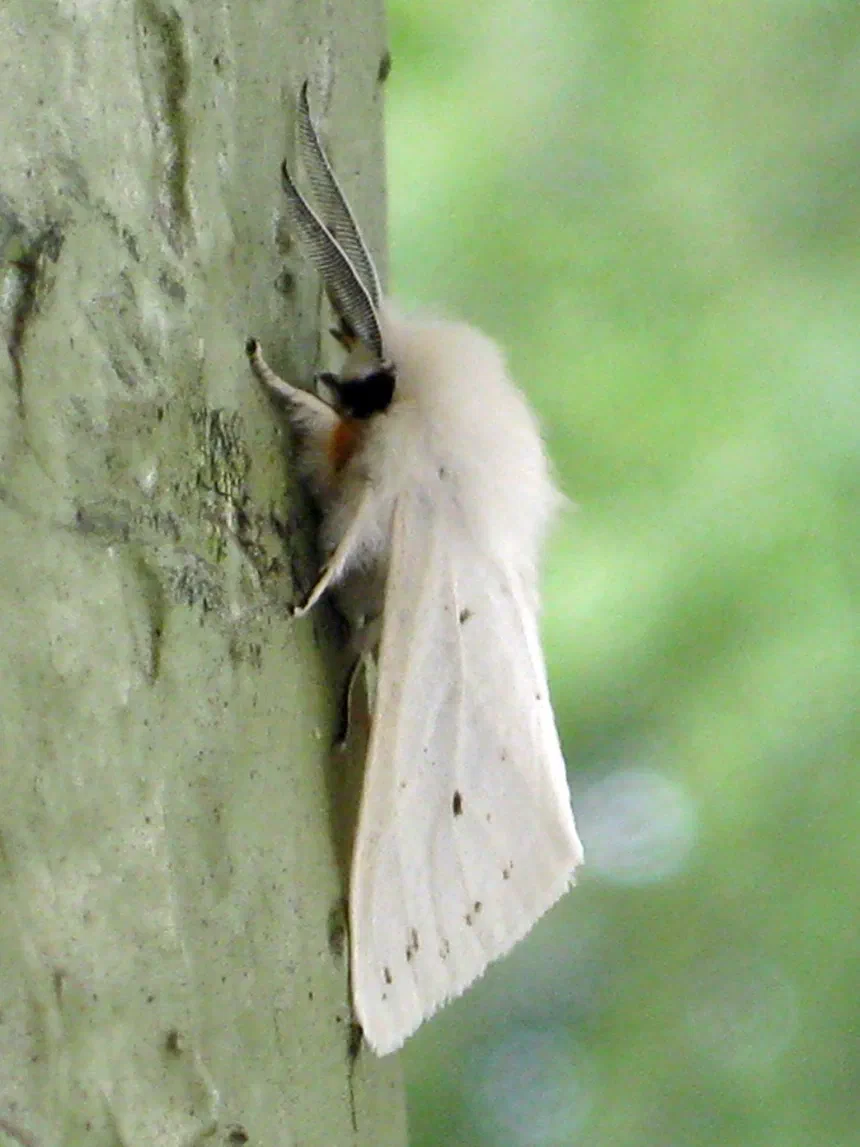
Image: TampAGS, for AGS Media — CC BY-SA 3.0 · source
What Is a Fall Webworm?
The fall webworm (Hyphantria cunea) is a moth in the family Erebidae, best known for the sprawling silk webs its caterpillars spin over the ends of tree branches in late summer and autumn. Native to North America, it has spread widely and is now considered an invasive pest across parts of Europe and Asia. Despite its unsightly nests, it rarely causes lasting harm to healthy trees.
Appearance and Identification
The caterpillars are the most recognizable stage. They are pale, ranging from creamy-white to light yellow or tan, and covered in long, fine hairs that grow from raised orange or black bumps. Fully grown larvae reach roughly an inch (about 25 mm) in length. Two color forms exist across the species’ range, differing mainly in the color of the head capsule (black or red-orange) and body markings.
The adult is a mostly white moth with a wingspan of about 1.2 to 1.6 inches (30 to 42 mm). In the northern part of its range the wings are often pure white, while individuals in southern regions frequently show scattered dark brown or gray spots. The moth’s body is fuzzy, and the front legs may carry orange or yellow patches.
Habitat and Range
The fall webworm thrives in almost any setting where suitable host trees grow, including deciduous forests, orchards, suburban yards, parks, and roadside plantings. It is highly adaptable and tolerates a broad range of climates. Native to North America from Canada to Mexico, the species was accidentally introduced to Europe in the mid-20th century and later to Asia, where it has become established across large areas and is monitored as an agricultural and ornamental pest.
Diet
Fall webworm caterpillars are generalist leaf-eaters and have been recorded feeding on several hundred species of deciduous trees and shrubs. Common hosts include mulberry, walnut, hickory, pecan, elm, willow, cherry, and various fruit and ornamental trees. The larvae feed communally inside their protective silk webbing, consuming leaf tissue and gradually expanding the nest to enclose fresh foliage. Adult moths do not feed to any significant degree and are short-lived.
Behavior
The defining behavior of this insect is web building. Young caterpillars construct a loose tent of silk over leaves at the tip of a branch and remain inside it as they feed, unlike some related species that leave the nest to forage. As the colony grows, the web enlarges and may eventually cover several feet of branch, filling with cast skins, droppings, and dried leaves. The silk offers protection from many predators and parasites. When disturbed, the caterpillars may jerk their bodies in unison. Late in development, larvae leave the web to seek sheltered spots to pupate.
Life Cycle and Reproduction
Fall webworms undergo complete metamorphosis: egg, larva, pupa, and adult. Females lay masses of several hundred eggs on the undersides of leaves, often covering them with hairlike scales from their own bodies. The caterpillars hatch and feed together for several weeks through multiple molts. Mature larvae drop or crawl to the ground and pupate in a thin cocoon among leaf litter, bark crevices, or soil, where the species overwinters as a pupa.
The number of generations per year depends on climate. Cooler northern areas typically see a single generation, while warmer southern regions can host two or more broods in a season, which is why webs may appear from early summer through fall.
Conservation Status
The fall webworm has not been assessed by the IUCN and is not a species of conservation concern. It is abundant throughout its native range and expanding in its introduced range. Where it is invasive, management focuses on limiting damage to orchards and ornamental trees rather than protecting the insect. On healthy, established trees the defoliation it causes is usually cosmetic, since the feeding occurs late in the growing season.
Frequently Asked Questions
Are fall webworms the same as tent caterpillars? No. They are often confused, but tent caterpillars build their nests in the forks of branches in spring, while fall webworms enclose branch tips in webbing in late summer and fall.
Do fall webworms kill trees? Rarely. Their late-season feeding is mostly cosmetic on healthy trees, though repeated heavy infestations can stress young or already weakened plants.
How can the webs be managed? Small nests can be pruned out or opened up so predators can reach the caterpillars. Chemical control is seldom necessary given the limited long-term impact on tree health.