Insects Guide
Emperor Dragonfly
What Is a Emperor Dragonfly? The emperor dragonfly (Anax imperator) is one of the largest and most powerful dragonflies found across Europe and much of Africa. A member of the hawker family (Aeshnidae), it is a strong, …
At a glance
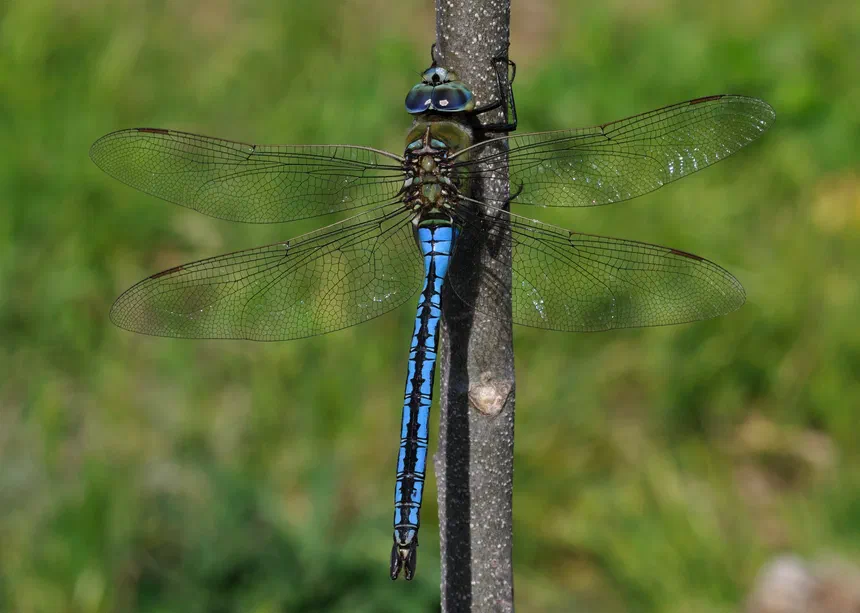
Image: Quartl — CC BY-SA 3.0 · source
What Is a Emperor Dragonfly?
The emperor dragonfly (Anax imperator) is one of the largest and most powerful dragonflies found across Europe and much of Africa. A member of the hawker family (Aeshnidae), it is a strong, restless flier that spends much of the day patrolling water bodies in search of prey and mates. Its bright coloring and impressive size make it one of the most recognizable dragonflies in its range.
Appearance and Identification
The emperor dragonfly is a large insect with a body length of roughly 3 inches (about 7.8 cm) and a wingspan close to 4 inches (about 10.5 cm). Males have an apple-green thorax and a sky-blue abdomen marked with a distinctive dark, notched line running down the center of the back. Females are similar but usually have a greener abdomen, especially when cool. Both sexes have large, forward-facing eyes that meet on top of the head, and clear wings that can take on a faint amber tint with age. In flight the abdomen is often held slightly downcurved, a useful field mark.
Habitat and Range
This species favors well-vegetated standing or slow-moving fresh water, including ponds, lakes, gravel pits, canals, and ditches. It tolerates a wide range of conditions and readily colonizes new or man-made water bodies. Its range is broad, covering much of Europe, large parts of Africa, and extending into the Middle East and central Asia. In recent decades the emperor dragonfly has expanded northward in Europe, a shift often linked to warming temperatures.
Diet
The emperor dragonfly is an aerial predator that hunts almost entirely on the wing. Adults catch a variety of flying insects, including midges, mosquitoes, flies, butterflies, moths, and even smaller dragonflies. Prey is seized with the spiny legs, which form a basket for grabbing insects in mid-air, and small items are often eaten while still flying. The aquatic larvae, called nymphs, are equally voracious, feeding on insect larvae, tadpoles, small fish, and other invertebrates.
Behavior
Adults are active, territorial fliers, and males in particular patrol long stretches of water, chasing off rivals and intercepting passing prey. They rarely settle for long during warm weather, spending hours on the wing. The dragonfly’s excellent vision and agile, direction-changing flight make it a highly effective hunter. When resting, it typically hangs vertically from vegetation. Emperor dragonflies are most active on sunny days and become sluggish in cool or overcast conditions.
Life Cycle and Reproduction
After mating, the female lays eggs alone, inserting them into floating or submerged plant material at the water’s surface, unlike many dragonflies that lay while paired. The eggs hatch within a few weeks, and the resulting nymphs live underwater for one to two years, molting repeatedly as they grow. When fully developed, a nymph climbs a plant stem out of the water, and the adult emerges from its larval skin, expands and hardens its wings, and takes flight. Adults live only a few weeks, during which their sole purpose is to feed and reproduce.
Conservation Status
The emperor dragonfly is listed as Least Concern by the IUCN. It is common and widespread across much of its range and appears to be benefiting from milder conditions, expanding into areas farther north than it once occupied. Like all dragonflies, however, it depends on clean, healthy freshwater habitats, so pollution, drainage of wetlands, and habitat loss remain potential local threats.
Frequently Asked Questions
Is the emperor dragonfly dangerous to humans? No. It cannot sting and does not bite people under normal circumstances. It is harmless to humans and helpful for controlling populations of mosquitoes and other insects.
How fast can an emperor dragonfly fly? While exact speeds vary, emperor dragonflies are among the swifter dragonflies and can fly quickly and maneuver sharply, easily outpacing much of the flying prey they pursue.
Why is it called the “emperor” dragonfly? The name reflects its large size and commanding presence; it is one of the biggest dragonflies in Europe and dominates the airspace over the waters where it lives.