Insects Guide
Elephant Hawk-Moth
What Is a Elephant Hawk-Moth? The elephant hawk-moth (Deilephila elpenor) is a striking, medium-sized moth in the family Sphingidae, famous for the bright pink-and-olive coloring of the adult and the trunk-like snout of …
At a glance
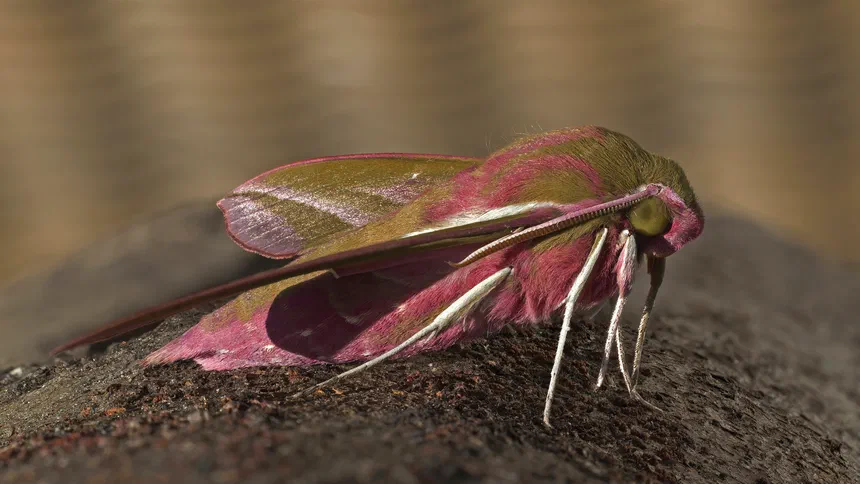
Image: Charles J. Sharp — CC BY-SA 4.0 · source
What Is a Elephant Hawk-Moth?
The elephant hawk-moth (Deilephila elpenor) is a striking, medium-sized moth in the family Sphingidae, famous for the bright pink-and-olive coloring of the adult and the trunk-like snout of its caterpillar. It is one of the most recognizable moths across Europe and much of temperate Asia, active on warm summer nights when it visits fragrant flowers.
Appearance and Identification
The adult is unmistakable, cloaked in a mix of deep olive-green and rich rosy pink that runs across the wings and body in bold diagonal bands. The forewings are swept back into the streamlined, triangular shape typical of hawk-moths, giving the insect a fast, powerful flight. Wingspan generally measures about 45 to 60 millimeters. The caterpillar is equally distinctive: usually grayish-brown (sometimes green), thick-bodied, and tapering toward a pointed tail horn. Near its head are two pairs of large, eye-like markings. When alarmed, the larva retracts its front segments, swelling the eyespots to mimic a small snake, a display that gives the species its “elephant” name from the trunk-like front end.
Habitat and Range
This moth thrives in a wide variety of open and semi-open landscapes, including woodland margins, hedgerows, damp meadows, riverbanks, parks, and suburban gardens. It readily uses human-altered environments wherever its food plants grow, and gardeners often encounter the large caterpillars on fuchsias. Its range spans much of Europe, from Ireland and Britain eastward across the continent, and extends through temperate Asia to Japan. Populations are found from lowlands up into moderate hill country.
Diet
Feeding habits change dramatically across the life cycle. Adults are nectar feeders and hover at tubular, sweet-scented flowers such as honeysuckle, valerian, and petunia, uncoiling a long proboscis to reach the nectar while on the wing. The caterpillars are the heavy feeders, consuming the leaves of willowherbs (especially rosebay willowherb), bedstraws, fuchsias, and related plants. This leaf-eating stage builds the fat reserves that carry the insect through pupation and, in the adult, fuels its energetic flight.
Behavior
The elephant hawk-moth is chiefly nocturnal, resting by day among vegetation where its coloring provides surprisingly good camouflage in dappled light. As dusk falls it becomes active, and it is a strong, agile flier capable of hovering like a hummingbird at flowers. The species has excellent night vision and is among the animals shown to distinguish colors in very dim light. Caterpillars are most conspicuous in late summer, when they often leave their food plants and wander across open ground in search of a place to pupate, which is when many people first notice them.
Life Cycle and Reproduction
The life cycle follows complete metamorphosis. In late spring and summer, females lay small, rounded eggs singly or in pairs on the leaves of suitable host plants. The caterpillars hatch and feed through the summer, growing rapidly and passing through several molts. When fully grown they descend to the ground and pupate, forming a mottled brown chrysalis among leaf litter or just below the soil surface. In most of its range the species overwinters as a pupa, with adults emerging the following late spring or early summer to mate and begin the cycle again. There is typically one generation per year, though warmer regions may see a partial second brood.
Conservation Status
The elephant hawk-moth has not been formally assessed by the IUCN, but it is regarded as widespread and common throughout most of its range, and in some areas it appears to be expanding. Its willingness to breed in gardens and disturbed habitats helps buffer it against local habitat loss. As with many insects, it can still be affected by pesticide use and the removal of nectar sources and larval food plants, so wildlife-friendly gardening benefits local populations.
Frequently Asked Questions
Why is it called an elephant hawk-moth? The name refers to the caterpillar, whose flexible, trunk-like front end can extend and contract in a way that reminded early naturalists of an elephant’s trunk.
Do the caterpillars sting or harm plants seriously? No. The caterpillars are harmless to handle and, while they eat leaves such as fuchsia, they rarely cause lasting damage to established garden plants.
When are adults most likely to be seen? Adults fly on warm nights from roughly late spring into midsummer and are most often spotted feeding at scented flowers after dark or resting nearby during the day.