Insects Guide
Eastern Tiger Swallowtail
What Is a Eastern Tiger Swallowtail? The eastern tiger swallowtail (Papilio glaucus) is a large, brightly colored butterfly native to the eastern United States and parts of southern Canada. Named for the bold black …
At a glance
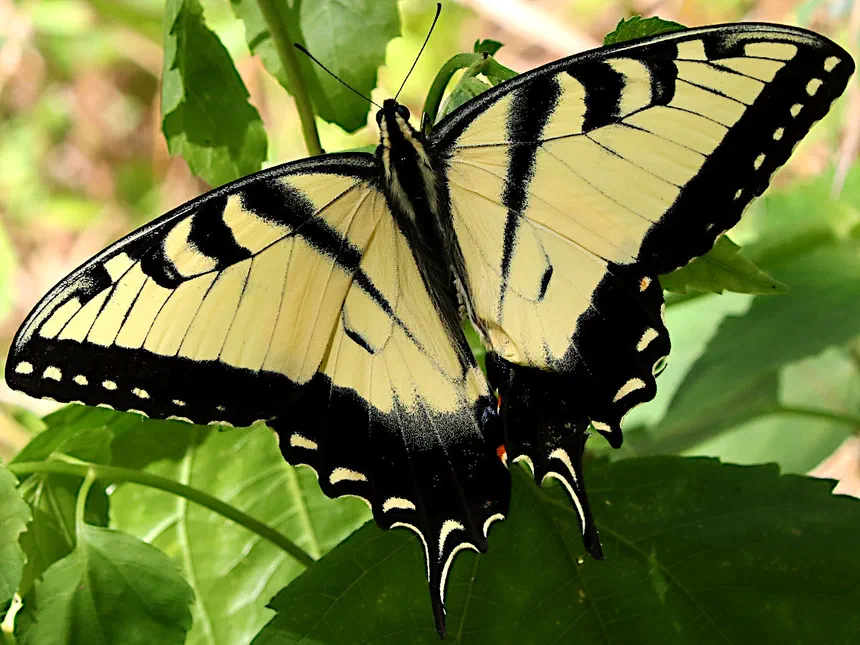
Image: Peterwchen — CC BY-SA 4.0 · source
What Is a Eastern Tiger Swallowtail?
The eastern tiger swallowtail (Papilio glaucus) is a large, brightly colored butterfly native to the eastern United States and parts of southern Canada. Named for the bold black “tiger” stripes running across its yellow wings, it is one of the most familiar and recognizable butterflies in North America. It belongs to the swallowtail family (Papilionidae), a group known for the tail-like extensions on their hindwings.
Appearance and Identification
Adults are unmistakable, with a wingspan typically ranging from about 3 to 5.5 inches (8 to 14 cm), making them among the largest butterflies in their range. Most individuals are yellow with four black vertical stripes on each forewing and dark wing margins dotted with yellow spots. The hindwings carry small blue and orange markings near the characteristic tails. Females come in two forms: a yellow form resembling the male, and a dark morph in which the yellow is largely replaced by black or brown, thought to mimic the poisonous pipevine swallowtail. Females also tend to show more blue on the hindwings than males.
Habitat and Range
The species occupies a broad swath of eastern North America, from southern Canada down through the eastern and central United States to the Gulf Coast. It favors deciduous woodlands, forest edges, wooded streams and rivers, and readily visits suburban gardens, parks, and roadsides. Because its caterpillars feed on a variety of common trees, it thrives in both wild and human-altered landscapes.
Diet
Feeding habits change dramatically across the life cycle. Caterpillars are herbivores that eat the leaves of woody plants, including wild cherry, tulip tree, ash, birch, and cottonwood. Adults feed on flower nectar and are especially drawn to wild cherry, milkweed, thistles, lilac, and Joe-Pye weed. Adults, particularly males, also gather at damp soil, mud, and puddles in a behavior called “puddling” to take up mineral salts.
Behavior
Eastern tiger swallowtails are strong, high fliers often seen gliding through the treetops and along sunlit woodland edges. Males patrol open areas and waterways in search of mates and frequently congregate at mud puddles. The butterflies are active during warm daylight hours and rely on their coloration for defense: the bright yellow-and-black pattern, the dark female mimicry, and the false “eye” and tail markings on the hindwing that can misdirect predators toward a less vital body part.
Life Cycle and Reproduction
Like all butterflies, the species undergoes complete metamorphosis through egg, larva (caterpillar), pupa (chrysalis), and adult stages. Females lay round green eggs singly on the leaves of host trees. The young caterpillar is brown and white, resembling a bird dropping, but matures into a plump green caterpillar with two prominent yellow-and-black eyespots that give it a snake-like appearance. When threatened, the caterpillar can evert a bright orange, forked gland called an osmeterium that emits a foul odor. The species overwinters as a chrysalis. In the north there is usually one generation per year, while warmer southern regions can produce two or three broods annually.
Conservation Status
The eastern tiger swallowtail is common, widespread, and not considered threatened; it has not been formally assessed by the IUCN and is regarded as secure throughout its range. Its use of many common host trees and tolerance of gardens and suburban habitat help keep populations robust. As with many insects, localized declines can stem from habitat loss and pesticide use, so maintaining native trees and nectar plants supports healthy populations.
Frequently Asked Questions
Why are some eastern tiger swallowtails black instead of yellow? Only certain females occur in a dark form, in which black or brown replaces most of the yellow. This morph is thought to mimic the distasteful pipevine swallowtail, offering protection from predators.
What do the caterpillars eat? Caterpillars feed on the leaves of common trees such as wild cherry, tulip tree, ash, and cottonwood, which is one reason the species is so widespread.
How long do the adult butterflies live? Adult eastern tiger swallowtails generally live only about two weeks, spending that short time feeding on nectar and reproducing.