Insects Guide
Dung Beetle
What Is a Dung Beetle? Dung beetles are a large, diverse group of scarab beetles best known for feeding on and burying animal manure. The sacred scarab, Scarabaeus sacer, is one of the most famous species and was revered …
At a glance
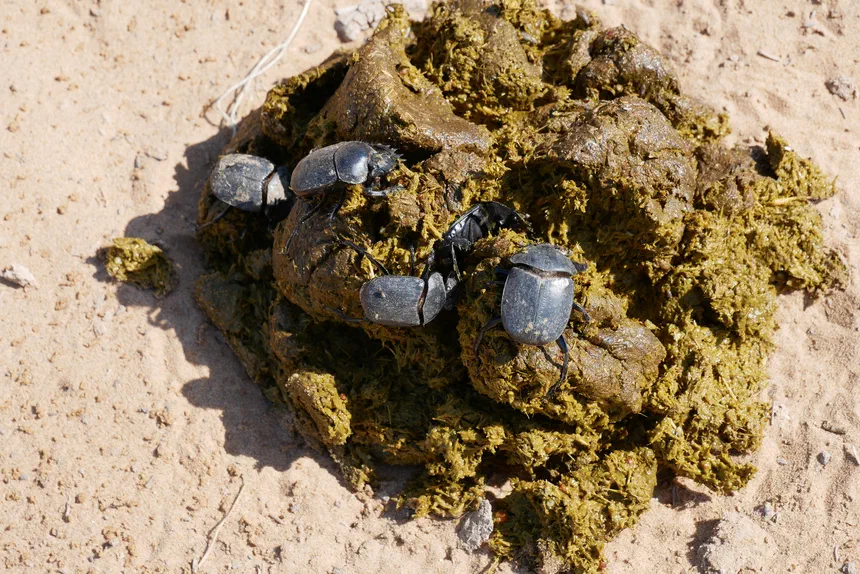
Image: Mosmas — CC BY-SA 4.0 · source
What Is a Dung Beetle?
Dung beetles are a large, diverse group of scarab beetles best known for feeding on and burying animal manure. The sacred scarab, Scarabaeus sacer, is one of the most famous species and was revered in ancient Egypt as a symbol of renewal. Together, dung beetles play an outsized role in recycling nutrients and keeping ecosystems clean.
Appearance and Identification
Most dung beetles are compact, oval, and heavily armored, ranging from roughly 0.5 to 1.2 inches (about 1 to 3 cm) in length depending on the species. Coloration is usually black, though many species shine with metallic green, blue, or bronze tones. They have stout, spade-like front legs adapted for digging, and the head and thorax often bear ridges or projections used to shovel and shape dung. The sacred scarab is a dull black species with a distinctive fan of teeth around the front of its head.
Habitat and Range
Dung beetles are found on every continent except Antarctica, occupying an enormous range of environments. They thrive in grasslands, savannas, deserts, pastures, and open woodlands wherever large herbivores leave droppings. Some species prefer forests, while others are specialists of sandy or arid terrain. Because they depend on the waste of mammals, their distribution closely follows that of grazing and browsing animals.
Diet
As their name suggests, dung beetles are coprophagous, meaning they feed primarily on the excrement of other animals. They favor the moist, nutrient-rich dung of herbivores, extracting fluids and fine organic particles for their own nourishment. The buried dung also serves as a food store for their developing larvae. A few species supplement their diet with decaying plant matter, fungi, or carrion, and some tropical species have shifted to eating fallen fruit or hunting other invertebrates.
Behavior
Dung beetles are often grouped by how they handle their food. “Rollers” shape a portion of dung into a ball and roll it away to bury elsewhere, sometimes traveling in remarkably straight lines using the sun, moon, or even the pattern of the night sky to navigate. “Tunnelers” dig straight down beneath a dung pile and pull the manure into underground chambers, while “dwellers” simply live and breed within the pat itself. Competition for fresh dung can be intense, and males may battle rivals with their horns or leg spurs. Their burrowing aerates the soil and speeds the return of nutrients to the ground.
Life Cycle and Reproduction
Reproduction centers on the dung the adults collect. A female typically lays her eggs inside a buried mass or a carefully sculpted “brood ball,” giving each larva a private supply of food. In many rolling species, a male and female cooperate to bury a ball together before the female deposits an egg inside. The larva hatches, feeds on the surrounding dung, and passes through several growth stages before pupating underground. After metamorphosis, the adult digs its way to the surface. Many species produce one or more generations per year, and adults of some species care for their brood far more attentively than most insects.
Conservation Status
Dung beetles as a whole are widespread and abundant, and most species have not been individually assessed by the IUCN. Even so, some populations are declining because of habitat loss, changes in livestock management, and the use of certain deworming drugs whose residues in manure can be toxic to the beetles and their larvae. Because they provide valuable services such as soil enrichment, pest suppression, and dung removal, protecting healthy dung beetle communities benefits farmers and natural ecosystems alike.
Frequently Asked Questions
Why do dung beetles roll balls of dung? Rolling lets a beetle quickly move a share of dung away from crowded competitors to a safe spot where it can be buried and used as food or a nursery for eggs.
Are dung beetles helpful to people? Yes. By burying manure they recycle nutrients, improve soil, reduce fly breeding, and help control livestock parasites, making them important allies in agriculture.
How strong are dung beetles? Some species are among the strongest animals for their size, capable of moving and rolling dung balls many times their own body weight.