Insects Guide
Dragonfly
What Is a Dragonfly? A dragonfly is a fast, agile flying insect belonging to the infraorder Anisoptera within the order Odonata. With more than 3,000 described species, dragonflies are among the most ancient winged …
At a glance
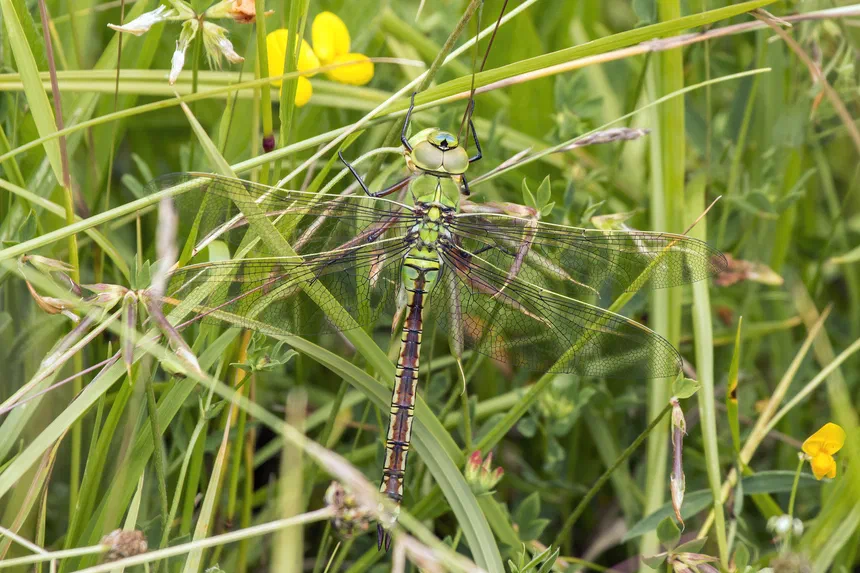
Image: Charles J. Sharp — CC BY-SA 4.0 · source
What Is a Dragonfly?
A dragonfly is a fast, agile flying insect belonging to the infraorder Anisoptera within the order Odonata. With more than 3,000 described species, dragonflies are among the most ancient winged insects, with close relatives dating back hundreds of millions of years. They are easily recognized by their long bodies, huge eyes, and two pairs of strong, transparent wings.
Appearance and Identification
Dragonflies have an elongated abdomen, a short thorax, and a rounded head dominated by two enormous compound eyes that can each contain tens of thousands of facets, giving nearly 360-degree vision. Their two pairs of wings are held out to the sides at rest, a key feature that separates them from damselflies, which fold their wings back over the body. Body coloration ranges widely, from metallic greens and blues to reds, yellows, and browns, and many species show bright, iridescent hues. Adult body length varies from roughly 1 to 5 inches (2.5 to 13 centimeters), with wingspans that can approach 5 inches (13 centimeters) in the largest species.
Habitat and Range
Dragonflies are tied to freshwater because their larvae are aquatic. Adults are commonly seen patrolling ponds, lakes, slow rivers, streams, marshes, and other wetlands, and they may range widely over meadows and fields while hunting. The group is found on every continent except Antarctica, reaching its greatest diversity in warm, wet tropical regions. Some species are strong migrants; the globe skimmer (Pantala flavescens), for example, undertakes long over-water journeys and has one of the longest migrations of any insect.
Diet
Dragonflies are strict carnivores at every stage of life. Adults are aerial hunters that catch other flying insects, including mosquitoes, midges, flies, gnats, and small moths, often seizing prey in mid-air with their spiny, basket-like legs. They are remarkably successful predators, capturing a high percentage of the prey they pursue. Aquatic larvae, called nymphs or naiads, are equally predatory, using a rapidly extendable, hinged lower jaw to snatch insect larvae, worms, tadpoles, and even small fish.
Behavior
Dragonflies are among the most accomplished fliers in the insect world. Their four wings can be powered independently, letting them hover, fly backward, change direction instantly, and reach considerable speeds. Most adults are active by day and favor warm, sunny weather, basking to raise their body temperature before hunting. Many species are strongly territorial, with males patrolling stretches of shoreline and driving off rivals. Their large eyes and quick reflexes make them difficult prey for birds and other predators.
Life Cycle and Reproduction
Dragonflies undergo incomplete metamorphosis, with three stages: egg, larva, and adult, and no pupal stage. After mating, which often takes place in flight and involves a distinctive wheel-shaped posture, females lay eggs in or near water, sometimes inserting them into plant tissue or dropping them onto the surface. The aquatic larva grows through many molts and may live from a few months to several years depending on the species and climate. When ready, the larva climbs out of the water, its skin splits, and the winged adult emerges to harden its wings before its first flight. Adults typically live only a few weeks to a few months.
Conservation Status
Because Anisoptera includes thousands of species, conservation status varies greatly. Many common and widespread dragonflies are listed as Least Concern by the IUCN, but numerous species, especially those restricted to specialized wetlands or single regions, are threatened by habitat loss, water pollution, drainage of wetlands, and the effects of climate change. Because they depend on clean freshwater, dragonflies are considered useful indicators of the health of aquatic ecosystems.
Frequently Asked Questions
Do dragonflies sting or bite people? Dragonflies do not have a stinger and pose no threat to humans. A very large individual might pinch if handled, but they are harmless and even helpful, since they eat mosquitoes and other pest insects.
What is the difference between a dragonfly and a damselfly? Both belong to the order Odonata, but dragonflies (Anisoptera) are usually stouter and hold their wings outstretched at rest, while damselflies are slender and typically fold their wings along the body.
How long do dragonflies live? Most of a dragonfly’s life is spent as an aquatic larva, which can last from several months to a few years. The flying adult stage is much shorter, usually only a few weeks to a couple of months.