Insects Guide
Dobsonfly
What Is a Dobsonfly? The dobsonfly (Corydalus cornutus) is a large, soft-bodied insect in the order Megaloptera, best known for its dramatic size and the fearsome-looking jaws of the males. Despite their alarming …
At a glance
What Is a Dobsonfly?
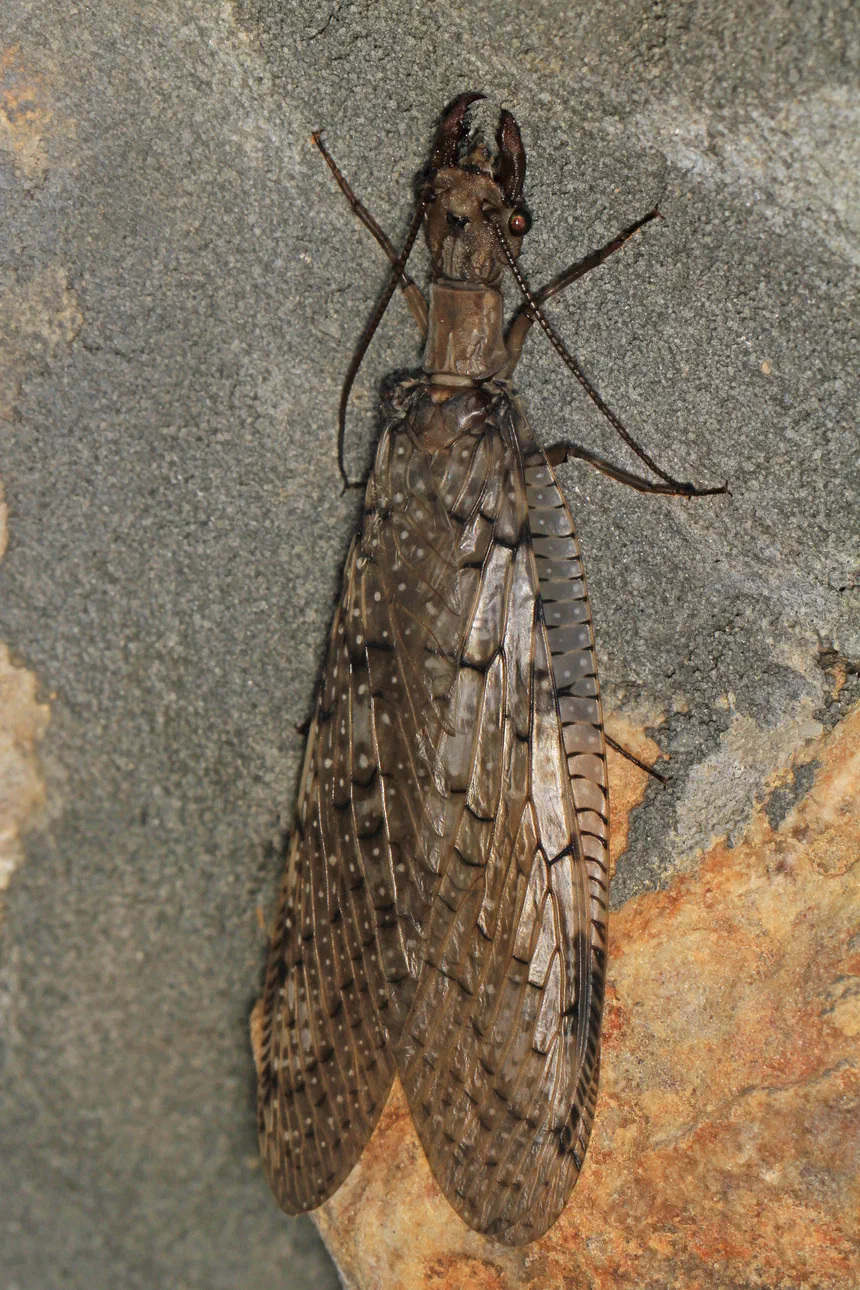
The dobsonfly (Corydalus cornutus) is a large, soft-bodied insect in the order Megaloptera, best known for its dramatic size and the fearsome-looking jaws of the males. Despite their alarming appearance, adults are essentially harmless and short-lived, spending most of their lives as aquatic predatory larvae known as hellgrammites.
Appearance and Identification
Dobsonflies are among the largest insects in North America, with a wingspan that can approach 5 inches. The body is grayish-brown, and the four long, membranous wings are mottled with faint gray and white patterning, held tent-like over the abdomen at rest. The most striking feature is sexual dimorphism in the mandibles: males possess enormously elongated, curved jaws that can reach an inch or more in length, while females have short, powerful mandibles. The male’s exaggerated pincers look intimidating but are too long and weak to deliver a meaningful bite; a female’s shorter jaws, by contrast, can pinch firmly. Both sexes have long, beaded antennae and a heavy, slow, fluttering flight.
Habitat and Range
The eastern dobsonfly is native to eastern North America, ranging widely across the eastern United States and into parts of southern Canada. Its distribution is tied closely to clean, well-oxygenated freshwater. The aquatic larvae live in fast-flowing streams and rivers, sheltering beneath rocks in riffles where the current keeps water oxygen levels high. Adults are rarely found far from these waterways and are often seen resting on streamside vegetation or near lights at night.
Diet
The dobsonfly’s feeding life is concentrated almost entirely in its larval stage. Hellgrammites are voracious aquatic predators, using their strong jaws to seize aquatic insect larvae, small invertebrates, and other prey they encounter among the stream-bottom rocks. As top invertebrate predators in many streams, they help regulate populations of other aquatic insects. Adult dobsonflies, in contrast, feed very little or not at all; with their brief life span, they rely on energy reserves stored during the larval years, and any feeding is limited to occasional fluids.
Behavior
Adult dobsonflies are largely nocturnal and are strongly attracted to lights, which is where many people first encounter them. They are clumsy, slow fliers. When threatened, adults may raise their heads and open their jaws in a defensive display, and can release a musky odor. The larvae are secretive and stay hidden beneath rocks by day, becoming more active predators as they range across the streambed. Hellgrammites can also breathe air for short periods and survive brief spells out of water, which allows them to move overland or endure receding water levels.
Life Cycle and Reproduction
Dobsonflies undergo complete metamorphosis through egg, larva, pupa, and adult stages. Females lay large, chalky-white egg masses on overhanging surfaces such as rocks, bridge supports, or vegetation directly above flowing water. Upon hatching, the tiny larvae drop into the stream below and begin life as hellgrammites. This larval stage is by far the longest, typically lasting one to three years, during which the larva molts many times and grows to several inches. When mature, the larva crawls out of the water onto the bank and pupates in soil or under debris. The adult emerges to mate and, in the case of females, lay eggs; adults live only about a week, making reproduction their sole purpose.
Conservation Status
The eastern dobsonfly has not been formally assessed by the IUCN and is not considered threatened. It remains widespread across its range. Because the larvae require clean, oxygen-rich, flowing water, hellgrammites are regarded as useful indicators of stream health, and their presence generally signals good water quality. Local declines can occur where pollution, siltation, or damming degrade stream habitat.
Frequently Asked Questions
Are dobsonflies dangerous to people? Not really. The long-jawed males cannot bite effectively, though a female’s shorter jaws can pinch if she is handled carelessly. Dobsonflies are not venomous and pose no serious threat.
What is a hellgrammite? A hellgrammite is the aquatic larval stage of the dobsonfly. These fierce-looking, segmented larvae live under rocks in streams and are prized by anglers as bait.
Why do adult dobsonflies live such a short time? The adult stage exists mainly to reproduce. Having stored energy over years as larvae, adults live only about a week, long enough to mate and lay eggs.