Insects Guide
Great Diving Beetle
What Is a Great Diving Beetle? The great diving beetle (Dytiscus marginalis) is a large predatory water beetle native to freshwater habitats across Europe and northern Asia. It belongs to the family Dytiscidae, a group …
At a glance
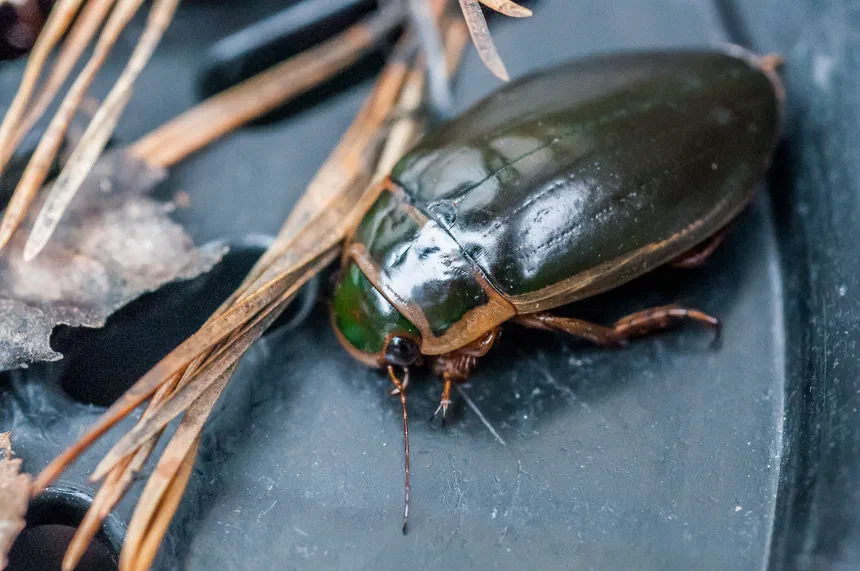
Image: Thintkk — CC BY-SA 4.0 · source
What Is a Great Diving Beetle?
The great diving beetle (Dytiscus marginalis) is a large predatory water beetle native to freshwater habitats across Europe and northern Asia. It belongs to the family Dytiscidae, a group of streamlined aquatic beetles whose members are among the most efficient invertebrate hunters in still water. Despite spending most of its life submerged, it remains an air-breathing insect that must return to the surface to renew its oxygen supply.
Appearance and Identification
This is one of the largest diving beetles found in temperate freshwater, with adults typically measuring around 27 to 35 millimeters in length. The body is broad, oval, and smoothly streamlined, allowing it to glide through water with little resistance. The upper surface is a dark olive-brown to nearly black, bordered by a distinctive yellow or orange-yellow margin running around the edges of the pronotum and wing cases. Males have smooth, glossy wing cases and enlarged, sucker-like pads on their front legs used to grip females during mating, while females often have grooved or ridged wing cases. The powerful, fringed hind legs act like oars, beating in unison to propel the beetle forward.
Habitat and Range
The great diving beetle favors still or slow-moving freshwater, including ponds, garden pools, ditches, canals, marshes, and the quiet margins of lakes. It generally prefers water bodies with abundant aquatic vegetation, which provides both cover and rich hunting grounds. The species is widespread across much of Europe and extends eastward through temperate regions of northern Asia. Although capable of tolerating a range of conditions, populations are healthiest in clean, well-vegetated water with good oxygen levels.
Diet
Both the adult beetle and its larva are voracious carnivores. Adults hunt a wide variety of prey, including insect larvae, worms, snails, tadpoles, and small fish, and they will also scavenge on dead animal matter. They seize prey with strong jaws and are known to overpower animals considerably larger than themselves. The larvae, sometimes called “water tigers,” are equally fearsome, using long, curved, hollow mandibles to inject digestive enzymes into prey and then suck out the liquefied tissue.
Behavior
Although fully aquatic in habit, the great diving beetle breathes atmospheric air. It rises to the surface tail-first and traps a bubble of air beneath its wing cases, which it carries underwater like a portable air tank and draws on while submerged. This adaptation lets it remain active below the surface for extended periods. Adults are also strong fliers and will leave the water at night, often taking to the air to disperse to new ponds, sometimes attracted to artificial lights or the reflective surfaces of wet roads and greenhouses. They are most active in low light and can survive cold winters as adults.
Life Cycle and Reproduction
Mating usually takes place in spring. The female uses a blade-like ovipositor to insert eggs into the stems or tissues of submerged aquatic plants. After hatching, the larvae grow through several stages, feeding aggressively on aquatic prey and molting as they enlarge. When fully grown, a larva crawls out of the water and burrows into damp soil or mud near the bank, where it forms a chamber and pupates. The adult beetle emerges some weeks later and returns to the water. Adults can be relatively long-lived for an insect, surviving for two to three years under favorable conditions.
Conservation Status
The great diving beetle has not been assessed on the IUCN Red List and remains widespread across its range. However, like many freshwater invertebrates, it is sensitive to habitat loss, pollution, and the drainage or degradation of ponds and wetlands. Maintaining clean, vegetated, fish-light water bodies benefits this species and the wider community of aquatic life it depends upon.
Frequently Asked Questions
Does the great diving beetle bite? It can deliver a sharp nip with its jaws if handled, and the larvae can pierce skin, but it poses no real danger to people.
How does it breathe underwater? It does not have gills. Instead it collects air at the surface and stores a bubble beneath its wing cases, using it as a reservoir while diving.
Can great diving beetles fly? Yes. Adults are capable fliers and often travel between ponds at night, which helps them colonize new habitats.