Insects Guide
Deer Fly
What Is a Deer Fly? Deer flies are small, biting flies in the genus Chrysops, part of the horse fly family (Tabanidae). They are best known for the persistent, painful bites the females inflict on mammals, including …
At a glance
What Is a Deer Fly?
Deer flies are small, biting flies in the genus Chrysops, part of the horse fly family (Tabanidae). They are best known for the persistent, painful bites the females inflict on mammals, including deer, livestock, and people, as they seek a blood meal. Despite their nuisance reputation, they are a natural part of many freshwater and woodland ecosystems.
Appearance and Identification
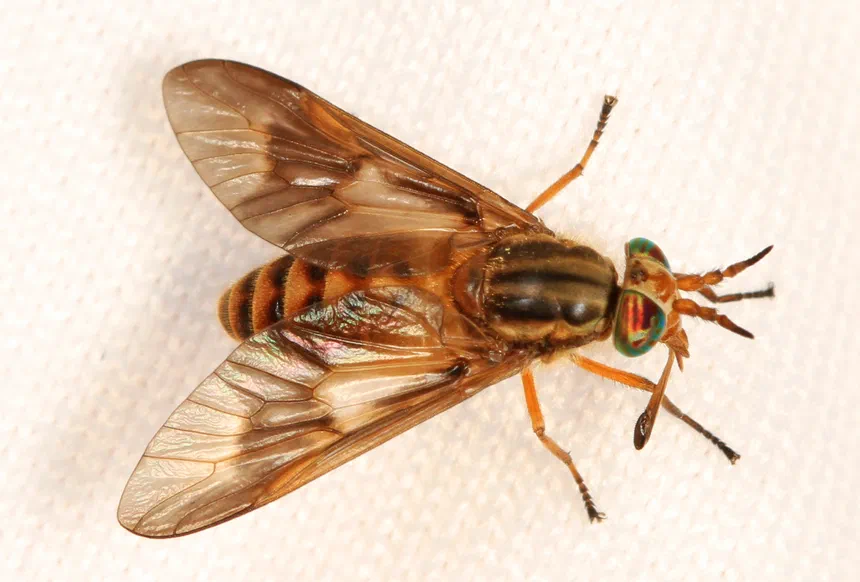
Deer flies are compact insects, typically 6 to 11 millimeters long, noticeably smaller than the related horse flies. Their bodies are usually yellowish to brown, often marked with dark stripes or bands on the abdomen. A key identifying feature is the wings, which carry dark bands or smoky patches that set them apart from most other flies. Their large, iridescent eyes can display bright green, gold, or coppery hues in life, fading after death. The antennae are relatively long and slender, and the mouthparts of the female form a short, blade-like structure used to slice skin.
Habitat and Range
Members of the genus Chrysops are found across most of the world, absent only from the coldest polar regions and the driest deserts. They are strongly associated with moist environments because their larvae develop in wet soil, mud, and the margins of ponds, marshes, streams, and swamps. Adults are most often encountered near these wetlands, along forest edges, trails, and shorelines, especially on warm, humid, sunny days when they are most active. Densely wooded areas bordering water tend to support the largest populations.
Diet
The feeding habits of deer flies differ sharply between the sexes. Males feed exclusively on nectar and pollen and are harmless to animals. Females also visit flowers for sugar, but they require a blood meal to develop their eggs. Using scissor-like mouthparts, a female cuts the skin and laps up the blood that pools at the wound, rather than piercing cleanly like a mosquito. This method makes their bites feel sharp and produces a wound that can bleed and itch. Common hosts include deer and other large mammals, cattle, horses, and humans.
Behavior
Deer flies are agile, fast-flying, and notoriously persistent. They are visually oriented hunters, drawn to movement, dark colors, warmth, and the carbon dioxide that animals exhale. A female will often circle a target repeatedly, frequently aiming for the head and shoulders, before landing to bite. They are active during daylight, with peaks in the warmer hours, and are especially bothersome in early to midsummer. Because they can carry pathogens between hosts, deer flies are occasionally involved in transmitting diseases such as tularemia to animals and, rarely, people.
Life Cycle and Reproduction
Like all flies, deer flies undergo complete metamorphosis, passing through egg, larva, pupa, and adult stages. After a blood meal, a female deposits a cluster of eggs on vegetation overhanging water or wet ground. The hatching larvae drop into the moist substrate below, where they live as predators and scavengers, feeding on small organisms in the mud. Larval development is slow and may extend over several months, often carrying the insect through winter. When mature, the larva pupates in drier soil, and the adult emerges to mate and, in the female’s case, seek blood. Adults live only a few weeks, but a full generation from egg to adult can span close to a year.
Conservation Status
The genus Chrysops has not been assessed as a whole by the IUCN, and individual species are generally not evaluated. Deer flies are widespread and abundant, and none are considered at risk. Their populations fluctuate naturally with rainfall and wetland conditions, since larval survival depends on moist habitat. As both pollinators and prey for birds, spiders, and other predators, they contribute to the ecosystems they inhabit despite their reputation as pests.
Frequently Asked Questions
Why do deer fly bites hurt so much? Females cut the skin with blade-like mouthparts rather than piercing it neatly, creating a small wound that bleeds and often itches or swells afterward.
How are deer flies different from horse flies? Both belong to the family Tabanidae, but deer flies are smaller and have patterned, banded wings, while horse flies are larger and usually have clear or solid-colored wings.
Do all deer flies bite? No. Only females bite, and they do so to obtain the blood needed to produce eggs. Males feed solely on nectar and never bite.