Insects Guide
Damselfly
What Is a Damselfly? Damselflies are slender, agile predatory insects that make up the suborder Zygoptera within the order Odonata, the same order that contains dragonflies. They are best known for their delicate build, …
At a glance
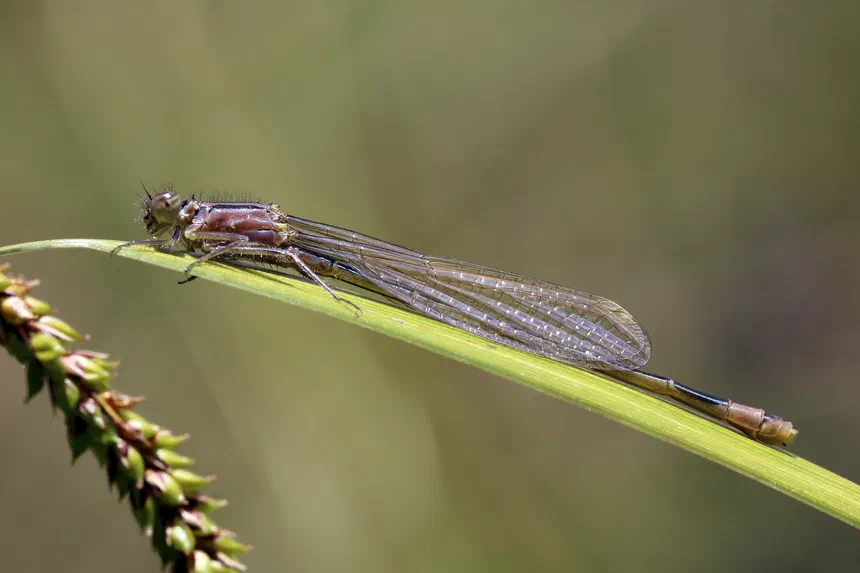
Image: Charles J. Sharp — CC BY-SA 3.0 · source
What Is a Damselfly?
Damselflies are slender, agile predatory insects that make up the suborder Zygoptera within the order Odonata, the same order that contains dragonflies. They are best known for their delicate build, large compound eyes, and gauzy wings, and they spend much of their lives in and around freshwater. With well over 2,500 described species, damselflies occur across most of the world’s wetlands.
Appearance and Identification
A damselfly has a long, thin abdomen, a short thorax, and two pairs of membranous wings laced with fine veins. Body length typically ranges from about 0.7 to 2 inches (18 to 50 mm), and many species are strikingly colored in metallic blues, greens, reds, or bronzes. The most reliable way to separate a damselfly from a dragonfly is to watch a perched individual: most damselflies hold their wings closed together above or alongside the abdomen, while dragonflies spread their wings out flat. Damselflies also tend to have a more fragile, fluttering flight and eyes that are clearly separated on either side of the head, rather than meeting in the middle.
Habitat and Range
Damselflies are tied to fresh water for breeding and are found on every continent except Antarctica. They favor still or slow-moving water such as ponds, lakes, marshes, ditches, and the edges of streams and rivers, especially where aquatic and bankside vegetation is plentiful. Some species tolerate a wide range of conditions, while others are specialists of clean streams, boggy pools, or particular plant communities, which makes them useful indicators of water quality.
Diet
Both larvae and adults are carnivores. Adult damselflies hunt small soft-bodied flying insects, including midges, mosquitoes, gnats, and mayflies, plucking prey from the air or from vegetation. The aquatic larvae, called nymphs or naiads, are ambush predators that feed on tiny invertebrates such as insect larvae, water fleas, and worms, and larger nymphs may take tadpoles or small fish fry. They capture prey using a specialized hinged, extendable lower jaw that shoots forward to seize a target.
Behavior
Adult damselflies are visual hunters active mainly by day and in warm weather. They are weaker, more delicate fliers than dragonflies and often stay close to vegetation, perching frequently between short flights. Many species are territorial, with males patrolling stretches of shoreline or defending perches near suitable egg-laying sites. Aquatic nymphs breathe through three leaf-like gills at the tip of the abdomen and move by walking or by flicking these gills to swim in short bursts.
Life Cycle and Reproduction
Damselflies undergo incomplete metamorphosis, passing through egg, nymph, and adult stages without a pupal phase. During mating, a male grasps a female behind the head with claspers at the end of his abdomen, and the pair often forms a distinctive heart or wheel shape while transferring sperm. Females lay eggs into plant tissue, mud, or floating vegetation, sometimes while still joined to the male. The nymphs develop underwater for months and, in some species, more than a year, molting repeatedly before crawling out of the water and emerging as winged adults. Adults generally live only a few weeks to a couple of months.
Conservation Status
Because Zygoptera is a large suborder, conservation status varies widely by species. Many widespread damselflies are ranked as Least Concern on the IUCN Red List, but a number of range-restricted or wetland-dependent species are considered threatened or endangered. The main pressures are loss and degradation of freshwater habitats, pollution, drainage of wetlands, and the effects of a changing climate on water availability.
Frequently Asked Questions
How can I tell a damselfly from a dragonfly? Look at a resting individual. Damselflies are generally slimmer, fold their wings closed over the body, and have eyes set apart on the sides of the head, while dragonflies are bulkier, hold their wings open, and have eyes that touch.
Do damselflies bite or sting people? No. Damselflies have no sting, and they are far too small and gentle to harm humans. They are harmless and even helpful, since they eat mosquitoes and other biting insects.
Where do baby damselflies live? The young, called nymphs, live underwater in ponds, streams, and wetlands, where they hunt small aquatic animals before climbing out to transform into flying adults.