Insects Guide
Cinnabar Moth
What Is a Cinnabar Moth? The cinnabar moth (Tyria jacobaeae) is a brightly colored day- and night-flying moth in the tiger moth subfamily (Arctiinae). Named for the red mineral cinnabar, it is one of Europe’s most …
At a glance
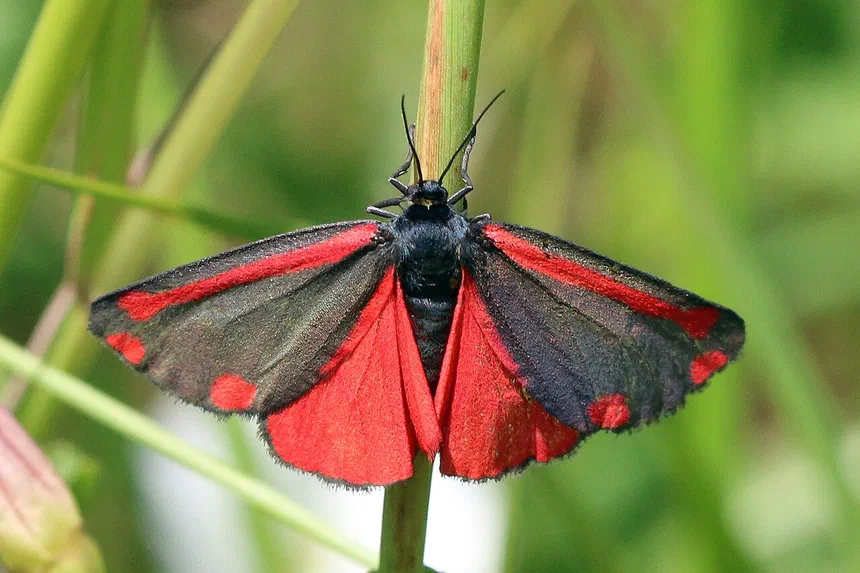
Image: Charles J. Sharp — CC BY-SA 4.0 · source
What Is a Cinnabar Moth?
The cinnabar moth (Tyria jacobaeae) is a brightly colored day- and night-flying moth in the tiger moth subfamily (Arctiinae). Named for the red mineral cinnabar, it is one of Europe’s most recognizable moths thanks to its vivid red-and-black wings, and it is closely tied to ragwort, the plant its caterpillars devour.
Appearance and Identification
Adults have a wingspan of roughly 32 to 42 mm. The forewings are a deep charcoal to slate gray, marked with a bold red stripe along the leading edge and two red spots near the outer margin. The hindwings are almost entirely scarlet with a narrow dark border. This red-and-black pattern is aposematic, a warning that the moth is distasteful to predators. The caterpillars are equally distinctive, ringed in alternating bands of bright yellow-orange and black, giving them a wasp-like appearance.
Habitat and Range
The cinnabar moth is native to Europe and across temperate western and central Asia. It favors open, sunny habitats where its host plants grow, including grasslands, meadows, coastal sand dunes, heathland, railway embankments, and disturbed or waste ground. Because ragwort thrives in poor and disturbed soils, the moth is common in such places. It has been deliberately introduced to countries such as the United States, Canada, Australia, and New Zealand as a biological control agent against invasive ragwort.
Diet
The moth is a herbivore at every feeding stage. Caterpillars feed almost exclusively on ragwort (Jacobaea and Senecio species), especially common ragwort, and will also take related groundsels. As they feed, the larvae absorb toxic alkaloids from the plant and store them in their bodies, becoming poisonous and unpalatable themselves. Adults feed on flower nectar, though they take in far less energy than the caterpillars accumulate.
Behavior
Cinnabar moths are active in both daylight and at night, and are often seen fluttering weakly over vegetation on warm days. Their bright coloring advertises their toxicity, so they rely on being conspicuous rather than hiding. Caterpillars feed in groups when young, clustering on ragwort plants where they can strip the foliage down to bare stems. When food runs short, large caterpillars may wander in search of new plants and occasionally resort to cannibalism.
Life Cycle and Reproduction
The species produces one generation per year. Adults emerge and fly from late spring into midsummer, when females lay batches of yellow eggs on the underside of ragwort leaves. The caterpillars hatch and feed through the summer, growing rapidly and passing through several molts. As autumn approaches, mature larvae move to the ground, spin cocoons in leaf litter or just below the soil surface, and pupate. The pupae overwinter, and the adults emerge the following spring to begin the cycle again.
Conservation Status
The cinnabar moth has not been assessed by the IUCN and has no global conservation ranking. It remains widespread and locally common across much of its native range. However, populations in parts of Britain and northern Europe have shown long-term declines, linked in part to the removal of ragwort, which is considered a weed toxic to livestock. Where ragwort is cleared, the moth loses its essential larval food plant.
Frequently Asked Questions
Are cinnabar moths dangerous to people? No. They are not harmful to humans. Their toxins are directed at predators, and the moths cannot bite or sting.
Why are the caterpillars yellow and black? The bold stripes are a warning signal. The caterpillars store poisons from ragwort, and the coloring tells birds and other predators that they taste bad and may be toxic.
Do cinnabar moths help control weeds? Yes. Because their caterpillars can defoliate ragwort, the moth has been introduced to several countries as a natural, biological control against invasive ragwort infestations.