Insects Guide
Cecropia Moth
What Is a Cecropia Moth? The cecropia moth (Hyalophora cecropia) is a large silk moth in the family Saturniidae and is often described as the biggest native moth in North America. Adults are best known for their broad, …
At a glance
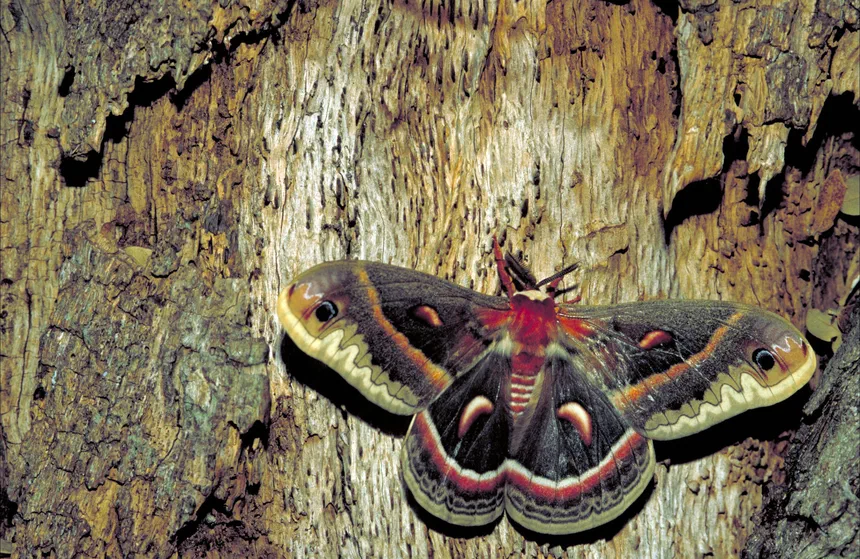
Image: Thomas G. Barnes, U.S. Fish and Wildlife Service — Public domain · source
What Is a Cecropia Moth?
The cecropia moth (Hyalophora cecropia) is a large silk moth in the family Saturniidae and is often described as the biggest native moth in North America. Adults are best known for their broad, richly patterned wings and their brief, non-feeding lives, which are devoted almost entirely to reproduction.
Appearance and Identification
This species is unmistakable thanks to its sheer size, with a wingspan that commonly reaches 5 to 6 inches and can approach 7 inches in the largest females. The wings are a deep grayish-brown, crossed by curved bands of white and reddish-orange and bordered with tan. Each wing carries a crescent- or comma-shaped spot, and the forewing tips bear an eyespot-like marking. The plump body is banded in red and white, and both sexes have feathery antennae, though the male’s are noticeably larger and bushier for detecting female scent. Freshly emerged adults are covered in fine hairlike scales that give them a velvety look.
Habitat and Range
The cecropia moth ranges across much of eastern and central North America, from southern Canada down through the eastern United States and westward roughly to the Rocky Mountains. It favors deciduous and mixed woodlands, forest edges, and brushy areas, but it also does well in parks, orchards, and leafy suburban neighborhoods where suitable host trees grow. Because adults are drawn to lights, they are sometimes noticed on porches or near streetlamps on warm nights in late spring and early summer.
Diet
Feeding is entirely the job of the caterpillar. After hatching, the larva chews through the leaves of a wide range of trees and shrubs, including maple, birch, cherry, apple, plum, willow, box elder, and lilac, among others. Over several weeks it grows dramatically, passing through a series of molts and reaching several inches in length. Adult cecropia moths, by contrast, have only vestigial, nonfunctional mouthparts and never eat. They live off fat reserves stored during the caterpillar stage, which is why their adult lives are so short.
Behavior
Cecropia moths are chiefly nocturnal. Adults spend the day resting quietly on tree trunks, fences, or foliage, where their muted upper-wing colors help them blend in. At night they become active and take flight, with males using their large antennae to track the pheromones released by females, sometimes over considerable distances. The mature caterpillar is a striking blue-green with rows of colorful tubercles, and it feeds openly, relying on size and coloration rather than concealment.
Life Cycle and Reproduction
The cecropia moth completes one generation per year. Females emit pheromones to attract males, typically mating in the hours before dawn, and afterward lay rows of eggs on the leaves of host plants. The caterpillars feed and grow through the summer before spinning a large, tough silken cocoon, often attached lengthwise to a twig, in which they pass the winter as pupae. Adults emerge the following spring or early summer, usually in the morning, and must expand and harden their wings before flight. With no ability to feed, adults live only about one to two weeks, just long enough to mate and lay the next generation of eggs.
Conservation Status
The cecropia moth has not been formally assessed by the IUCN and is not considered globally threatened. It remains widespread across its range, though local populations can be affected by habitat loss, pesticide use, artificial lighting, and introduced parasitoid flies originally released to control other insects. Preserving native trees and shrubs and limiting nighttime lighting can help support healthy local populations.
Frequently Asked Questions
Do adult cecropia moths bite or sting? No. Adults cannot even feed, since they lack functional mouthparts, and they have no sting. They are entirely harmless to people.
Why do cecropia moths live such a short time as adults? Because adults do not eat, they rely on energy stored during the caterpillar stage. That limited fuel supply gives them only a week or two of life, focused on finding a mate and reproducing.
Where might I find a cecropia moth? Look on tree trunks, walls, or near outdoor lights on warm late-spring and early-summer nights across eastern and central North America, especially in wooded or leafy suburban areas.