Insects Guide
Cabbage White
What Is a Cabbage White? The cabbage white (Pieris rapae) is a small, pale butterfly in the family Pieridae, often called the small white or small cabbage white. Native to Eurasia and North Africa, it has spread across …
At a glance
What Is a Cabbage White?
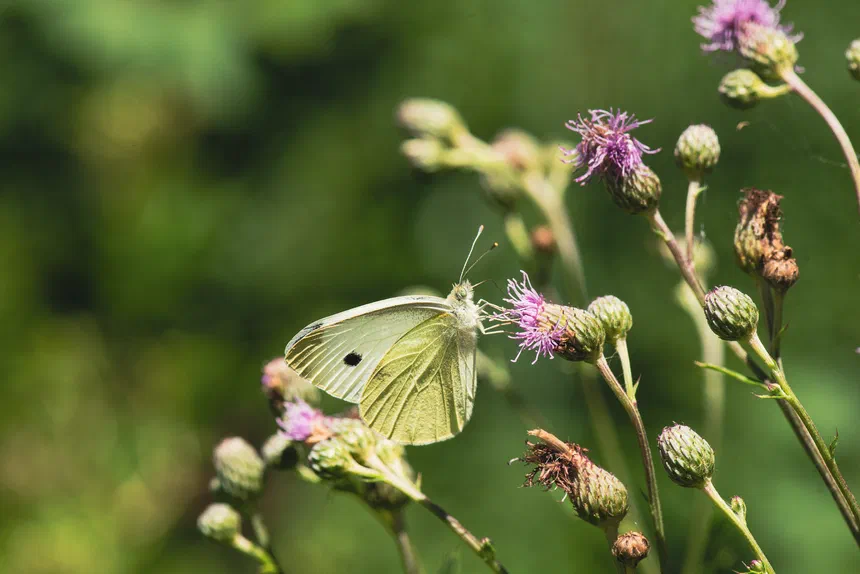
The cabbage white (Pieris rapae) is a small, pale butterfly in the family Pieridae, often called the small white or small cabbage white. Native to Eurasia and North Africa, it has spread across much of the globe alongside human agriculture, and its green caterpillars are among the most familiar garden pests of cabbage and related crops.
Appearance and Identification
The cabbage white is a modestly sized butterfly with a wingspan generally in the range of about 1.3 to 2.4 inches. The upper wings are a soft, chalky white, tipped at the forewing corner with a smudge of charcoal gray or black. Females typically bear two black spots on each forewing, while males usually show just one, a handy field mark for telling the sexes apart. The undersides of the hindwings are a pale yellowish or greenish cream, dusted with fine dark scales that help the resting butterfly blend against foliage. Its close relative, the large white (Pieris brassicae), looks similar but is noticeably bigger with bolder black wingtips.
Habitat and Range
Few butterflies are as adaptable as the cabbage white. It thrives in open, sunny, disturbed places, including vegetable gardens, farm fields, meadows, hedgerows, roadside verges, and city parks. Originally distributed across Europe, temperate Asia, and North Africa, the species was accidentally introduced to North America in the mid-1800s and later reached Australia, New Zealand, and other regions. It is now one of the most widespread butterflies in the world, largely because its host plants, cultivated brassicas, follow people wherever they farm.
Diet
The diet differs sharply between life stages. Caterpillars are herbivores that feed almost exclusively on plants in the mustard family (Brassicaceae), including cabbage, broccoli, kale, cauliflower, mustard, and wild relatives such as garlic mustard. They chew large holes in leaves and can bore into cabbage heads, which is why the species is regarded as an agricultural pest. Adult butterflies, by contrast, feed on flower nectar from a wide variety of blooms, using a coiled tube-like proboscis to sip sugary fuel that powers flight and reproduction.
Behavior
Cabbage whites are active by day and fly in warm, sunny weather, often in a fluttery, seemingly aimless path low over vegetation. Males patrol gardens and fields searching for females and will investigate almost any white object, sometimes even scraps of paper. The butterflies are strong, persistent fliers and readily disperse into new areas, which has aided their global spread. In cooler regions the species overwinters as a chrysalis, tucked against a wall, fence, or plant stem, and emerges in spring.
Life Cycle and Reproduction
Like all butterflies, the cabbage white undergoes complete metamorphosis through egg, larva, pupa, and adult. A female lays her small, ribbed, bullet-shaped eggs singly on the undersides of host leaves, often depositing dozens over her short life. The velvety green caterpillar that hatches feeds and grows through several molts before pupating as a chrysalis attached by a silk girdle. In warm climates the species produces several generations each year, cycling from egg to adult in a matter of weeks. Adults typically live only about two to three weeks, just long enough to mate and lay the next generation.
Conservation Status
The cabbage white has not been formally assessed by the IUCN, and it is in no way threatened. On the contrary, it is abundant and expanding, and in many introduced regions it is treated as an invasive crop pest rather than a species of conservation concern. Gardeners and farmers manage it with row covers, hand-picking of caterpillars, and natural enemies such as parasitic wasps and birds. Its resilience makes it a useful subject for studying insect migration, host-plant chemistry, and adaptation.
Frequently Asked Questions
Is the cabbage white harmful to gardens? Its caterpillars can be, since they feed heavily on cabbage, kale, broccoli, and related crops, chewing ragged holes and sometimes tunneling into heads. The adult butterfly itself causes no damage.
How do I tell males from females? Look at the forewing spots. Females usually have two black spots on each forewing, while males have a single spot.
Where did cabbage whites in North America come from? They are not native. The species was accidentally introduced from Europe around the 1860s and quickly spread across the continent.