Insects Guide
Common Buckeye
What Is a Common Buckeye? The common buckeye (Junonia coenia) is a medium-sized, warm-weather butterfly of the brush-footed family (Nymphalidae), instantly recognized by the row of striking eyespots on its wings. It is …
At a glance
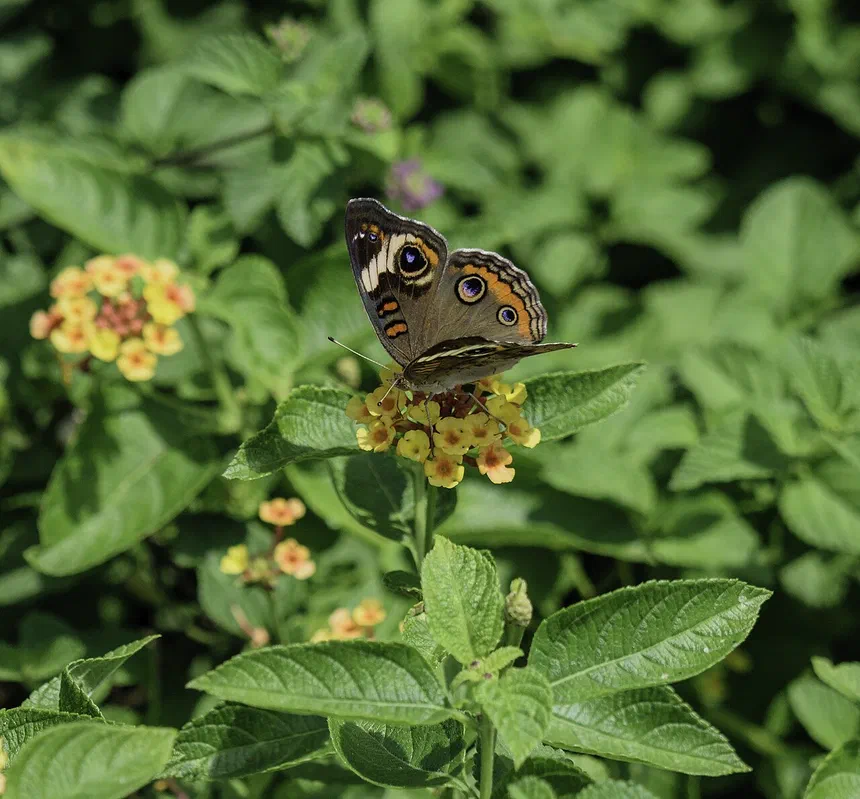
Image: PumpkinSky — CC BY-SA 4.0 · source
What Is a Common Buckeye?
The common buckeye (Junonia coenia) is a medium-sized, warm-weather butterfly of the brush-footed family (Nymphalidae), instantly recognized by the row of striking eyespots on its wings. It is one of the most familiar butterflies across much of North America, favoring open, sunlit ground where flowers and low herbs are plentiful.
Appearance and Identification
The upper wings are a soft tan to brown, marked by several large, multicolored eyespots ringed in black, blue, and buff. Each forewing carries two orange bars near the leading edge and a broad off-white band, while the hindwing bears one large and one smaller eyespot. The undersides are more muted, ranging from tan to a rosy brown in cooler seasons, which helps the resting butterfly blend into dry vegetation. Wingspan typically falls between about 4 and 7 cm. Males and females look broadly similar, though females tend to be slightly larger.
Habitat and Range
Common buckeyes thrive in open, disturbed, and sunny landscapes: old fields, meadows, roadside verges, weedy lots, sand dunes, and the margins of trails and gardens. They are strongly tied to warm regions and are resident year-round across the southern United States and into Mexico. Each year they expand northward through spring and summer, recolonizing much of the central and northern United States and parts of southern Canada before cold weather pushes the population back south.
Diet
As caterpillars, common buckeyes feed on the leaves of host plants rich in certain plant chemicals (iridoid glycosides), including plantains, toadflax, snapdragons, and members of the acanthus and figwort families. Adults are nectar feeders, visiting a wide variety of low, open flowers such as asters, chicory, gumweed, and knapweed. Adults will also sip moisture and minerals from damp soil, a behavior known as puddling.
Behavior
Buckeyes are active, sun-loving butterflies. They frequently bask with wings spread flat on bare ground or low vegetation to absorb warmth. Males are territorial and perch on open patches, darting out to investigate passing insects and pursue females. Their flight is low, quick, and erratic, which helps them evade predators. The prominent eyespots are thought to startle or misdirect attacking birds. In autumn, populations in many areas undertake a loose southward migration.
Life Cycle and Reproduction
Like all butterflies, the common buckeye passes through a complete metamorphosis of four stages: egg, larva (caterpillar), pupa (chrysalis), and adult. Females lay small green eggs singly on the leaves or buds of host plants. The spiny caterpillars are dark with branching bristles and orange or cream markings, and they feed and grow through several molts before forming a mottled brown chrysalis. Development from egg to adult takes only a few weeks in warm conditions, allowing several overlapping generations each year. Adults living into cooler months may survive longer, and the seasonal color shift of the underside wings is linked to temperature and day length during development.
Conservation Status
The common buckeye has not been formally assessed by the IUCN, but it is abundant, widespread, and adaptable. It readily uses disturbed and human-altered habitats, and it faces no known broad threats. Its populations fluctuate naturally from year to year with the reach of its seasonal northward expansions.
Frequently Asked Questions
Why does the buckeye have eyespots? The large eyespots likely deter predators by mimicking the eyes of a larger animal, startling birds or drawing pecks toward the wing edge rather than the body.
Do common buckeyes migrate? Yes, in a loose sense. They cannot survive hard winters in the north, so northern populations die back or drift south in autumn while southern residents repopulate the range each spring and summer.
What do buckeye caterpillars eat? They feed on plantains, snapdragons, toadflax, and related plants that contain iridoid glycosides, chemicals the larvae use in their own defense.
References
The conservation status and key facts in this profile are supported by these sources:
- Animal Diversity Web — Junonia coenia (accessed 2026-08-06)
- GBIF — Junonia coenia (accessed 2026-08-06)
Found an error, source problem, or image concern? Report this page.