Insects Guide
Blue Morpho
What Is a Blue Morpho? The blue morpho (Morpho menelaus) is a large, brilliantly colored butterfly of the family Nymphalidae, famous for the shimmering blue of its upper wings. It belongs to the genus Morpho, a group of …
At a glance
What Is a Blue Morpho?
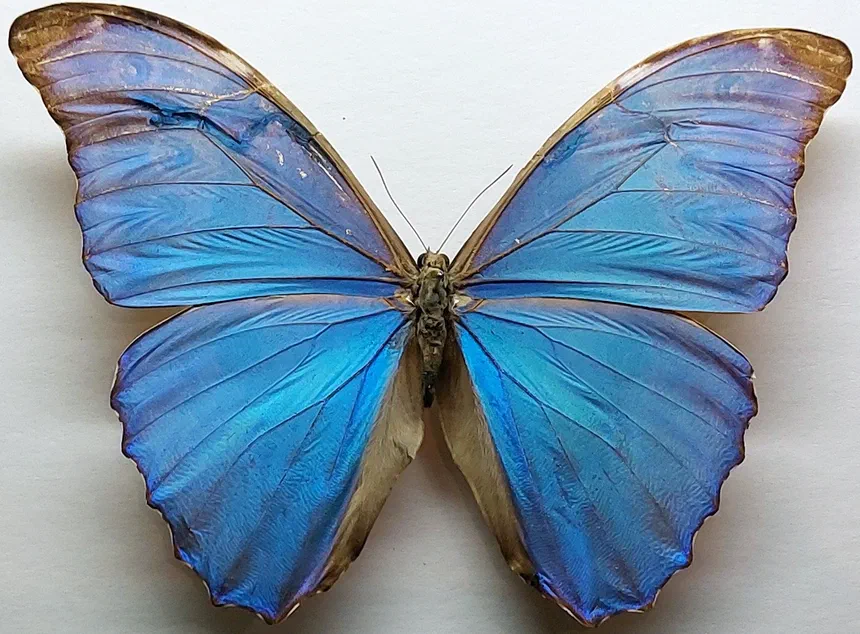
The blue morpho (Morpho menelaus) is a large, brilliantly colored butterfly of the family Nymphalidae, famous for the shimmering blue of its upper wings. It belongs to the genus Morpho, a group of showy neotropical butterflies found across the forests of Central and South America.
Appearance and Identification
The blue morpho is best known for the vivid, metallic blue that flashes across the top of its wings. This color is not made by pigment but by microscopic scales that scatter and reflect light, a phenomenon called structural coloration. As the wings tilt in flight, the blue seems to flare and vanish, producing a flickering effect. The underside of the wings is a dull brown patterned with several eyespots, providing camouflage when the butterfly rests with its wings closed. With a wingspan often between 12 and 20 centimeters (5 to 8 inches), it ranks among the larger butterflies in its range. Females tend to be less intensely blue than males, often with more brown along the wing margins.
Habitat and Range
Blue morphos live in the tropical forests of Central and South America, from Mexico south through the Amazon Basin to countries such as Brazil, Colombia, Peru, and Venezuela. They favor humid, lowland rainforest, spending much of their time in the shaded understory and along forest edges, clearings, and streams. Adults are frequently seen flying along sunlit trails or gaps in the canopy where light breaks through.
Diet
Blue morphos are herbivores whose diet changes completely across their life stages. Caterpillars feed on the leaves of various host plants, including members of the legume family. Adults do not have chewing mouthparts and instead use a long, coiled proboscis to drink liquids. Rather than feeding on flower nectar, adult morphos favor the juices of rotting or fermenting fruit, tree sap, fungi, and fluids from decaying matter. They also visit damp soil and mud to take up minerals, a behavior known as puddling.
Behavior
These butterflies are active by day, typically flying in a bobbing, unpredictable pattern low through the forest understory. The alternating flash of blue upperwing and brown underside as they beat their wings is thought to confuse predators such as birds, making the insect hard to track. When threatened or at rest, a morpho closes its wings to reveal the drab, eyespotted underside, blending into the leaf litter and bark. Males can be territorial and may patrol favored stretches of forest, sometimes chasing away rival males or other passing insects.
Life Cycle and Reproduction
Like all butterflies, the blue morpho undergoes complete metamorphosis with four stages: egg, larva (caterpillar), pupa (chrysalis), and adult. Females lay eggs singly on suitable host plants, where the emerging caterpillars feed and grow, molting several times as they develop. Blue morpho caterpillars are often reddish-brown with brighter patches and bear tufts of irritating hairs that help deter predators. When fully grown, the caterpillar forms a pale green chrysalis in which it transforms. After emerging, the winged adult lives only a short time, usually a few weeks, during which its main task is to mate and, for females, to lay the next generation of eggs.
Conservation Status
The blue morpho has not been formally assessed by the IUCN, and it remains reasonably widespread across its large range. Even so, it depends on healthy tropical forest, so ongoing deforestation and habitat loss are the main long-term concerns for local populations. The species is also collected for the decorative trade and displayed in butterfly houses, though many exhibits now rely on sustainably farmed stock rather than wild-caught insects.
Frequently Asked Questions
Why are blue morpho wings so blue? The blue comes from the structure of tiny scales that reflect blue light, not from any blue pigment. This is why the color shifts and shimmers as the angle of view changes.
What do blue morphos eat? Adults drink the juices of fermenting fruit, tree sap, and fluids from decaying matter using a straw-like proboscis, while the caterpillars eat leaves.
How long do blue morphos live? The adult butterfly generally lives only about two to four weeks, though the full life cycle from egg to adult takes considerably longer.
References
The conservation status and key facts in this profile are supported by these sources:
- Animal Diversity Web — Morpho menelaus (accessed 2026-08-06)
- GBIF — Morpho menelaus (Linnaeus, 1758) (accessed 2026-08-06)
Found an error, source problem, or image concern? Report this page.